Nikki Glaser Sets the Tone and Steals the Show at the Golden Globes
From the instant Nikki Glaser walked onto the stage at the 83rd Annual Golden Globe Awards, it was evident that the evening was about to unfold differently than expected. Her return as host—marking her second consecutive year in the role—was met with immediate enthusiasm, and by the time her opening monologue concluded, it was clear why. Critics, industry insiders, and viewers at home quickly agreed: Glaser had once again delivered a performance that set a new standard for awards-show hosting.
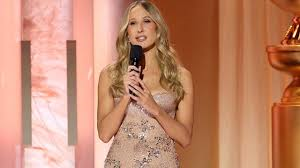
Rather than leaning on predictable formulas that often define opening monologues, Glaser brought a sharp yet controlled comedic approach that balanced boldness with restraint. Her humor was incisive without being harsh, confident without veering into arrogance, and playful while remaining thoughtful. From the Beverly Hilton ballroom to living rooms across the country, her presence felt commanding and intentional, helping establish a tone that carried through the rest of the broadcast.
A key strength of Glaser’s performance was her ability to read the room and adjust in real time. Her jokes landed with precision, earning genuine laughter while avoiding the mean-spirited edge that can sometimes alienate audiences. Instead of relying on tired roast clichés, she offered humor that felt current and carefully constructed—witty observations that felt fearless but never gratuitous. Almost instantly, clips from her monologue began circulating online, with social media lighting up in approval.
One of the most talked-about elements of her opening was how skillfully she navigated the line between poking fun at Hollywood and celebrating it. When she joked about Leonardo DiCaprio’s legendary career—quipping that his achievements were especially impressive given his famously young dating history—the moment drew laughs without discomfort. Reports suggested DiCaprio himself reacted with good humor, underscoring Glaser’s knack for delivering jokes that sting lightly without souring the mood.
Although some headlines fixated on specific punchlines—such as her playful jab at cable news or her commentary on media narratives—the broader takeaway was how deliberately she avoided divisive territory. Glaser even acknowledged that certain political jokes she initially considered simply didn’t feel right for the moment. By choosing not to lean into polarizing humor, she created a monologue rooted in shared cultural experiences rather than partisan tension, a decision many viewers appreciated.
Online reactions reflected that sentiment. Fans praised her timing, her self-awareness, and her ability to remain incisive without crossing into cruelty. On forums and social platforms, commenters noted that she managed to make the ceremony feel entertaining and cohesive, striking a balance that many awards shows struggle to achieve. Viewers described her approach as refreshing, pointing out that her warmth and intelligence helped elevate the entire broadcast.
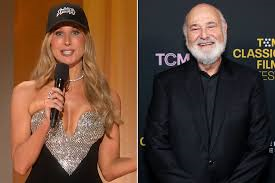
What truly set Glaser apart, however, was her ability to shift tone seamlessly as the evening unfolded. Instead of ending the night with another barrage of jokes, she closed with a subtle and respectful tribute to the late filmmaker and actor Rob Reiner. Wearing a cap inspired by This Is Spinal Tap, she referenced one of Reiner’s most iconic works with the understated line, “This one went to 11.” The moment struck an emotional chord while preserving the celebratory spirit of the night.
This tonal versatility highlighted Glaser’s deeper understanding of the role of a host. She wasn’t simply there to deliver punchlines; she was guiding the emotional and narrative arc of the ceremony. Compared to hosts of past years whose appearances sometimes felt obligatory or awkward, Glaser’s presence felt purposeful, as though she understood how to frame the entire event rather than just open it.
Industry response mirrored audience enthusiasm. Critics from major outlets—often skeptical of awards-show hosting—praised her intelligence, control, and comedic discipline. Some reviews suggested her performance helped counterbalance weaker elements of the telecast, while others emphasized how rare it is for a host to be sharp without resorting to unnecessary offense.
The social media response was swift and widespread. Memorable lines from her monologue were clipped, shared, and dissected across platforms, with many calling it one of the strongest Golden Globes openings in recent years. Discussions emphasized not just her humor, but her command of live television—a skill that becomes increasingly valuable in an era of instant online reaction.
This hosting success also arrived during a notable upswing in Glaser’s broader career. In recent years, she has expanded well beyond stand-up comedy, taking on roles in television, film, and writing. Upcoming projects include new streaming specials and a romantic comedy collaboration with Judd Apatow at Universal, signaling her growing influence behind the scenes as well as on stage.
Her evolution from stand-up comic to multi-dimensional creative force has been gradual and deliberate. While fans first embraced her for her sharp observational comedy, she has increasingly taken on roles that allow her to shape narratives, collaborate on storytelling, and influence projects at a structural level. Hosting the Golden Globes—especially for a second consecutive year—has become a defining milestone in that journey.
Her first stint as host had already earned praise for revitalizing the ceremony after a lackluster opening the year before. Returning for the following year, Glaser built on that foundation with greater confidence and nuance, demonstrating growth not just in joke-writing but in her understanding of tone, pacing, and audience engagement.

In post-show interviews, she revealed that several prepared jokes never made it to air—an intentional choice reflecting her belief that not every clever idea belongs onstage. Critics pointed to this restraint as one of her greatest strengths, noting that her humor felt inclusive and thoughtful rather than attention-seeking.
By focusing on insights about celebrity culture, Hollywood’s self-image, and the mechanics of awards shows themselves, Glaser delivered humor that felt both insider-savvy and widely accessible. Her monologue functioned almost like a tightly structured stand-up set adapted for a massive televised event, blending satire with sincerity.

In the days following the broadcast, many viewers suggested that Glaser had raised expectations for what awards-show hosting can be. Social media comments praised her authenticity, adaptability, and confidence, with many noting that she wasn’t trying to imitate past hosts or lean on nostalgia—she was simply being herself.
Ultimately, Nikki Glaser’s appearance at the Golden Globes was more than a successful opening monologue. It represented a moment of artistic and professional affirmation, showcasing her ability to navigate high-pressure live television with wit, intelligence, and emotional awareness. If the 2026 ceremony is any indication, her influence within comedy and entertainment is only continuing to grow.