“The Photo That Made Millions Question Their Own Eyes”
Optical illusions are some of the most captivating examples of how easily the human brain can be fooled. They expose just how complex—and how unreliable—our perception of reality truly is. Even people who are confident in their eyesight can hesitate, second-guess themselves, and stare twice when faced with a cleverly crafted visual trick.
Recently, one such illusion took the internet by storm. A photograph showing six girls sitting on a couch quickly went viral because, at first glance, only five pairs of legs seem to appear. The image left thousands of viewers confused and sparked intense discussion across social media platforms like Reddit and Twitter.

At first, the photo appears impossible. How could one person be sitting there without any legs? The explanation lies in how our brains interpret perspective, depth, and visual information. It highlights the shortcuts our minds take when processing complicated scenes.
Why Optical Illusions Fool Us
The Queensland Brain Institute explains optical illusions as moments when the eyes and brain do not quite agree on what is being seen. Our brains are constantly interpreting visual input, filling in gaps and creating meaning from what our eyes deliver. Most of the time, this happens so smoothly that we never notice it.
However, illusions take advantage of this process. They introduce ambiguity, forcing the brain to guess at shapes, angles, and spatial relationships — often incorrectly.
Movement perception plays a major role here. Humans evolved to detect even the slightest motion, which once helped identify predators or prey. Today, that same instinct can be triggered by cleverly designed visuals, making us see motion or patterns that aren’t really there.
Artists and photographers also manipulate light, shadow, symmetry, and depth to produce images that challenge our expectations. The result is something that feels wrong even though it looks right — a perfect puzzle for the mind.
The Viral Photo That Left Everyone Guessing
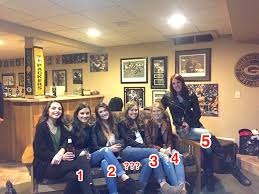
The famous image appears simple: six girls sitting side by side on a couch. But a quick glance reveals only five visible pairs of legs. Many viewers felt as though someone’s legs had vanished entirely.
This confusion made the photo incredibly shareable. People rushed to comment sections and forums, trying to explain what they were seeing. Some thought the image had been digitally altered. Others studied the clothing, posture, and angles, trying to understand how the illusion worked.
The mystery kept people hooked, turning a single photograph into a global brain teaser.
How the Illusion Actually Works
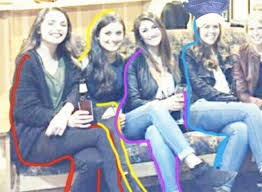
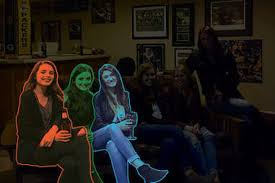
The illusion is created by careful positioning and overlapping limbs. Discussions on Reddit and The Tab revealed that the girls’ legs are aligned in a way that makes them appear to belong to someone else.
One Reddit user explained it like this:
-
The first girl has her legs crossed.
-
The second girl has one leg showing with a tear in the knee, partly hidden by the first girl’s legs.
-
The third girl leans forward, causing her legs to line up in a way that makes them look like they belong to the second girl.
Because of this overlap, the brain incorrectly groups certain legs together, making it appear as though one girl has none at all. Small visual clues — such as torn jeans, socks, or shoes — reveal the truth, but they are easy to overlook at first.
This happens because the brain prefers simple explanations. When visual information becomes confusing, it fills in the blanks using the most logical pattern — even if it’s wrong.
Why This Illusion Became So Popular
The image spread rapidly for a few key reasons:
-
It’s relatable — everyone enjoys solving visual puzzles.
-
It’s challenging but solvable, which makes it satisfying.
-
It encourages discussion, with people comparing ideas and debating what they see.
Together, these elements turned a single photo into a worldwide interactive experience.
What Science Tells Us About Illusions
Optical illusions offer valuable insight into how the human brain works. Researchers have identified several reasons why we fall for them:
-
Gestalt principles cause us to group shapes and patterns together, even when they don’t actually belong.
-
Flattened perspective in photos can distort depth and spacing.
-
Continuity bias makes us assume objects continue in predictable ways.
-
Limited attention means small clues are easily missed.
All of these combine to make illusions both fascinating and deceptive.
How to See Through the Trick
If the photo still seems confusing, try this:
-
Study where knees, socks, and shoes line up.
-
Notice who is leaning forward or sitting farther back.
-
Look closely at clothing details and shadows.
When you do, the illusion disappears — every girl has two legs, just cleverly hidden.
Why Illusions Matter
Beyond entertainment, optical illusions teach us something important: our brains are not perfect. They rely on shortcuts and assumptions to understand the world, which can sometimes lead us astray.
These illusions remind us to question what we think we see — a lesson that applies not just to images, but to everyday life.