What Trump Said Live Sent Shockwaves Across America
A single remark from Donald Trump involving Rep. Ilhan Omar sent shockwaves through Washington and beyond 😳 What he said on stage instantly ignited a political firestorm—and the fallout was immediate.
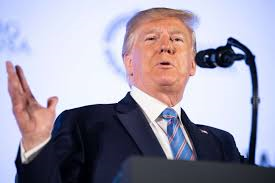
Inside the packed arena, time seemed to pause for a fraction of a second, as though the crowd—and perhaps the country—had collectively stopped breathing. Then the moment exploded. Trump’s words didn’t merely rise above the noise; they tore straight through it, overpowering chants, camera flashes, and the controlled composure of Ilhan Omar herself. “Get the HELL out of our country,” he declared, each word delivered with force and intent. It wasn’t just another campaign line—it landed like a blunt instrument, shattering the atmosphere and exposing deep fractures in the national psyche.
Supporters inside the venue responded instantly. Cheers surged, fists rose, and thousands of phones lit up the room, recording what many immediately recognized as a defining cultural moment. The energy was combustible—pure adrenaline mixed with fierce loyalty—and it spilled outward at lightning speed. Cable news cut in. Social media erupted. Within minutes, hashtags surged; within hours, the phrase itself had become a political Rorschach test.
Outside the arena, the reaction was starkly different. Critics recoiled—not only at the language, but at the deliberate targeting of a sitting member of Congress. Commentators and legal analysts moved swiftly, dissecting the implications and questioning the boundaries Trump had crossed. For many Americans, the statement felt like something more than rhetoric—a signal that belonging could be revoked based on identity, dissent, or origin. The words rippled through immigrant communities, newsrooms, and academic spaces, carrying a chilling resonance.
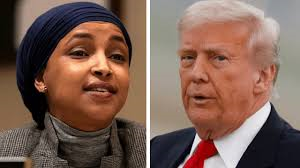
By nightfall, the moment had escaped the confines of the rally. The footage was replayed endlessly, examined from every angle. This was no longer a dispute over legislation or policy—it had become a confrontation over national identity itself. The question was unavoidable: Who counts as American? Who decides that? And what does loyalty really mean?
Amid the chaos, a striking contrast emerged. Omar did not react with visible emotion. She stood firm, composed, and unyielding—her restraint serving as a quiet counterbalance to the spectacle around her. Trump, meanwhile, offered no retreat. No clarification. No apology. The standoff solidified into a symbolic snapshot of a country wrestling with its own values. Politics had shifted beyond disagreement into a struggle over moral boundaries and belonging.
The nation quickly split into two competing narratives. For supporters, the moment felt validating—a release for those who believe their identity and voice have been sidelined. For opponents, it sounded an alarm: proof that fear and exclusion could be wielded openly, even against elected officials. The crowd’s roar became emblematic of a larger, anguished divide.
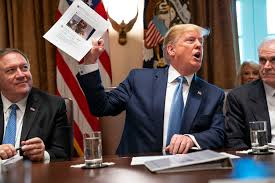
In the days and weeks that followed, the reverberations didn’t fade. Television panels replayed the clip on repeat. Social platforms amplified division over dialogue. Yet beneath the noise, a deeper reality surfaced: a single sentence had laid bare how fragile civil discourse had become. America was no longer arguing about policy alone—it was confronting the core question of what the nation is, and who gets to belong. Remaining neutral was no longer an option. The moment demanded a reckoning.