A Forgotten Grooming Invention From the Age of Mid-Century Innovation
In the history of personal grooming, few inventions reflect mid-20th-century creativity as vividly as the Rally Dry Shaver. More than a simple grooming tool, it embodied an era when everyday household items were infused with optimism, innovation, and a belief that technology could improve even the most ordinary routines.
From the 1940s through the 1960s, society was energized by progress. New appliances, mechanical devices, and consumer products promised efficiency, convenience, and a glimpse into a modern future. Shaving—an age-old daily ritual—became a prime target for reinvention during this period of experimentation.
For generations, wet shaving had remained largely unchanged. Men relied on double-edged razors, soap, water, and brushes, carefully preparing lather before slowly and deliberately shaving. The process emphasized patience, precision, and routine, offering a quiet moment of mindfulness alongside practical grooming.
As postwar culture increasingly valued speed and convenience, inventors sought alternatives to time-consuming rituals. Daily tasks were expected to adapt to modern life, and shaving—long considered tedious—was ripe for disruption.
Rethinking the Shave
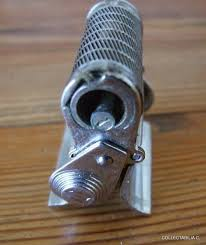
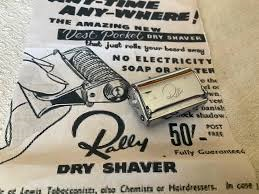
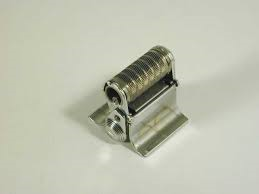
The Rally Dry Shaver emerged from this mindset as a bold departure from tradition. It promised a dry shave that required no electricity, water, soap, or preparation. At its core was a rolling cylindrical blade lined with fine teeth, designed to cut hair through a scissor-like shearing motion.
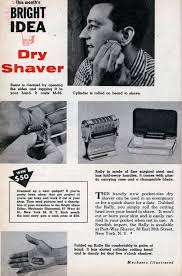
Users simply rolled the device across their skin, trimming facial hair without lather or mirrors. The appeal was clear: portability, simplicity, and speed. The Rally aimed to combine the immediacy of electric shavers with the tactile control of manual tools, positioning itself between tradition and modernity.
This hybrid approach reflected a broader cultural fascination with “modern convenience”—the idea that engineering could streamline everyday life without sacrificing engagement. The Rally’s rolling mechanism preserved a sense of physical interaction while eliminating much of the preparation associated with shaving.
Engineering and Use
From a technical standpoint, the Rally Dry Shaver was impressively compact and mechanically intricate. Its toothed cylinder required precise alignment to cut hair efficiently while avoiding skin pinching. Users guided the shaver by hand, using small, deliberate movements to follow the contours of the face.
Unlike electric shavers, it needed no power source, making it ideal for travel. Unlike wet razors, it eliminated water, soap, and cleanup. However, the simplicity of its design masked the precision required for comfortable use. Any manufacturing imperfections could lead to irritation or uneven trimming.
The device still demanded skill, offering a unique tactile experience that blended manual control with mechanical innovation. It did not remove human involvement from shaving—it reshaped it.
Advertising and Appeal
Marketing for the Rally Dry Shaver emphasized speed, mobility, and modern living. Advertisements targeted busy men and frequent travelers, presenting the shaver as a practical solution for life on the move. This messaging aligned perfectly with postwar ideals of efficiency and lifestyle improvement.
Culturally, the Rally resonated with consumers fascinated by innovation. During a time when televisions, home appliances, and electronics were transforming domestic life, the shaver symbolized forward-thinking personal care. Its novelty reflected not just a product feature, but a mindset—one that welcomed change and celebrated invention.
Challenges and Decline
Despite its ingenuity, the Rally Dry Shaver struggled to gain lasting popularity. Many users found it less comfortable than both traditional razors and emerging electric models. The shearing mechanism sometimes caused irritation or inconsistent results, especially for sensitive skin.
Additionally, the device required practice, undermining its promise of effortless convenience. As electric shavers improved rapidly in the 1950s and 1960s—offering smoother results and easier operation—they eclipsed the Rally. Wet shaving, meanwhile, remained popular among those who valued ritual and closeness.
Caught between these two worlds, the Rally occupied a niche that proved too narrow for widespread adoption.
A Collector’s Curiosity
Today, the Rally Dry Shaver lives on as a collectible artifact rather than a mainstream grooming solution. Vintage enthusiasts prize it for its unconventional design and its reflection of mid-century optimism. Surviving models, especially those in good condition or original packaging, are valued as tangible reminders of an experimental era.
Its significance extends beyond mechanics. The Rally represents a time when inventors eagerly challenged conventions and viewed even routine tasks as opportunities for reinvention. It captures a cultural moment defined by creativity, ambition, and a belief in progress.
Lessons From Mid-Century Design
The story of the Rally Dry Shaver mirrors the broader narrative of postwar innovation. This was a period marked by confidence in technology and a willingness to experiment. Designers prioritized bold ideas, often accepting imperfections as part of progress.
Although the Rally did not achieve lasting success, its shortcomings underscore the era’s fearless approach to design. Innovation was not guaranteed to succeed—but it was always worth attempting.
Influence on Modern Grooming
While the Rally itself faded, its underlying ideas persisted. Modern electric shavers, travel razors, and dry-shave technologies reflect the same goals: reducing preparation time, increasing portability, and adapting grooming to busy lifestyles.
In many ways, the Rally was an early step in this evolution. Its emphasis on independence and mobility foreshadowed modern expectations for personal care products designed to function anywhere.
A Symbol of Creative Risk
Among collectors, the Rally Dry Shaver is admired as a symbol of design risk-taking. Its unusual rolling mechanism sparks conversation, offering insights into the balance between innovation and user experience—an issue that remains central to product design today.
Studying devices like the Rally allows modern designers to learn from both ambition and limitation, appreciating how creativity and practicality must align for lasting success.
Final Thoughts
The Rally Dry Shaver is more than a forgotten grooming tool—it is a snapshot of a time when imagination guided invention. It represents the belief that no routine was too ordinary to improve and no idea too unconventional to explore.
Though it never achieved widespread adoption, its legacy endures as a testament to curiosity, experimentation, and mid-century optimism. Today, it stands as a conversation piece, a collectible, and a reminder that innovation often begins with daring ideas—even when they don’t endure.
In the broader story of grooming and design, the Rally Dry Shaver remains a small but meaningful emblem of an era when the future felt open, mechanical ingenuity flourished, and even the daily shave invited reinvention.