They Called Me “Soldier Boy.” Three Days Later, Everything Collapsed
I spent twenty-two years in Delta Force. I retired early, not because my body failed me, but because my son needed a father more than the world needed another operator. I traded night raids and foreign soil for carpools, school projects, and quiet dinners. I believed that chapter of my life was closed.

Then the principal called me “Soldier Boy” and told me to accept that my son had been bullied by the football team.
I didn’t argue. I didn’t shout. I just listened.
And then I went to work.
It started with a phone call from Freddy’s English teacher. Her voice trembled as she spoke, choosing words carefully, as if afraid they might shatter. My seventeen-year-old son had collapsed. Paramedics were involved. By the time I reached the hospital, Freddy was unconscious, his face swollen beyond recognition, tubes snaking out of him like roots. A fractured skull. Broken ribs. Internal bruising.
The doctor talked about monitoring pressure on the brain. About the next forty-eight hours being critical.
I nodded, thanked him, and memorized everything in the room. The machines. The staff. The way the nurse avoided my eyes.
That was when I knew this wasn’t an accident.
The truth surfaced quickly, though no one volunteered it. Freddy had been cornered in a stairwell. Seven varsity players. Laughter first. Then silence. Someone called it “roughhousing.” Someone else said “boys being boys.”
The school moved fast. Lawyers before apologies. Administrators before accountability. Futures were mentioned. Scholarships. The football season. Donors.
Principal Blake Lowe met with me the next morning. He leaned back in his chair, arms crossed, smirk ready.
“You military types,” he said. “Always looking for a fight. This was unfortunate, but we need to think about the bigger picture.”
Then he called me “Soldier Boy.”
That was the moment I stopped seeing him as an obstacle and started seeing him as a liability.
For seventy-two hours, I didn’t sleep. I didn’t threaten anyone. I didn’t step outside the law. I mapped patterns. I reviewed incident reports buried in files. I spoke to janitors, substitute teachers, former players. I followed money. I followed silence.
What I found was rot.
This wasn’t the first time. Just the first time someone nearly died.
Once the structure revealed itself, it collapsed quickly. Parents got careless. Text messages surfaced. Videos recorded conversations never meant to leave living rooms. Booster funds vanished under scrutiny. The district panicked.
By the third day, prosecutors were involved. Charges followed. The football program was suspended indefinitely. Administrators resigned “for personal reasons.” Families who had hidden behind influence suddenly found themselves exposed.
Freddy stabilized. He woke slowly. Confused. Scarred. But alive.
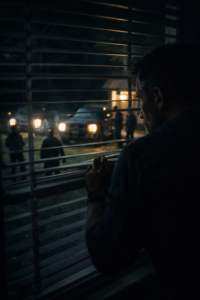
That evening, Ray Cooper sat alone in his dark living room. Old habits die hard. Darkness still felt safer than light.
His phone buzzed. Detective Platt again.
“They’re angry,” the detective said. “The fathers. They think you humiliated them. They’re heading your way.”
Ray placed the phone face down.
Outside, engines roared. Trucks rolled onto his lawn, chewing up the grass. Headlights lit the porch like a stage. Seven men stepped out. Big men. Confident men. Men who had never been told no.
“Soldier Boy!” one of them shouted.
Ray stepped onto the porch calmly, hands visible, posture relaxed.
“You shouldn’t be here,” he said evenly.
They laughed.
Ray continued, “Every word you say from this point on is being recorded. Every step you take onto my property is trespassing. The restraining orders are already filed. The cameras are live. The police are on their way.”
Someone hesitated. Another cursed.
Ray didn’t move.
“You came here thinking intimidation would work,” he said. “That’s how this all started. It didn’t work then. It won’t work now.”
Red and blue lights appeared at the end of the street.
Silence followed.
One by one, the men backed away. Engines started. Trucks reversed.
Ray stood there until the street was empty again.
Weeks later, Freddy returned home. He walked slowly. He smiled cautiously. Father and son rebuilt their days together—homework, fishing, quiet dinners where safety felt real again.
Ray never spoke to reporters. Never claimed credit.
This was never about revenge.
It was about what happens when systems fail—and someone refuses to accept a convenient lie.
Ray Cooper didn’t break the law.
He broke the illusion that money, status, or fear place anyone above consequences.
And that lesson traveled far beyond one hospital room and one small town.