They Barred Her From Surgery — So She Changed Medicine From the Morgue
They told her she couldn’t train as a surgeon because she was a woman.
So she was sent underground—to a hospital basement filled with dead children.
There, she uncovered a disease that had been silently killing thousands.
New York City, 1935.
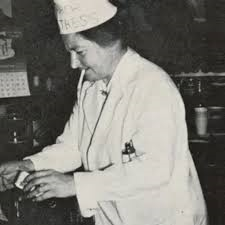
The morgue beneath Babies Hospital was cold and dim, heavy with the smell of disinfectant and cigarette smoke. Dr. Dorothy Andersen stood over the body of a three-year-old girl. The child’s chart carried a familiar label: Celiac disease.
At the time, it was the diagnosis doctors reached for when children wasted away despite eating. The treatment was little more than hope—banana diets and patience. Most of the children died anyway.
Andersen didn’t accept it.
She had seen too many of these cases, and they didn’t add up. These children weren’t refusing food. They were ravenous. They ate constantly, yet grew thinner by the day. Their bellies bloated. Their limbs skeletal.
And there was something else—something that didn’t belong.
Their lungs were always filled with thick, sticky mucus.
Celiac disease didn’t do that.
Andersen took her scalpel, lit another cigarette, and began the autopsy. She wasn’t searching for confirmation of what textbooks claimed. She was searching for what had actually killed this child.
Dorothy Andersen had always existed outside the boundaries of expectation.
Brilliant and driven, she applied for surgical residency after medical school. She was rejected—not for lack of talent, but because surgery was considered a man’s domain. Women, she was told, were better suited to pathology.
So she became one.
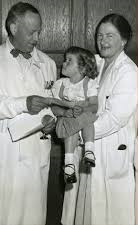
She wore boots instead of heels. She built her own furniture. She threw loud gatherings in her lab. She smoked through autopsies and never apologized for her presence in a profession that had tried to limit her.
Now, confined to a basement morgue, she decided she would still save lives—starting with the truth.
When Andersen opened the child’s abdomen, she examined the pancreas. It should have been soft and functional.
It wasn’t.
The organ was rigid, scarred, and riddled with cysts. Its ducts—meant to carry digestive enzymes to the intestine—were completely blocked. The pancreas had failed entirely.
This child hadn’t died of celiac disease.
She had starved because her body couldn’t absorb nutrients, no matter how much she ate. Without pancreatic enzymes, digestion was impossible.
Andersen understood immediately: this wasn’t an anomaly.
She pulled records from dozens of similar cases—children labeled “celiac,” buried without answers. Night after night, she reviewed autopsies, comparing notes, searching for patterns.
The same findings appeared again and again.
Destroyed pancreases.
Clogged lungs.
Identical pathology.
This was a separate disease—unrecognized, unnamed, and widespread.
She called it Cystic Fibrosis of the Pancreas.
Identifying the disease was only the beginning. Children were still dying on pediatric wards across the country. Andersen needed a way to diagnose them before they reached the autopsy table.
She developed a diagnostic technique that involved collecting fluid from the small intestine to measure pancreatic enzymes. It was difficult, invasive, and uncomfortable.
But it worked.
For the first time, doctors could distinguish cystic fibrosis from celiac disease while patients were still alive. Treatment could begin. Lives could be saved.
Then, years later, another clue emerged.
During the extreme heat of the summer of 1948, Andersen noticed her cystic fibrosis patients collapsing from heat exhaustion at unusually high rates. Along with pediatrician Dr. Paul di Sant’Agnese, she investigated further.
They discovered the cause: these children were losing massive amounts of salt through their sweat.
That insight led to the development of the sweat test—a simple, non-invasive method to diagnose cystic fibrosis by measuring salt levels in perspiration.
More than 75 years later, it remains the gold standard.
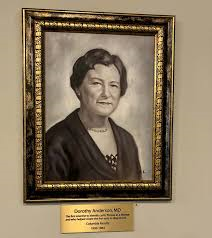
In 1938, Andersen published her landmark paper:
“Cystic Fibrosis of the Pancreas and Its Relation to Celiac Disease.”
It reshaped pediatric medicine.
She didn’t just identify a disease. She defined its pathology, established diagnostic criteria, created testing methods, and helped pave the way for enzyme replacement therapies that allowed patients to digest food and survive.
Children once dismissed as “failure to thrive” finally had an explanation—and a future.
Dorothy Andersen lived on her own terms until her death in 1963.
She never married. She climbed mountains. She trained cardiac surgeons using hearts she had studied in the morgue. She never softened herself to fit an institution that had tried to exclude her.
After her death, a colleague wrote:
“She was one of the most remarkable women I have ever known. Her intellect was extraordinary, and her devotion to medicine absolute.”
Her greatest legacy, however, was her refusal to accept vague answers.
When doctors wrote “celiac disease” without proof, she demanded evidence.
When women were barred from surgery, she found another way to save lives.
When textbooks conflicted with reality, she trusted her own observations.
Today, people with cystic fibrosis live into middle age and beyond. In the 1930s, most died before their third birthday.
That change began in a hospital basement, with a pathologist who refused to believe that “some children just die” was an acceptable conclusion.
She was denied the career she wanted because of her gender.
So she built a different one—and changed medicine forever.
Dr. Dorothy Hansine Andersen (1901–1963):
The woman told she couldn’t be a surgeon.
The pathologist who learned from the dead to save the living.
The rebel who mapped an invisible killer and gave thousands of children a chance at life.
She was sent to the basement.
From there, she launched a revolution.