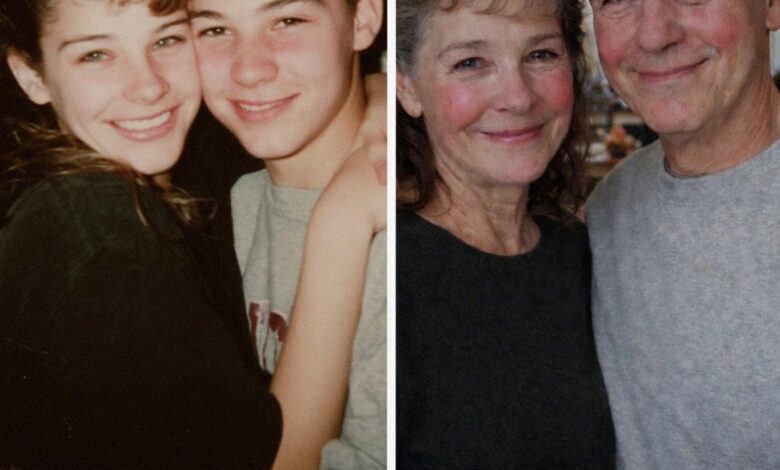
I Was Volunteering on Valentines Day When I Saw My First Loves Name on the List …
So I Delivered His Card Myself!
I am sixty-four years old, and I have spent most of my life mastering the art of the busy schedule. My daughter, Melissa, calls it “productive denial,” while my son, Jordan, simply watches me with a quiet, observant intensity, as if gauging the speed of an approaching storm. I volunteer for everything—food drives, coat collections, church suppers—because keeping my hands occupied is the only way to ensure my heart doesn’t wander back to the places it was broken. Helping strangers is a safe harbor; it requires empathy but no true vulnerability. It is much easier to care for the world than to sit in a quiet room and confront my own reflection.
With Valentine’s Day approaching, I found myself at Cedar Grove, a local assisted living facility. The mission was simple: write cards for residents who rarely received visitors. The activity room was a blur of red construction paper and lace doilies, smelling of that specific, burnt communal coffee that seems to fuel every nonprofit endeavor. Marla, the coordinator, handed me a clipboard with a list of names. “Some of these folks haven’t had a piece of mail in years,” she said softly. “Your words might be the only kindness they see today.”
I scanned the list with the detached efficiency of someone checking off a grocery list. But then, my eyes snagged on a name, and the air in the room seemed to vanish. Richard. The same surname. The same middle initial. My pen hovered, trembling. Forty-six years ago, Richard was my first love, the boy who read books for others and swore he would never leave. Then, one summer night, he vanished into a silence so profound it felt like a physical weight.
At nineteen, I was working in my aunt’s hair salon, dreaming of a future Richard and I had sketched out on his porch swing. We were going to conquer the world together. But the night he was supposed to meet me at the Maple Street diner to say goodbye before leaving for college, he never showed. I sat in that vinyl booth until the coffee turned cold and the waitress stopped asking if I wanted a refill. When I called his house, his mother simply said, “He’s not here,” and hung up.
A few weeks later, I stood in a clinic with peeling wallpaper and discovered I was pregnant. I didn’t tell Richard because I couldn’t find him, and I didn’t tell my parents because I was terrified. Eventually, I married a man for the sake of stability, a man who gave me Melissa and Jordan before our marriage dissolved into a relief-filled divorce. Now, decades later, the ghost of my first love was sitting in Room 402.
I wrote a generic card—Wishing you a happy day. You matter. Warmly, Claire.—but I couldn’t just leave it in the basket. I asked Marla if I could deliver it personally. My legs felt like lead as I walked toward the common area. The nurse, Kim, pointed him out. He was sitting by the window, the winter sun illuminating a face that had aged but eyes that remained the same steady, haunting blue.
“Richard?” I whispered.
He looked up, and for a moment, the forty-six years between us evaporated. He breathed my name as if it were a prayer he had forgotten he knew. We retreated to the quiet of the library, where the scent of old paper and lemon cleaner hung heavy in the air. He read my card, his lips trembling. “I never get mail,” he admitted, his voice a hoarse rasp.
The truth came out in jagged pieces. Richard hadn’t abandoned me by choice. His father, a man of iron will and terrifying temper, had discovered our plans. He had taken Richard’s keys, intercepted our letters, and sent him to live with an uncle three states away under the threat of disinheritance. Richard had been told I moved on, that I was married and happy. He had lived his life in a shadow of “what ifs,” believing he was the one who had been forgotten.
I left Cedar Grove in a daze, my hands gripping the steering wheel until my knuckles turned white. I didn’t call Melissa or my friends. I went home and sat in the dark, letting the memories of the clinic and the lonely years of early motherhood wash over me. By midnight, I realized that while Richard’s absence had shaped the contours of my life, it no longer had the right to define my future. If there was to be a reckoning, it would be on my terms.
The next morning, I called Jordan. He arrived within the hour, practical and alert. I told him about Richard, and then I said the words I had kept locked in a vault for thirty-nine years. “When Richard left, I was pregnant. Jordan… he is your father.”
Jordan didn’t flinch. He didn’t ask why I’d waited. He simply took my hand and said, “Let’s go see him. I’m coming with you.”
When we returned to Cedar Grove, the air felt different—sharper, cleaner. We found Richard in his usual spot. When I introduced Jordan, the color drained from Richard’s face. He looked at my son—a man who shared his brow, his height, his steady hands—and began to count the years in his head.
“How old are you?” Richard asked, his voice breaking.
“Thirty-nine,” Jordan replied, his tone even and respectful, but shielded by a necessary distance.
Richard collapsed into tears, a lifetime of missed moments crashing down on him. “I didn’t know,” he sobbed. “Claire, I swear, I didn’t know.” He explained that doctors had told him in his twenties that he was sterile, a lie likely concocted or exploited by his family to further isolate him. He had spent his life believing he would never leave a legacy.
I didn’t offer him the easy comfort of immediate forgiveness. “You left,” I said, my voice steady. “And I raised him alone. I am not here for an apology, Richard. I am here for the truth.”
We moved to the library again, the three of us. Richard accepted the weight of his history, acknowledging that by allowing his father to decide his fate, he had inadvertently decided mine. The silence that followed wasn’t empty; it was a space where the truth could finally breathe.
To my own surprise, I found myself inviting him to dinner. Not as a romantic gesture, but as a recognition of our shared humanity. “No more secrets,” I told him, my spine straight. “No more disappearing. If you want to be in our lives, you walk through the front door as yourself.”
Richard nodded, his hands shaking as he gripped his cane. He refused the wheelchair, choosing to walk out of the facility on his own power, flanked by the woman he had lost and the son he had never known. As the cold Arizona air hit our faces, I realized the calendar didn’t need to be stuffed anymore. For the first time in sixty-four years, the quiet didn’t feel like an enemy. It felt like a beginning.