They Thought It Was a Joke—Until Someone Finally Stepped In
The hallway buzzed with the careless energy of the end of the day—lockers slamming, voices overlapping, laughter bouncing off the walls. To most people, it was just noise. To him, it felt overwhelming.
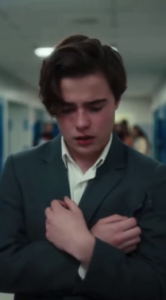
He stood there quietly, adjusting the strap of his backpack, counting the seconds until he could leave. That jacket had been his favorite—worn thin at the elbows, familiar, safe. He’d saved for it, worn it through cold mornings and long days. It felt like armor.
Then he felt it.
A sudden tug. A sharp pull. The unmistakable sound of fabric tearing.
He turned just in time to see the scissors snap shut.
The laughter came fast. Loud. Cruel. The kind that doesn’t echo because it doesn’t need to—it sinks straight into your chest. Someone nudged him. Someone else pointed. Phones came out. A joke, they thought. Entertainment.
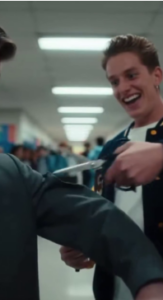
He looked down at his sleeve. The cut was clean, deliberate. Ruined.
For a moment, he didn’t move. Didn’t speak. Didn’t react. His arms folded across his chest instinctively, as if he could hide the damage—or himself. His face stayed calm, but his eyes dropped, heavy with something far deeper than embarrassment.
It wasn’t anger.
It was resignation.
This wasn’t the first time someone had tested how quiet he was.
How much he would take.
How invisible he seemed.
The boy with the scissors smirked, basking in the attention. Power, for him, came easily. He didn’t think about consequences—only the reaction. And he’d gotten one.
Or so he thought.
From the far end of the hallway, someone noticed what most had ignored.
She moved through the crowd without raising her voice, without pushing anyone aside. Calm, deliberate, focused. She held her phone in her hand—not recording the aftermath, but something far more important.
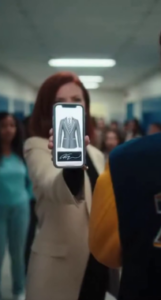
She stopped in front of the group and held the screen up.
A photo.
The jacket.
Uncut.
Whole.
Taken just minutes earlier.
The laughter faded.
The boy with the scissors stiffened.
She didn’t yell. She didn’t accuse. She simply showed the truth—steady and undeniable. Then she looked at him, not with rage, but with disappointment so sharp it cut deeper than any blade.
“What happened here?” she asked quietly.
Suddenly, the crowd shifted. The energy changed. What had felt like a joke moments ago now felt heavy. Uncomfortable. Real.
An administrator arrived. Then another. Questions were asked. Statements were made. The scissors were taken away. The phones went down.
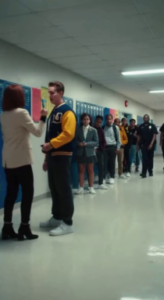
The boy whose jacket was cut still didn’t speak. But this time, it wasn’t because he felt small.
It was because he didn’t have to.
Someone had stepped in.
Someone had believed him without needing him to beg.
Someone had stopped it before it could be brushed off or laughed away.
As the crowd slowly dispersed, he stood a little straighter. The jacket was still ruined—but something else had been repaired.
Dignity.
Safety.
The quiet knowledge that cruelty doesn’t always win.
And as he walked down the hallway toward the exit, he realized something important:
Sometimes, hope doesn’t arrive loudly.
Sometimes it shows up calmly, holding proof in one hand—
and courage in the other.