When a Father Walked In — and a Child’s World Changed Forever
From the instant the morning bell echoed through the halls, the classroom buzzed with restless energy. Chairs scraped loudly against the floor, backpacks lay unzipped and spilling over desks, and hushed whispers ricocheted from wall to wall. The teacher stood near her desk, half-smiling, half-distracted, making only a token effort to quiet the noise.
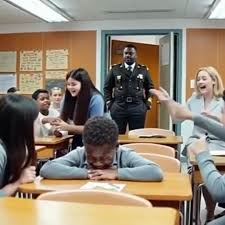
On the surface, the room felt lively. But beneath the chatter lingered something colder—something unkind.
At his desk near the side of the room sat John.
His shoulders were drawn inward, his eyes locked on the corner of his textbook as if concentrating hard enough might make him invisible. His chest tightened with every breath. Tears burned behind his eyes as laughter bubbled up around him.
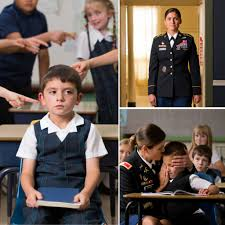
A few students snorted quietly. Someone muttered a cruel comment. Another pointed, amused by the reaction they were provoking. Whether they noticed his pain—or simply didn’t care—made little difference to how deeply it cut.
John gripped the edge of his desk. His vision blurred. He wished, with everything he had, that he could disappear.
Then the atmosphere shifted.
The classroom door opened—not forcefully, but with a calm, deliberate motion that instantly drew attention. The sound itself wasn’t loud, yet it sliced cleanly through the noise.
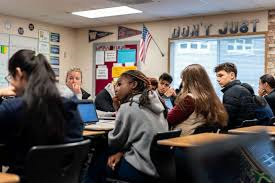
Conversations died mid-sentence. Chairs froze. Even the teacher straightened, blinking as though jolted awake.
A man stood in the doorway.
He was tall, quietly composed, dressed simply in a clean shirt, a worn jacket, and sturdy shoes—the kind worn by someone accustomed to working with their hands. There was nothing flashy about him, yet his presence carried weight. Without saying a word, he commanded respect.
He stepped inside at an unhurried pace, his gaze steady as he took in the room. Silence settled completely.
John looked up.

Recognition flashed across his face—and with it, relief. The man met his eyes and offered a warm, gentle smile, one that instantly eased the fear knotting John’s chest.
Turning to the class, the man spoke calmly.
“Good morning. My name is Mr. Thomson,” he said. “I’m John’s father.”
A collective gasp rippled through the room. The teacher’s expression shifted to surprise, then discomfort.
Mr. Thomson moved toward the front, his voice steady and composed.
“I understand my son had a difficult moment today.”
He didn’t raise his voice. He didn’t need to. Every word landed firmly.
The students stared. The teacher shifted uneasily, guilt evident in her posture.
“But before anything else,” Mr. Thomson continued, pausing thoughtfully, “I’d like to share something with you.”
He spoke slowly, deliberately—not for drama, but because he cared that they truly heard him.
“I don’t have what many people consider a ‘typical’ job,” he said. “I’m not a doctor or a lawyer. I don’t wear suits or carry a briefcase. And because of that, people sometimes make assumptions—assumptions that don’t stop with me.”
He glanced at John, who sat a little straighter now.
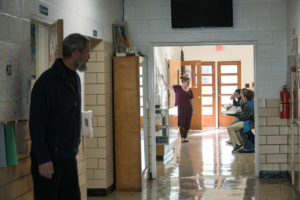
“What I am,” Mr. Thomson said, “is an inventor.”
The room erupted in whispers.
“An inventor?”
“Like real inventions?”
“Does he make robots?”
The teacher began to speak, but the quiet authority in Mr. Thomson’s gaze was enough. The room fell silent again.
“Yes,” he said with a small smile. “A real one. I work on ideas that don’t exist yet—ideas that could help the world. It takes imagination, patience, and a lot of perseverance.”
He gestured toward John.
“And my son has been part of that journey. Not just watching—but working alongside me. He’s my partner. My co-creator.”
John’s eyes widened. The tears were gone now, replaced by something brighter.
“We’re building something together,” Mr. Thomson continued. “A device that transforms polluted air into clean oxygen. It’s still in development, but think about what that could mean—for crowded cities, for people with breathing problems, for our planet.”
The room seemed to shift. Wonder replaced mockery.
The teacher stared at the floor, visibly shaken by her earlier indifference.
“Every family looks different,” Mr. Thomson said gently. “Every path is different. But no child deserves to be ridiculed for who they are—or where they come from.”
His voice grew firmer, though never harsh.
“You may not understand someone’s life by looking at them. You may not know their struggles or their dreams. But respect,” he said, “is something we owe one another. Always.”
He turned to John and gave him a nod—quiet, proud, full of love.
John lifted his chin. The boy who moments earlier had wanted to vanish now sat tall.
Mr. Thomson headed toward the door, then paused.
“Kindness,” he said, “is not weakness. It’s strength. And curiosity about others will always take you further than judgment.”
With that, he left.
For a long moment, no one spoke.
Then, slowly, the students began looking at John differently—not with laughter, but with interest. Not with cruelty, but with respect.
From that day on, the teasing faded. The hallways felt quieter. The conversations softened.
And John walked through school no longer shrinking—but standing in the knowledge of his worth.
Because sometimes, all it takes is one moment.
One voice.
One truth.
One parent willing to step forward—
to change the course of a child’s entire world.