How Tim Conway Turned Slowness Into Comedy History
Beneath the bright lights of The Carol Burnett Show—a series already beloved for its warmth, spontaneity, and remarkable ensemble chemistry—one sketch emerged that would become iconic for a reason few performers ever master. It wasn’t flashy writing or elaborate visuals that made it legendary. It was timing, stretched to an almost impossible extreme.
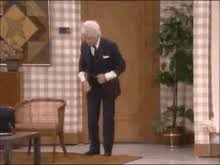
Audiences would come to know it as “Tim Conway Is the World’s Oldest Doctor,” a sketch that distills everything that made Conway a singular force in comedy.
On the surface, the premise is simple. There’s no complex storyline, no costume spectacle, no shifting sets. The entire scene takes place in an ordinary living room—an intentionally plain environment that allows performance to take center stage. Harvey Korman portrays a seriously ill man confined to his home, clearly in distress. He waits anxiously for a doctor’s visit, hoping for immediate relief and professional assurance.
From the outset, Korman establishes urgency. His posture is rigid, his voice strained, his expressions communicating that his condition is worsening with every passing second. This desperation is essential—it creates the tension that fuels everything that follows.
When the door finally opens, the audience expects competence and speed. Instead, they are introduced to the doctor’s father, played by Tim Conway, and the sketch instantly shifts from conventional pacing into something bordering on the surreal.
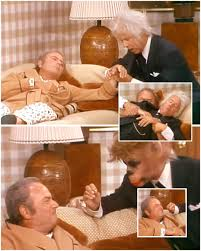
Conway enters hunched so deeply it appears as though time itself has bent him forward. His movement is astonishingly slow—so slow it disrupts the audience’s sense of rhythm almost immediately. Laughter begins before he says a single word.
What makes the entrance extraordinary isn’t simply that Conway is portraying an elderly man. It’s the absolute sincerity of his commitment. Every step is microscopic and deliberate. A foot lifts, hesitates, trembles, and eventually lands—only for the entire process to begin again. Seconds stretch unbearably long. The audience laughs not only at what they’re seeing, but at how long they are forced to sit with it.
This is where Conway’s brilliance becomes unmistakable. Where many comedians rush toward punchlines, Conway does the opposite. He turns delay into a weapon.
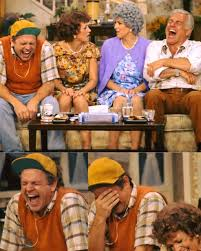
As Conway inches forward, the camera repeatedly cuts to Korman, whose reactions become a second performance altogether. Korman turns away, presses his hand to his face, bites his lip—his body visibly shaking as he fights to maintain control. These moments are not scripted exaggerations; they are real attempts by a seasoned professional to avoid breaking character during a live broadcast.
The interplay between Conway’s relentless slowness and Korman’s barely contained laughter creates an additional layer of comedy that the audience eagerly consumes.
Because The Carol Burnett Show was filmed before a live audience, their reactions play a crucial role. Each burst of laughter feeds Conway’s instincts. Instead of speeding up, he slows down even more. He understands that the audience is both delighted and tortured, and he leans fully into that tension. Each pause grows longer. Each movement becomes a test of endurance.
By the time Conway finally reaches Korman’s character, the sketch could resolve. Instead, it escalates.
The examination begins, and ordinary medical actions transform into epic physical challenges. Conway bends forward to listen to the patient’s chest, a motion that unfolds at a pace so slow it feels almost geological. His hands shake violently. His breathing grows labored. His balance appears perpetually on the verge of collapse. Simply leaning forward becomes its own extended comedic sequence, complete with false starts and prolonged hesitation.
Standing upright again is even worse.
Here, Conway demonstrates an extraordinary grasp of physical storytelling. He speaks very little. Dialogue becomes nearly irrelevant. Instead, he relies on strained grunts, wheezing breaths, exaggerated facial expressions, and impossibly long silences. These pauses are not empty; they are carefully measured beats designed to stretch anticipation until laughter becomes unavoidable.
Each second he delays is another punchline waiting to land.
Meanwhile, Korman’s character grows increasingly frantic. His illness begins to feel secondary to the terrifying possibility that this doctor may never finish a single action. His eyes widen. His voice tightens. His body stiffens with disbelief. The contrast is flawless: one man racing against time, the other seemingly unaffected by it.
This dynamic reveals why Korman was Conway’s ideal partner. Korman’s reactions are precise, grounded, and emotionally honest. They give Conway’s absurdity something real to push against. Without that sincerity, the sketch would lose much of its power. Together, they create chaos that feels meticulously controlled.
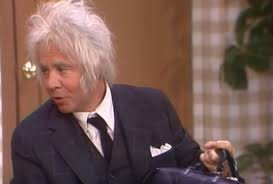
“The World’s Oldest Doctor” also represents the peak of a particular era of television comedy—one that trusted performers as much as writers. The Carol Burnett Show famously encouraged improvisation and allowed actors to follow what worked in the moment.
Conway was especially known for introducing unexpected elements into sketches, forcing his fellow performers to respond in real time. This sketch embodies that philosophy at its finest.
As the examination drags on, the audience realizes the joke has evolved. It’s no longer just about age or slowness. It becomes a study in patience, endurance, and the absurdity of waiting. Conway transforms restraint—something many performers fear—into the very engine of comedy.
Decades later, the sketch remains one of the most beloved moments in the show’s history. It is frequently cited as a masterclass in physical comedy and as proof of Korman’s unmatched ability to react truthfully under pressure. More than anything, it serves as a reminder of a time when television comedy trusted silence, allowed moments to breathe, and let laughter grow naturally instead of forcing it.
And that’s only the beginning of why the sketch endures.
As it continues, it becomes clear that “The World’s Oldest Doctor” is not simply a caricature of frailty. It is a demonstration of how comedy can be built almost entirely from absence—the absence of speed, of dialogue, and of resolution.
Conway shapes time itself into a comedic instrument. He resists the instinct to reassure the audience that a joke is coming. He allows discomfort to linger. Viewers wait, laugh, wait again, and laugh even harder. In doing so, Conway illustrates a fundamental truth: humor often comes not from what happens, but from how long it takes to happen.
This approach requires extraordinary control. One misjudged pause could derail everything. Conway, however, operates with near-perfect precision. Every tremor, breath, and hesitation is placed exactly where it will provoke the strongest reaction. The longer he delays, the more the audience leans forward, complicit in the anticipation.
Korman’s role becomes even more vital as tension mounts. His reactions progress from impatience to fear, and finally to something close to existential dread. He is no longer merely a sick man awaiting care—he is trapped in a reality where time itself has betrayed him.
What elevates the sketch beyond slapstick is Korman’s sincerity. He never breaks character. He never acknowledges the absurdity directly. He reacts as a real person would, grounding the scene and making Conway’s exaggerated movements feel even more extreme by contrast.
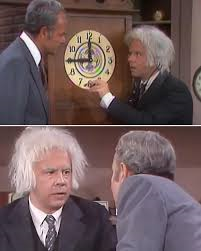
This chemistry reflects the broader spirit of The Carol Burnett Show, where cast members trusted one another completely. Burnett herself encouraged breaking when laughter became uncontrollable, recognizing that these unscripted struggles often became the most memorable moments.
Conway, in particular, excelled at pushing scenes just far enough to destabilize his co-stars without destroying the structure. He never breaks character, even as others visibly fight to survive the moment.
This contrast—one performer utterly committed, the other barely holding on—intensifies the humor. Viewers aren’t just laughing at the characters; they’re laughing at the shared human struggle to remain composed.
As the sketch continues, time seems to stretch. Silence becomes louder than dialogue. Conway proves that restraint, when wielded correctly, can overwhelm any punchline.
His mastery places him firmly in the lineage of great physical comedians. Like Keaton, he understood stillness. Like Chaplin, he let the body speak. Yet Conway’s style remains uniquely his own—deliberately awkward, full of friction between motion and resistance, urgency and indifference.
The sketch endures because it is universal. No cultural context is required. Anyone can understand the frustration of waiting too long for something simple. That accessibility keeps the moment alive for new generations through reruns and clips.
It also reflects a philosophy of comedy that valued performers over premises. Writers provided the foundation, but actors supplied the soul. Conway’s performance demonstrates what happens when a comedian is trusted to follow instinct rather than pace.
In an era where comedy often prioritizes speed and density, “The World’s Oldest Doctor” stands as a quiet rebuttal. It reminds us that slowing down can sometimes produce the biggest laugh of all.
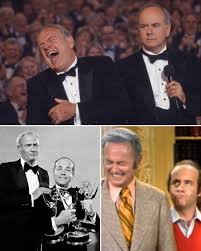
The sketch also reinforces the importance of partnership. Conway’s brilliance depends on Korman’s reactions, just as Korman’s reactions depend on Conway’s patience. Their work is inseparable—a model of ensemble comedy at its best.
Above all, the sketch is joyful. There is no cruelty, no cynicism, no edge of mockery. The humor comes from exaggeration and shared experience. The audience laughs not at age, but at the absurdity of taking slowness to its absolute limit.
Years later, Conway’s painfully slow walk across that living room remains unforgettable—not because it was loud or flashy, but because it was patient.
In a medium driven by immediacy, Tim Conway chose delay—and by doing so, created a moment of television history that still resonates, proving that sometimes the slowest movement can carry comedy all the way into legend.