Democratic Lawmaker Faces Up to 17 Years in Prison After ICE Facility Confrontation
What began as a brief visit framed as congressional oversight has grown into a far-reaching legal and constitutional battle — one that could extend well beyond a federal courtroom in Newark.
When Representative LaMonica McIver entered the Immigration and Customs Enforcement (ICE) facility at Delaney Hall on May 9, the encounter lasted only minutes. But in the months since, it has triggered federal felony charges, constitutional disputes, political fallout, judicial intervention, and renewed debate over the limits of congressional authority when confronting executive-branch enforcement.
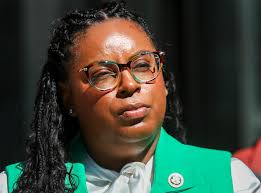
At the center of the case is a confrontation that started as an oversight inspection and ended in a physical clash outside an immigration detention center.
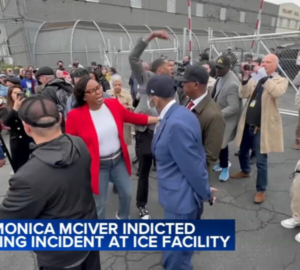
Federal prosecutors allege that McIver assaulted and obstructed law enforcement officers as they attempted to arrest Newark Mayor Ras Baraka, who was accompanying the delegation.
According to the government, McIver’s actions crossed from lawful oversight into criminal interference. Her defense disputes that claim, arguing that she was performing constitutionally protected duties in a chaotic, poorly managed environment marked by restricted access and heightened tensions.
The Incident and What Followed
On May 9, 2025, McIver arrived at the Delaney Hall ICE facility alongside other Democratic lawmakers to conduct what they described as an unscheduled congressional inspection — a practice members of Congress are legally permitted to carry out as part
of oversight of federal agencies.
Prosecutors say the situation escalated when federal agents attempted to arrest Mayor Baraka outside a secured area. Charging documents allege that McIver then “forcibly impeded and interfered” with officers and made physical contact with at least two federal agents.
The indictment accuses her of slamming her forearm into one officer and pushing past another using her forearms. She faces three counts under federal assault statutes. If convicted, she could receive up to 17 years in prison — eight years for each of two primary counts and an additional year for a third.
Mayor Baraka was briefly detained on a misdemeanor trespassing charge, but prosecutors later dropped that charge. Local officials quickly criticized his arrest as unnecessary and excessive.
At her arraignment, McIver pleaded not guilty and made clear she intends to fight the charges, maintaining that her conduct fell within her oversight responsibilities.
A Legal and Political Flashpoint
The dispute soon expanded beyond the events at the detention center, evolving into a broader argument over prosecutorial discretion, congressional authority, and political retaliation.
McIver’s attorneys argue the charges are politically motivated, pointing to what they describe as inconsistent treatment compared with other politically charged cases — including those involving January 6 defendants, many of whom received pardons or had charges dismissed under former President Donald Trump.
Her defense has raised claims of selective and vindictive prosecution in an effort to have the case dismissed.
The matter also raised constitutional questions related to the Speech or Debate Clause, which generally shields members of Congress from prosecution for legislative acts. McIver’s legal team contends that her actions were part of legitimate oversight and therefore protected. Prosecutors counter that physically obstructing law enforcement has no connection to protected legislative activity.
In November 2025, U.S. District Judge Jamel K. Semper issued a pivotal ruling. He denied McIver’s motion to dismiss most of the charges, concluding that her alleged conduct was not covered by legislative immunity and that there was insufficient evidence of selective or vindictive prosecution.
His ruling allowed two of the three felony counts to move forward toward trial, reinforcing the principle that congressional authority does not provide blanket protection for actions outside the bounds of lawful oversight.
Judicial Rebuke of Government Messaging
While allowing the case to proceed, Judge Semper has criticized aspects of the government’s conduct outside the courtroom.
During pre-trial hearings in October, he sharply rebuked the Department of Homeland Security for social media posts that characterized McIver and other Democratic officials as engaging in a “reckless stunt by sanctuary politicians” and tied the incident to broader narratives about domestic extremism.
The judge described the posts as prejudicial and potentially damaging to the integrity of a future jury pool. He ordered several of them removed, signaling concern that public messaging by federal agencies could undermine the fairness of judicial proceedings.
Oversight Versus Enforcement
At its core, the case highlights a long-standing tension between congressional oversight and executive-branch law enforcement.
Members of Congress have traditionally asserted the right to conduct unannounced inspections of federal facilities, including ICE detention centers, as part of their oversight responsibilities. Advocacy groups such as Amnesty International USA have supported this position, warning that criminalizing such visits could discourage oversight and weaken accountability.
Supporters of McIver argue that confusion over access rules, the recent opening of the facility, and heightened public opposition contributed to the confrontation. They claim tensions escalated due to how ICE and DHS handled the visit rather than misconduct by lawmakers.
Prosecutors and law enforcement supporters counter that oversight authority does not permit interference with arrests or physical obstruction of officers. In their view, laws prohibiting assault or obstruction apply equally to elected officials.
That interpretation underpins the government’s decision to pursue felony charges against McIver even after dismissing the mayor’s misdemeanor case.
National Reactions and Broader Stakes
The case has drawn national attention and polarized reactions. Democratic lawmakers, particularly from New Jersey, have condemned the prosecution, warning it could deter elected officials from conducting oversight of federal agencies.
Others argue that political office should not place anyone above the law and that alleged physical interference with law enforcement must carry consequences regardless of intent or status.
The controversy also intersects with wider debates over immigration enforcement, detention practices, and federal-local relations. The Delaney Hall facility itself has faced criticism from local officials over permitting and oversight issues, intensifying tensions between municipal leaders and federal authorities.
Constitutional Implications
As the case moves toward a possible November trial, its implications extend beyond McIver’s personal and political future.
A conviction could redefine how aggressively lawmakers approach oversight during active enforcement operations. A dismissal could reinforce broader protections for elected officials operating in contentious settings.
Ultimately, the case raises a fundamental constitutional question: where does legitimate oversight end and unlawful interference begin?
That question is playing out in a legal system under intense political pressure, and its resolution may shape the balance of power between branches of government for years to come.
A Collision of Law, Politics, and Narrative
The McIver case also underscores how public narratives can crystallize long before facts are adjudicated. Social media statements, political framing, and public denunciations have complicated an already sensitive legal process.
Judge Semper’s insistence on limiting prejudicial commentary reflects a judicial effort to preserve fairness amid political turbulence.
As proceedings continue, the outcome will not only determine McIver’s fate but also help clarify how dissent, oversight, and enforcement coexist in a polarized era — and how the nation’s legal and democratic norms withstand that pressure.