He Left Years Ago. The Street Gave Him a Second Chance
They saw his ex on the street with three kids who looked just like him, and he almost walked away. What he discovered when he told her to get in the car changed all of their lives forever.
The wind in downtown Chicago had a special kind of cruelty in December. It didn’t simply blow—it cut. It slipped through layers of wool and resolve alike, finding skin and doubt with equal ease. Holiday lights shimmered overhead, strung between glass towers along Michigan Avenue, but the warmth they promised felt distant, reserved for people with places to go and families waiting inside.
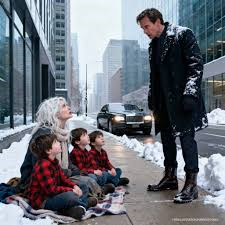
Mason Wilder stepped out of his black Tesla and pulled his scarf tighter, barely noticing the cold. His smartwatch buzzed with reminders. His phone glowed with unread messages from investors. The city was noise and motion, and he moved through it the way he always did—focused, detached, efficient.
He had built a life where surprise had no room. Numbers behaved. People were predictable. Success followed rules.
Then he saw her.
At first, she blended into the background—another person the city politely ignored. A woman sitting against a brick wall, shoulders hunched, a thin blanket wrapped around her legs. Three children were pressed close to her, sharing what little warmth she could give. One had his head buried in her side. Another clutched a cracked plastic toy. The smallest slept, cheeks red from the cold.
Mason slowed.
Something tugged at him, sharp and familiar. The woman lifted her head just enough for the streetlight to catch her face.
It was Emma.
The name hit him harder than the wind. Memories rushed in—late nights in a cramped apartment, laughter over cheap takeout, arguments about dreams that didn’t line up. He hadn’t seen her in years. Not since he left, chasing opportunity, promising to come back when things were “stable.”
Then he saw the kids’ faces.

One boy had his jaw. The girl’s eyes were unmistakably his. The youngest, even asleep, carried the same shape of brow he saw every morning in the mirror.
Mason’s first instinct was to turn away.
This wasn’t possible. This wasn’t his life anymore. He had meetings to get to, responsibilities that fit neatly into calendar blocks. Whatever this was—it belonged to the past.
He took two steps toward the café.
Then one of the children coughed. A deep, rattling sound that didn’t belong in someone so small.
Mason stopped.
He turned back.
“Emma?” His voice sounded strange to his own ears.
She looked up fully now. Recognition crossed her face, followed by something heavier—fear, embarrassment, exhaustion. She pulled the kids closer, as if shielding them from him.
“Mason,” she said quietly.
They stared at each other, the city rushing around them.
“What… what is this?” he asked, gesturing helplessly.
Her eyes dropped. “I didn’t plan for you to see me like this.”
He looked at the children again. “How old are they?”
She hesitated too long.
His chest tightened. “Emma.”
“They’re yours,” she said finally. “All three.”
The words settled slowly, like snow that doesn’t seem heavy until it starts breaking branches.
“Why didn’t you tell me?” he asked.
“I tried,” she said. “You were always traveling. Always busy. Then you stopped answering. I figured… you’d moved on.”
“I didn’t know,” he said, anger rising—but not at her. At himself.
The smallest child stirred, whimpering. Emma rubbed his back automatically.
Mason made a decision before fear could stop him.
“Get in the car,” he said.
She shook her head immediately. “No. I don’t want your pity.”
“This isn’t pity,” he said, opening the passenger door. “It’s cold. The kids need warmth. Please.”
The children watched him with wide, curious eyes.
After a moment, Emma nodded.
Inside the car, the heater hummed to life. Color slowly returned to the children’s faces. One of them smiled, shy and uncertain, at the glowing dashboard screen.
Mason drove without speaking for a few minutes, letting the silence breathe.
“Where are you staying?” he asked gently.
Emma swallowed. “Nowhere, really.”
That was the moment everything cracked open.
He took them to a hotel first. Then food. Real food. Watching the kids eat felt like witnessing something sacred. They laughed. They argued over fries. They relaxed.
Later that night, Mason sat alone, staring out at the city lights, realizing how small his world had been.
The next months changed everything.
He rearranged his life—meetings rescheduled, priorities rewritten. Lawyers helped with paperwork. Doctors checked on the kids. Emma found stability again, and eventually work she loved. The children learned his routines, his laugh, the way he made pancakes on Sundays and read badly at bedtime.
One evening, as snow fell softly outside their apartment window, the oldest child climbed into Mason’s lap and asked, “Are you staying?”

Mason held him close.
“Forever,” he said.
And for the first time in his carefully constructed life, he meant it.