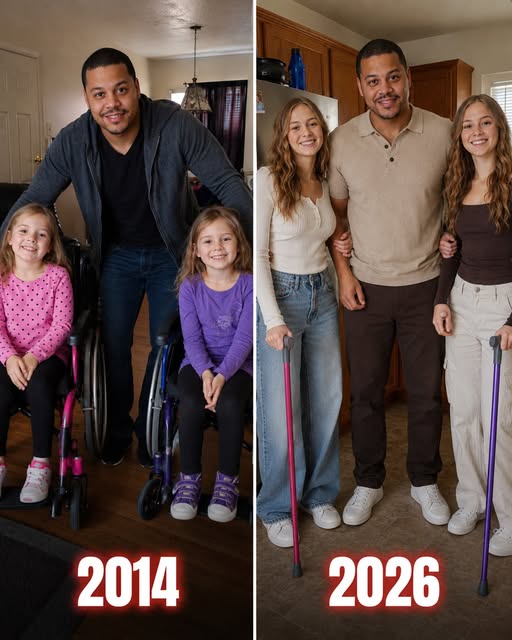
I Raised My Wheelchair-Bound Twin Daughters Alone After Their Mom Walked Out When They Were Six – On Father’s Day, 12 Years Later, They Said, ‘Dad, Please Don’t Be Mad, but We’ve Been Hiding Something from You’
A loving father spent twelve years piecing his daughters’ lives back together after a tragic accident, only to discover one Father’s Day morning that they had secretly been trying to rescue him as well.
The pancakes were slightly overcooked, as usual whenever Hazel became too busy chatting to pay attention. From my bed, I listened to the muted sounds coming from the kitchen: two sets of footsteps moving around without the help of wheels.
Twelve Father’s Days had passed since the accident, and for the first time, my daughters were already walking before I had even opened my eyes. I stayed still because happiness had become something fragile to me, something I held with caution. Then Hazel’s laughter floated down the hallway, followed by a brief chirp from the smoke alarm. Alone, I smiled into my pillow.
Hazel and Iris woke under white hospital lights, unable to feel their legs.
The memory returned anyway. Father’s Day always seemed to unlock the same painful room. The girls had been six years old, damp swim bags in the trunk, arguing over music while their mother drove us home. A driver ran a red light.
She escaped with bruises. Hazel and Iris woke under white hospital lights, unable to feel their legs. The doctors spoke gently, as though softer voices might somehow lessen the reality. Three weeks later, their mother was gone. She left a note taped to the refrigerator:
“I don’t want to spend my life pushing wheelchairs. Besides, you were the one who wanted kids.”
I stared at those words until my vision blurred.
Every dollar went toward therapy insurance would not cover.
The next twelve years arrived in fragments: late-night lessons on braiding hair, endless therapy paperwork, rejected insurance claims, stretching schedules taped above the kitchen sink. I worked two jobs, then three. I sold the house, the car, and my father’s watch the last thing I still owned from him. Only the chain remained in my pocket, a reminder that love could be measured in sacrifices.
Every dollar went toward therapy insurance would not cover. Every spare moment belonged to specialists, braces, exercises, and pain my daughters hid so I would not fall apart. I missed celebrations, weddings, and simple family dinners. For years, I called sacrifice by different names.
Iris appeared beside her, carrying a tray, knees trembling but proud. Hazel balanced close behind, grinning hard now.
Then, five months earlier, on a completely ordinary Tuesday, Hazel took three steps. Iris followed. Both clung to my hands while their former therapist, Claire, stood in the doorway with tears in her eyes and one hand over her mouth.
Former was important. By then, another therapist had taken over. Claire was no longer involved in their daily treatment. She was simply the woman who had helped create that miracle and someone I had spent four years trying not to think about. I pushed the thought aside when Hazel called,
“Dad?”
Iris appeared beside her, carrying a tray, knees trembling but proud. Hazel balanced close behind, grinning hard now.
I sat upright too quickly, wiping at my face as though I could hide my emotions.
“We made breakfast,” Hazel announced. “Some of it is even edible.”
I sat up too fast, wiping my face like I could hide emotion with my palm.
“Look at you two. Waiters now.”
“Don’t get used to it,” Iris said, setting the tray on my lap. “This is a one-time-a-year operation.”
The pancakes drooped around the edges. The strawberries had been carved into uneven heart shapes. The coffee looked powerful enough to restart a stopped heart.
“It’s perfect,” I said.
Hazel reached for my hand, fingers warm and nervous.
The two of them remained standing close together, exchanging one of those quick twin glances I had learned to recognize before every difficult appointment throughout their childhood. I swallowed hard.
“What is it?” I asked.
Hazel reached for my hand, fingers warm and nervous.
“Dad, please don’t be mad. We’ve been keeping a secret from you for years, and we hope you’ll forgive us.”
My stomach tightened. Instantly, my mind raced through every possible disaster: hidden pain, bad medical results, unpaid bills, or some accident they had concealed to protect me.
I looked at Hazel. Hazel looked at Iris. Iris looked toward the hall like the door might bite her.
“Tell me,” I said.
“It’s good,” Iris rushed in, already crying. “We promise.”
Before Hazel could continue, the doorbell rang. The three of us froze, as though the sound itself carried danger.
I looked at Hazel. Hazel looked at Iris. Iris looked toward the hall like the door might bite her.
“Who is that?” I asked.
Neither of them answered. In that silence, twelve years of abandonment came rushing back. Their mother had found them, I thought. Somehow she had reached them through messages, social media, or apologies they had hidden from me. And now she had chosen Father’s Day to appear.
I stood so quickly the tray shifted and orange juice spilled.
“Did your mother contact you?”
My voice was barely above a whisper.
“Dad,” Hazel said.
“Did she?”
“It isn’t her,” Iris whispered.
I stood so fast the tray slid, and orange juice spilled unnoticed.
But I was already moving toward the hallway, my hands shaking the same way they had outside surgery rooms.
“Stay here,” I said.
“Daddy, wait.”
But I was in the hallway, hands shaking the way they had outside operating rooms. The words I had carried for twelve years echoed in my mind: You do not get to come back. You do not get to ask for them. They are mine. They have always been mine.
I unlocked the door and opened it.
It was not their mother.
Hazel’s voice cracked behind me.
It was Claire. She stood there in a pale yellow dress, clutching a small red velvet box against her chest like armor. Her eyes already shimmered with emotion.
“Hi,” she whispered.
My knees nearly gave out. I caught myself on the doorframe. Behind me came the scrape of Iris’s old wheelchair being moved aside out of habit, followed by the careful sound of two sets of footsteps approaching independently.
“Oh, girls,” I whispered without turning. “Why would you do this?”
Hazel’s voice cracked behind me.
I stood trapped between hope and fear, uncertain which one would hurt more.
“Dad, please.”
Claire lowered the box slightly, as though realizing how much a gift could resemble a threat.
“I can leave,” she said quickly. “If this is wrong, I can go.”
“No,” Iris cried. “Please just listen.”
I stood between wanting and fear, unable to choose which wound to protect first.
Only after I stepped aside did Claire enter. We gathered in the living room while the smell of burned breakfast still drifted from the kitchen. The red velvet box sat on the coffee table between us like something dangerous. My daughters sat close enough on either side of me to catch me if I broke.
I shut my eyes, because that was true. I had never been brave enough to erase her name.
“How long?” I asked.
Hazel answered immediately.
“Five months.”
“Five months?”
The laugh that escaped me sounded strange. Iris wiped away tears.
“We found her number in your contacts. You never deleted it.”
“Claire thinks we can try this. Claire says our balance is better. Then, when we started walking, you stopped saying her name.”
I shut my eyes, because that was true. I had never been brave enough to erase her name.
“You talked about Claire constantly during therapy,” Iris said. “Claire thinks we can try this. Claire says our balance is better. Then, when we started walking, you stopped saying her name.”
“Because you needed me focused,” I said.
“We needed you alive,” Hazel said, gripping my wrist. “You sold Grandpa’s watch. You sold the car. You worked three jobs. You skipped your birthdays. You gave up every small thing until there was nothing left but us.”
Her hand trembled on mine.
“That’s my job.”
“Then let us do ours,” she said. “Let us be your daughters for one day.”
Her hand trembled on mine.
I looked at Claire. Images from four years of therapy sessions flashed through my mind: her steady hands guiding their balance, her calm counting, her laughter floating down clinic hallways after impossible victories.
Claire reached for her bag.
I had imagined a future with her in moments I always punished myself for. The old rule inside me surfaced immediately: You do not get to want this. Not yet. Not while the girls still need strengthening exercises, new braces, better insurance, and you standing whole.
I stood up.
“I need air.”
“Dad, no,” Hazel said.
“Just a minute.”
I made it to the stairwell before my legs gave out.
Claire reached for her bag.
“I’ll go.”
“It was never you, Claire. Please.”
I grabbed my keys, dropped them twice, and left before anyone could stop me. The hallway felt painfully bright and empty.
For twelve years I thought I was carrying my daughters. I had missed how carefully they carried me back.
I made it to the stairwell before my legs gave out, then sat outside with my father’s watch chain wrapped around my fingers. The watch itself was long gone. Only the chain remained, carried like a prayer. For years I believed it symbolized devotion. Now it looked more like evidence.
For twelve years I thought I was carrying my daughters. I had missed how carefully they carried me back.
They had noticed everything: the birthdays I ignored, the worn-out clothes, the way I recoiled whenever Claire smiled because wanting something for myself felt selfish. They had not betrayed me. They had simply loved me in return.
Hazel started crying again, but this time she smiled through it.
I eventually stood, wiped my face, and returned upstairs. The apartment felt quiet, as though it had already survived a storm. Claire sat between the girls. All three had red eyes. The box remained unopened.
I knelt in front of Hazel and Iris because apologies should never come from above.
“I owe you both an apology,” I said. “I made you carry my sadness in secret. That was not fair.”
Iris touched my sleeve.
“We just wanted you happy, Daddy.”
“I know. And I confused protecting you with disappearing into you. You’re not my unfinished project. You’re my finished miracle.”
I turned to Claire. She still sat carefully, as though one wrong word might send me running again.
Hazel started crying again, but this time she smiled through it.
“So you’re not mad?”
“I’m the opposite of mad. I’m scared, grateful, embarrassed, and very hungry.”
A surprised, watery laugh escaped Iris. Even Claire smiled. Something inside my chest loosened.
I turned to Claire. She still held herself carefully, as if one wrong breath might send me running again.
“I can’t promise forever,” I said. “I don’t even know how to start. But I can say yes to coffee, if you still want that.”
Relief hit me so hard I laughed. Really laughed. Hazel groaned.
She let out a shaky laugh.
“Coffee sounds perfect.”
Then she handed me the red velvet box. My stomach tightened again. I opened it, expecting a ring and fearing one at the same time.
Instead, inside was a small brass key resting on a folded card.
“It’s not a proposal,” she said quickly. “The girls insisted I bring something symbolic. It’s a spare key to my apartment building, not my door. An invitation to visit someday, with boundaries and coffee first.”
“We told you he would panic.”
Relief hit me so hard I laughed. Really laughed. Hazel groaned.
“We told you he would panic.”
Iris sniffed.
“We also told you not to use velvet.”
“It was festive,” Claire said, smiling through tears.
I closed the box and held it against my chest. Not because it solved anything, but because it asked for nothing more than a beginning.
Claire sat quietly beside me, giving me room to breathe.
The pancakes had gone cold by then, darker and tougher around the edges. Iris insisted on reheating them anyway. Hazel rose carefully and extended a hand to her sister. Together they walked into the kitchen, side by side. Not perfectly. Not quickly. But on their own.
I watched until my vision blurred. For years I had dreamed of seeing them stand without me. I had never expected the deeper ache of realizing they wanted me to stand without guilt as well.
Claire sat beside me quietly, leaving room for that.
“I was afraid,” I told her. “Afraid that wanting a life meant loving them less.”
I wanted to believe her. Maybe that was enough for a first morning.
Claire glanced toward the kitchen, where the girls were quietly arguing over syrup.
“Love doesn’t shrink when you let someone sit beside it,” she said.
I wanted to believe her. Maybe that was enough for a first morning.
Hazel called,
“Dad, your pancakes are getting worse by the second.”
Iris added,
Claire laughed once, soft and careful, and I didn’t look away.
“Claire, you’re invited too, unless you value your teeth.”
Claire looked at me for permission. I nodded. It was a small gesture, but something long sealed inside me shifted open.
We ate together beneath the blinking smoke alarm. The pancakes tasted like sugar, charcoal, and impossible good fortune. Hazel and Iris kept exchanging smug looks, proud of their ridiculous plan.
Claire laughed once, soft and careful, and I didn’t look away. The chain in my pocket felt warm. No longer proof that I had given everything away, but proof that I was still capable of receiving something. Twelve Father’s Days had taught me how to survive. This one messy, smoky, awkward, and full of kindness showed me how to begin again.
END