For 20 Years, I Thought My Mother Chose a Homeless Stranger Over Me Then He Revealed the Secret She Took to Her Grave
For most of my life, I was convinced that my mother devoted the best of herself to a homeless man who lived behind our home.
We rarely had enough to get by. The power was shut off more than once. My shoes were held together with tape, and I learned early not to ask for new clothes.
Still, every single afternoon, Mom made sure Victor had a hot meal.
I hated him for it.
Even after my mother died, I continued bringing him food only because I had promised her I would.
But the day after the funeral, I found Victor standing beside a black SUV, dressed in a clean coat and holding a silver locket my mother had always said disappeared years ago.
Then he met my gaze and finally told me the truth.
Victor had never been a stranger.
He was family.
The Empty Shelter
The morning after my mother’s funeral, I arrived at her house carrying a container of homemade beef stew.
Cooking was never something I excelled at, but it was the one dish I could make without disaster. I followed Mom’s recipe from memory—brown the beef slowly, add the vegetables afterward, and never hurry the broth.
Being in her kitchen without her felt wrong.
Everything was exactly as she had left it. The worn dish towels still hung beside the sink. Her favorite blue mug rested upside down on the drying rack. A handwritten grocery list remained attached to the refrigerator with a chipped magnet.
For one brief, impossible moment, I expected her to come through the doorway and tell me the stew needed more salt.
Instead, there was only silence.
I packed the stew into one of the plastic containers she had reused countless times and carried it toward the backyard.
“Victor?” I called.
Nothing.
His makeshift shelter sat beyond the fence near a line of overgrown bushes. For nearly twenty years, he had lived there beneath layers of tarps, scrap wood, and plastic sheets that rattled in the wind.
But that morning, it was deserted.
His blanket had been folded neatly into a square. The dented coffee cans where he kept his belongings were gone. Even the pile of firewood by the fence had been stacked with care.
It was as if he had vanished without a trace.
A knot formed in my chest.
“Victor?”
“Fiona.”
I spun around.
A man stood near the back steps.
For a moment, I didn’t recognize him.
He was wearing a clean dark coat, and his long beard had been trimmed. Without the tangled hair hiding his face, I noticed the deep lines around his mouth. He looked thinner than I remembered.
His eyes were swollen from crying.
A polished black SUV stood beside him.
I stared.
“Victor?”
A tired smile crossed his face.
“I thought you might not come.”
“I brought dinner,” I replied automatically, lifting the container. “But what is happening? Where are your things? Whose car is that?”
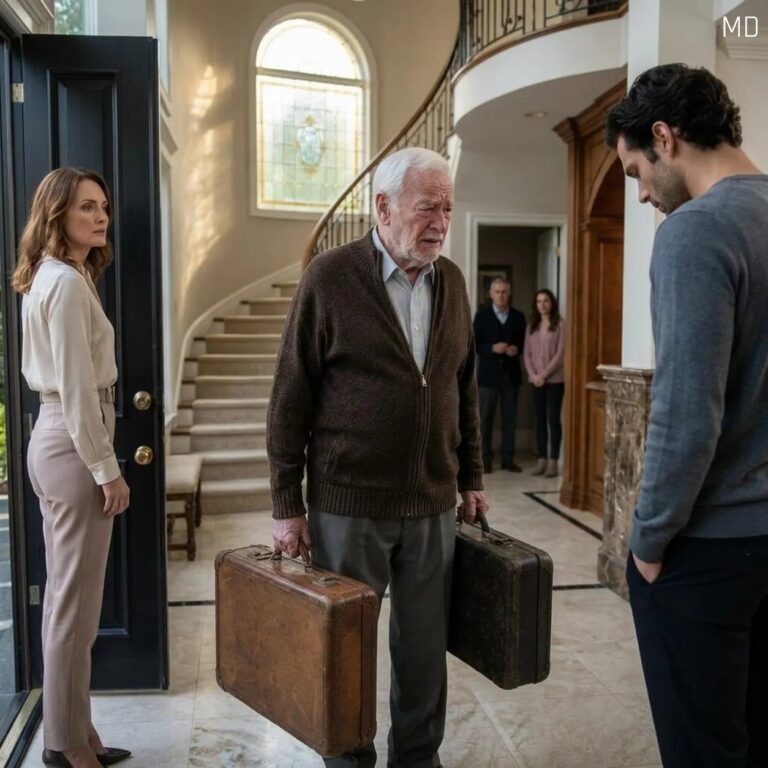
Before he could respond, our elderly neighbor, Mrs. Bell, stepped out from the driver’s side.
“It belongs to my nephew,” she said. “Victor wanted to visit your mother’s grave early this morning. He didn’t want to go while Mark or the other relatives were there.”
The mention of my uncle made my stomach tighten.
Then I saw what Victor held in his hand.
A small silver locket.
I recognized it instantly.
I had seen it in old photographs of my mother.
She wore it all the time when I was little until one day, when I was eight, she said it had been lost.
“Where did you get that?” I whispered.
Victor closed his fingers around it protectively.
“Your mother gave it to me.”
The container nearly slipped from my hands.
The Third Meal
When I was growing up, lunch was always prepared for three people.
Two plates stayed on our worn kitchen table—one for Mom and one for me.
The third meal went into whatever container Mom had managed to save and wash.
That meal was always for Victor.
I hated that third container.
I hated seeing Mom give him the biggest piece of chicken while I wore sneakers patched with tape. I hated watching her add extra vegetables to his soup when our cabinets were nearly bare.
We were struggling too.
Why did his needs always seem to matter more than ours?
I was eleven when I finally voiced it.
“He eats better than I do.”
Mom stood by the stove stirring chicken soup. She didn’t turn around.
“Fiona, please don’t start.”
“The electricity was turned off twice this winter,” I continued. “But Victor still gets a hot lunch every day.”
Her shoulders tensed.
“He needs help.”
“So do we.”
The spoon slipped from her fingers and clattered against the sink.
“Don’t speak about him that way.”
I crossed my arms. I was cold, hungry, and carrying the kind of anger children feel when they cannot understand the choices adults make.
“He’s just some man living behind our house.”
Mom faced me.
Every bit of color had drained from her face.
“No,” she said quietly. “He isn’t just some man.”
“Then who is he?”
For a split second, something shifted in her expression.
I thought she was finally about to tell me.
Instead, she picked up the container and placed it in my hands.
“Take him his lunch.”
I stayed where I was.
“Maybe we wouldn’t be so poor if you stopped feeding strangers.”
Her hand slammed against the counter hard enough to make me jump.
“Never say that again,” she warned. “You have no idea what that man gave up.”
“For whom?” I demanded. “For you?”
Mom began to shake.
Then she turned back toward the stove.
“Take him the food, Fiona. This conversation is over.”
So I carried the soup outside.
Victor sat near the fence rubbing his hands together to stay warm.
“Chicken soup?” he asked.
“Yes.”
His face lit up.
“Your mother makes the best chicken soup.”
“You don’t even know her,” I snapped.
The smile faded from his face.
After a long silence, he lowered his eyes to the container.
“I know her soup.”
At the time, that answer only fueled my anger.
Years later, I would finally understand what he had been holding back.
The Quiet Things I Never Noticed
Victor remained behind our house throughout my childhood.
He never asked us for money. He rarely came to the door. He stayed near the fence and accepted whatever Mom brought him with a quiet gratitude that somehow annoyed me even more.
Yet odd things kept happening.
After storms, neatly cut firewood appeared by the back steps.
When a porch board loosened, it was repaired before Mom even called for help.
During my second year of high school, the soles of my winter boots split apart.
The next morning, a secondhand pair in my size sat beside my backpack.
“Where did these come from?” I asked.
“A church donation,” Mom replied too quickly.
Through the kitchen window, I spotted Victor brushing snow off our steps.
I should have understood then.
But resentment has a way of hiding kindness in plain sight.
As I grew older, I stopped asking. I moved away, built my own life, and visited Mom whenever I could.
Victor stayed behind the house.
Mom kept feeding him.
We argued about it less often, but only because I learned not to bring it up.
The Illness That Took My Mother
Cancer took my mother slowly, then all at once.
Stephanie had always been strong. She carried groceries with both hands, opened doors with her elbows, fixed leaking faucets, painted walls, and worked extra shifts without complaint.
By the end, she looked tiny beneath the hospital blankets.
Her wrists had become so thin I could see every bone.
Two weeks before she died, I sat beside her hospital bed when she quietly spoke my name.
“Fiona.”
“I’m here.”
“You need to promise me something.”
I leaned closer.
“You should rest.”
“No.” Her fingers tightened around my wrist with surprising strength. “It’s about Victor.”
Even then, irritation rose inside me.
“Mom, please. Not this again.”
“Promise me you’ll keep bringing him food.”
“Why?” My voice cracked. “Why is it always him?”
Tears filled her eyes.
“I never chose him over you.”
“That’s how it felt.”
“I know.”
Her voice broke.
“And I am so sorry.”
I stared at her, waiting for the answer I had wanted my entire life.
“Then tell me the truth.”
She glanced toward the hospital room door as though she feared someone might overhear.
“If Mark comes to the house after I’m gone, don’t let him touch the blue box.”
“Uncle Mark?”
Her grip tightened.
“Promise me.”
“What does Mark have to do with Victor?”
“He’ll erase him completely.”
“Erase who?”
But she only repeated herself.
“Protect the blue box.”
She looked terrified, and despite all my questions, she was still my mother.
“I promise.”
A tear slipped down her cheek.
Then she whispered something I didn’t understand.
“He was my safe place.”
A few days later, she was gone.
The Man Who Wanted to Clean Up the Past
After the funeral, relatives filled the house carrying casseroles, sandwiches, and awkward expressions.
They spoke softly and avoided meeting my eyes for too long.
Uncle Mark stood in the hallway sorting through Mom’s belongings.
He had always seemed calm and respectable. His shirts were perfectly pressed. His voice rarely rose. He wore the kind of smile that made people feel foolish for questioning him.
I walked over.
“What are you doing?”
“Helping you.”
“By opening her boxes?”
“Your mother kept too many things,” he replied. “Old papers, broken dishes, useless memories. Some things only caused her pain.”
“I’ll decide what stays.”
His smile tightened.
“You’re grieving, Fiona. This isn’t the time to make emotional decisions.”
I looked through the back window toward Victor’s shelter.
Then I remembered Mom’s warning.
“Interesting,” I said. “Mom warned me about you.”
His hand froze above a cardboard box.
“What did Stephanie say?”
“She told me not to let you touch the blue box.”
For a brief second, his composure cracked.
Then he let out a soft laugh.
“She was very ill.”
“She was frightened.”
“Of me?”
“You tell me.”
Mark glanced toward the other relatives before leaning closer.
“Some pain should remain buried.”
At the time, I didn’t know what he meant.
The following morning, I found Victor beside the black SUV with my mother’s locket in his hand.
And the past refused to remain buried any longer.
The Locket My Mother Never Lost
“That necklace was lost,” I told Victor.
“No,” he answered. “Stephanie only told you that.”
“Why would she give it to you?”
“Because it belonged to me before it belonged to her.”
I stared at him.
He opened the locket with trembling fingers.
Inside was a faded photograph of two children sitting on a porch. The girl had scraped knees and uneven braids. The boy beside her had one arm around her shoulders.
I recognized my mother immediately.
The boy was Victor.
On the back of the photograph, three words had been scratched into the metal in childish handwriting.
My safe place.
“That’s Mom,” I whispered.
Victor nodded.
“And the boy beside her…”
“Is me.”
I stepped backward.
“No. My mother had one brother. Mark.”
“Mark was the youngest,” Victor said. “I was the oldest.”
“You’re lying.”
“I wish I were.”
My chest felt too tight to breathe.
“If you were her brother, why did she let you live outside for twenty years?”
Victor flinched.
Mrs. Bell answered for him.
“Because Mark frightened her.”
I turned toward her.
“What did he do?”
“He told Stephanie that people would question whether she was a suitable mother if she allowed Victor into the house. She was poor, single, and terrified someone might take you away.”
Victor looked toward the kitchen window.
“Your mother kept me as close as she believed she safely could.”
“She fed you outside.”
“She kept me alive.”
His voice carried no anger toward her, only love.
“I wasn’t always easy to help, Fiona. I had been sick for a long time. I had lost my home and stopped trusting people. But Stephanie never stopped trying.”
Then I remembered Mom’s final warning.
“The blue box.”
Victor raised his eyes.
“She mentioned it?”
“She told me Mark would erase you.”
Mrs. Bell pointed toward the house.
“Then you need to find it before he does.”
The Truth Inside the Blue Box
I ran into Mom’s bedroom and pulled open the closet.
Blankets, old coats, and boxes covered the floor.
Beneath a stack of quilts, I found a small blue box.
My name had been written across the lid.
My hands trembled as I opened it.
Inside were photographs, letters, school papers, and envelopes tied together with faded ribbon.
The first picture showed Mom as a little girl standing beside Victor. Her knees were scraped. His lip was swollen.
On the back, Mom had written:
Victor walked me home again.
Another photograph showed them beneath a blanket on a worn sofa.
Another showed Victor carrying Mom’s schoolbag while she smiled beside him.
Then I found an envelope with my name on it.
I unfolded the letter.
My dearest Fiona,
If you are reading this, I was not brave enough to tell you the truth while I was alive.
Victor was my brother before the world gave him any other name.
When we were children, he packed my lunches, walked me to school, and gave me the warmest blanket when there was only one.
One winter, the pipes froze. We had no heat, and the house was painfully cold. Victor took our mother’s bracelet and tried to sell it.
He did not want money for himself.
He wanted to buy blankets.
Our parents never forgave him. Mark never allowed anyone to forget it.
For years, Mark repeated the same story: Victor steals.
He never mentioned that Victor had stolen to keep us from freezing.
Later, when Victor became ill and struggled to live normally, the family treated his illness as proof that he was dangerous.
Mark told me that allowing Victor near you could make people question whether I was a responsible mother.
I was poor, alone, and frightened.
I believed he could take you away from me.
So I made the greatest mistake of my life.
I kept Victor alive, but I allowed you to believe he was a stranger.
Please forgive me.
And please do not let Mark put him outside again.
Love always,
Mom
By the time I finished reading, the letter was wet with my tears.
All those years, I had believed Mom was choosing Victor over me.
In reality, she had been trying to protect both of us while living beneath a fear Mark had carefully created.
The boots.
The firewood.
The repaired porch.
Victor had been caring for us from the other side of the fence.
As close as he had been permitted to come.
For illustrative purposes only
The Brother Everyone Pretended Was Dead
I carried the blue box to Mrs. Bell’s house.
She opened the door before I finished knocking.
“You found it,” she said.
I held up one of the photographs.
“Tell me this is real.”
“It is.”
“Why didn’t anyone tell me?”
“Your mother was afraid. And the rest of the family believed the version Mark repeated for years.”
“The story about the bracelet.”
Mrs. Bell nodded.
“People remembered that Victor took it. They chose to forget why.”
“To buy blankets.”
“To survive,” she corrected gently.
I looked down at the photograph.
“Mark turned one desperate act into Victor’s entire identity.”
“And once people accept a simple story, they rarely ask whether it is true.”
I thought about how easily I had accepted it too.
I had judged Victor without ever knowing him.
I had resented a man who had once gone hungry so my mother could eat.
I hurried back to the house.
When I entered the living room, Uncle Mark was standing near the table.
The blue box was in his hands.
The Moment the Family Learned the Truth
“Put it down,” I said.
Mark turned toward me with his familiar patient smile.
“Fiona, you’re upset. Let me take care of this.”
“No. You’ve taken care of enough.”
Victor stepped into the house behind me.
Mark’s expression hardened immediately.
“Get him out.”
I moved in front of Victor.
“His name is Victor.”
My voice shook, but I did not step aside.
“And he is Mom’s brother.”
Aunt Linda stared at her husband.
“What is she talking about?”
Mark said nothing.
Her eyes widened.
“You told us Victor died.”
Mark’s jaw tightened.
“Because it was easier.”
The entire room fell silent.
“Easier for whom?” I asked.
“For everyone,” he snapped. “Victor caused nothing but trouble.”
I lifted Mom’s letter.
“She wrote down everything.”
The confidence disappeared from his face.
“She explained how you threatened her. You used her poverty against her. You convinced her that loving her own brother could cost her custody of me.”
“I protected this family.”
“No,” I said. “You protected the story in which Victor didn’t exist.”
Victor stepped forward.
His hands were trembling, but his voice remained steady.
“Stephanie chose me when we were children. She stood beside me when everyone else walked away.”
Mark laughed bitterly.
“And look what it did to her. He drained her for twenty years.”
“I already regret twenty years of misunderstanding,” I said. “I will not spend another day repeating your cruelty.”
Mark reached for his coat.
“You’ll regret helping him.”
Aunt Linda stepped between him and the table.
“Leave the box.”
“Linda.”
“You told me he was dead.”
Her voice shook, but she did not move.
“You allowed us to mourn a living man because acknowledging him embarrassed you.”
Mark looked around the room, searching for someone to defend him.
No one did.
For the first time, the silence was not protecting him.
It was judging him.
He dropped the blue box onto the table, pulled open the front door, and left.
A Place at the Table
After Mark was gone, I turned toward Victor.
He remained near the doorway, as though he was afraid to step any farther into the house.
For twenty years, he had eaten outside.
For twenty years, his meals had been carried through the back door in reused plastic containers.
For twenty years, he had watched his sister’s life through a kitchen window because that was the only closeness fear had allowed them.
I pulled out a chair.
“Uncle Victor,” I said.
His face crumpled when he heard the word uncle.
“Come sit down.”
I went into the kitchen and poured the stew into two bowls.
When I returned, Victor was still standing beside the doorway.
“I can eat outside,” he said quietly.
“No.”
He looked at me uncertainly.
“You don’t eat outside anymore.”
I placed the bowls on Mom’s chipped kitchen table.
“Tonight, you’re staying here. Tomorrow, we’ll figure out what comes next.”
He slowly sat down, still holding the silver locket.
For a few moments, neither of us spoke.
Then Victor lifted a spoonful of stew and tasted it.
His eyes filled with tears.
“It tastes like hers,” he whispered.
I knew it didn’t.
Mom had been a far better cook than I would ever be.
But I also knew he wasn’t talking about the stew.
He was talking about being welcomed.
About being remembered.
About finally being allowed to sit in the place where he had always belonged.
That evening, for the first time in twenty years, Victor’s meal did not disappear through the back door.
It remained on the kitchen table.
And so did he.
Because family should never be hidden behind fences, buried beneath shame, or forced to survive outside the window.
Sometimes the truth comes too late to repair every wound.
But it can still open the door.
And when it does, someone has to be brave enough to say:
Come inside.
Your place is here.
END