Inside the Financial Strategy Driving a Zero-Cost Shopping Concept
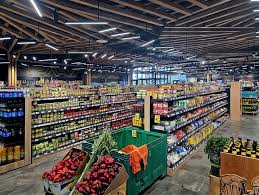
As inflation and food prices continue to dominate household budgets across the United States, a surprising concept emerging in Manhattan has sparked widespread discussion — the idea of a grocery store where customers don’t pay at checkout.
The initiative, reportedly backed by prediction-market platform Polymarket, isn’t simply a charitable gesture. It reflects a growing intersection between technology platforms, consumer economics, and social experimentation in urban markets — an area closely watched by investors, policy analysts, and financial strategists alike.
A Response to Rising Living Costs
Over the past several years, food inflation has consistently ranked among the top financial pressures for American households. According to economic analysts, groceries represent one of the most visible indicators of purchasing-power erosion. When staple prices rise, consumer confidence tends to fall — a relationship tracked closely by markets and lenders.
This environment has encouraged private firms to explore unconventional engagement strategies that also generate brand exposure and behavioral data insights. A “free grocery” model — even temporarily — creates a controlled real-world experiment:
-
How do consumers behave when cost barriers disappear?
-
Do spending patterns shift afterward?
-
Does brand trust increase measurable platform adoption?
For financial technology companies, those insights carry significant value.

Marketing, Data, and Market Strategy
Prediction-market platforms like Polymarket operate in an ecosystem tied to behavioral forecasting — analyzing how people anticipate future events. Physical activations such as a free grocery concept can serve multiple strategic objectives:
-
Brand acquisition in high-density urban markets
-
Consumer sentiment measurement
-
Engagement funnel expansion
-
Cross-sector visibility among regulators and institutional observers
From an advertising and investor standpoint, the initiative highlights how digital platforms increasingly move beyond software into physical-world engagement to build measurable influence.
Economic Ripple Effects
While the concept attracts public attention, economists are also interested in its broader implications:
Retail Competition:
Free-access models challenge traditional grocers’ perception of value and loyalty dynamics.
Urban Consumer Behavior:
Major cities like New York often act as testing grounds for scalable economic models.
Financial Signaling:
Such initiatives can affect investor perception of a company’s growth strategy and long-term positioning.
Debt & Budget Relief Angle:
Even short-term grocery cost reductions can impact household cash flow, potentially affecting credit usage patterns — an area monitored by lenders and financial institutions.

Symbolism in a High-Cost Economy
Whether viewed as innovation, marketing, or social commentary, the project reflects a larger narrative unfolding across the U.S.:
Consumers are searching for relief
Companies are competing for attention
Financial platforms are experimenting with influence
In a market environment shaped by interest rates, credit pressure, and spending adjustments, even a grocery store becomes more than retail space — it becomes a signal of how business models are evolving to capture trust, data, and relevance.