The Man I Sentenced Gave Me My Life Back
In 2008, I sat behind the bench and handed down a sentence that would define another man’s life. Michael Torres was twenty-four years old when I sentenced him to twenty years in prison for an armed robbery that yielded barely three hundred dollars. From the standpoint of the law, the case was straightforward. A weapon had been used. The statute was clear. The gun was unloaded, and he had apologized while committing the crime, but none of that altered the mandatory outcome. I carried out my duty with professional distance, assuring myself that he would still be young enough to rebuild his life upon release at forty-four.
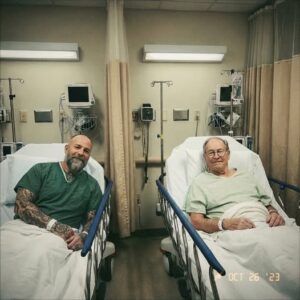
I never stopped to wonder what desperation had brought him to that moment.
For the next fifteen years, Michael existed in my memory only as a file number—08-CR-2847—one among thousands I processed with the same impartial efficiency. Eventually, even that abstraction faded as I moved on, applying the law again and again with clinical consistency.
Everything changed last year.
A diagnosis of genetic kidney failure reduced my future to months. When no suitable donor emerged from my family or friends, hope thinned quickly. Then, unexpectedly, an anonymous donor stepped forward. The surgery lasted fourteen hours and succeeded. When I woke in recovery, weak and disoriented, I found a single photocopied document resting beside my bed: my own sentencing order from 2008.
Scrawled across the top in blue ink were four words: Now we’re even.
That was how I learned who had saved my life.
The weight of that realization was immediate and overwhelming. The man whose freedom I had taken for fifteen years had chosen to give me the rest of my life. Gratitude was too small a word. What I felt was a profound, bodily sense of debt that settled into me and refused to loosen its grip.
I eventually found Michael working at a motorcycle repair shop on the south side of town. He was a model parolee now, mentoring other formerly incarcerated men. We met at a nearby diner, and over coffee I asked the question that had haunted me since the surgery: why?
Why would he give an organ to the judge who had imprisoned him?
Michael told me that the first five years of his sentence were consumed by what he called a “toxic” hatred. It nearly destroyed him. Eventually, he said, he realized forgiveness wasn’t about absolving others—it was about reclaiming control over his own life. Donating his kidney wasn’t an act of repayment or reconciliation. It was an assertion of agency. For the first time in fifteen years, he was making a choice freely.
In his mind, the scales were balanced. I had imposed consequence. He chose to give life.
That meeting reshaped everything that followed. In retirement, I began volunteering with re-entry programs, helping men navigate the very systems I once administered from a distance. I no longer see case files or docket numbers. I see people—complex, flawed, capable of growth beyond their worst moments.
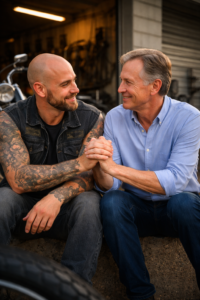
Michael and I now meet weekly with his group, the Second Chance Riders. We talk about life, accountability, and starting again. He still insists that we are even.
But I know better.
What he gave me cannot be measured in years, organs, or legal outcomes. He gave me the chance to understand justice differently—and the grace to finally see the human being behind the paperwork. His choice to let go of resentment taught me that true redemption doesn’t arrive loudly. It lives in quiet decisions, made not for recognition, but for freedom.
And that lesson will stay with me for whatever time I have left.