Why a Simple Song Still Speaks So Deeply After 50 Years
For Neil Diamond, Song Sung Blue was never intended to be a showstopper or a grand statement. When the song was released in 1972, its power came not from spectacle, but from restraint. It stood apart precisely because it avoided flash, choosing instead a quiet honesty rooted in simplicity.
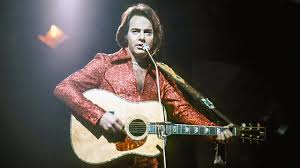
Built around a gentle melody and straightforward lyrics, the song expressed a universal truth: happiness and sadness often coexist, and music has the ability to express emotions that words alone cannot. That emotional clarity—never overstated, never exaggerated—is why the song has remained relevant for more than fifty years.
That same philosophy of emotional sincerity carries into the tribute film Song Sung Blue, where actors Hugh Jackman and Kate Hudson approach Diamond’s music with reverence rather than reinvention. Instead of reshaping the songs for modern spectacle, the film allows them to exist as they were meant to be felt—personal, reflective, and deeply human.
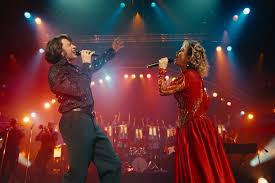

The result is not a traditional musical biopic filled with theatrical excess, but a grounded, emotionally driven story that honors the spirit of its musical inspiration.
The Enduring Legacy of Song Sung Blue
Released in May 1972 on Diamond’s album Moods, Song Sung Blue quickly became one of the most recognizable songs of his career. Written by Diamond himself and loosely inspired by the second movement of Mozart’s Piano Concerto No. 21, the song was intentionally crafted to be simple and accessible.
Diamond later described it as a song with a “very basic message,” admitting he never anticipated it would achieve major success. Yet it did exactly that. By July 1972, it reached No. 1 on the U.S. Billboard Hot 100, remaining in the Top 40 for twelve weeks. It also climbed to No. 14 in the United Kingdom, marking Diamond’s second U.S. chart-topper after Cracklin’ Rosie in 1970.
The lyrics—encouraging listeners to keep singing through sadness and to find comfort in shared emotion—resonated deeply during a period marked by cultural change and introspection. The song’s quiet reassurance, free of dramatic crescendos or forced climaxes, became a defining hallmark of Diamond’s songwriting style.
Industry recognition followed, with Song Sung Blue earning Grammy nominations for Record of the Year and Song of the Year at the 1973 awards. While it didn’t take home a trophy, its true legacy lay elsewhere—in the lasting bond it created between Diamond and his audience.
Decades later, the song remains a staple of his catalog, performed countless times in concert and featured on numerous compilations. Its influence extends beyond awards or chart positions; it became a symbol of Diamond’s ability to connect through emotional honesty.
The Story Behind the Film Song Sung Blue
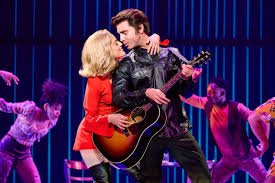
The 2025 film adaptation, written and directed by Craig Brewer, draws its emotional foundation from that same simplicity. The movie is inspired by a 2008 documentary of the same name by Greg Kohs, which followed real-life Wisconsin musicians Mike and Claire Sardina, members of a Neil Diamond tribute band called Lightning & Thunder.
Brewer—known for character-focused films such as Hustle & Flow and Dolemite Is My Name—recognized that the heart of the story wasn’t performance, but perseverance. His adaptation centers on the couple’s personal journey: their struggles, dreams, resilience, and the role music played in shaping their lives.
Rather than transforming Diamond’s songs into grand musical set pieces, the film allows them to exist naturally within the story. The music is woven into the narrative as emotional texture, not spectacle.
When Diamond viewed the completed film, reports from Brewer and the media suggest he was deeply moved. Not by nostalgia or glamour, but by the care with which his work was treated. The film reflected the same sincerity he valued in his own songwriting.
Hugh Jackman and Kate Hudson: Performing with Purpose
At the core of Song Sung Blue is the authentic chemistry between Jackman and Hudson, who portray Mike and Claire Sardina. Their performances have been widely praised for their emotional realism and warmth.
Jackman, no stranger to musical roles after Les Misérables and The Greatest Showman, avoids imitation in favor of emotional truth. His performance focuses on character rather than mimicry. Hudson complements this with a performance marked by quiet vulnerability, grounding the film’s emotional core.
Both actors contributed vocally to the soundtrack, blending live performance with studio recording to create a sound that feels organic rather than overly polished. The film features a range of Diamond’s music—from energetic tracks like Cherry, Cherry to introspective pieces such as Play Me—all performed with restraint and sincerity.
Hudson’s portrayal earned her a Golden Globe nomination, recognizing the emotional depth and nuance she brought to a role defined by resilience and lived experience.
A Film About Meaning, Not Myth
What truly sets Song Sung Blue apart is its refusal to turn Diamond’s legacy into a highlight reel. Instead, it explores the deeper role music plays in everyday life—how songs hold memory, emotion, and connection across time.
The film’s narrative mirrors the emotional structure of Song Sung Blue itself. There is no exaggerated drama or artificial climax, only the unfolding of real lives shaped by music. This approach reflects Diamond’s belief that once a song is released, it no longer belongs solely to its creator—it belongs to everyone who hears it.
Critics and audiences have responded positively, praising the film’s heartfelt performances, respectful storytelling, and emotional authenticity. Review aggregator scores reflect appreciation for its sincerity and refusal to chase spectacle.
New Chapters in Diamond’s Legacy
The release of Song Sung Blue coincided with a significant moment in Diamond’s career: the sale of his entire music catalog to Universal Music Group. This marked the transition of his work into a new era of preservation and celebration.
While Diamond no longer controls how his songs are licensed or interpreted, seeing his music carried forward with care likely offered reassurance that its emotional truth remains intact. A gesture emblematic of this connection came when Diamond gifted Jackman a signed acoustic guitar accompanied by a personal message—an acknowledgment of trust and gratitude.
Why Song Sung Blue Still Matters
In a cultural landscape driven by reinvention and excess, Song Sung Blue stands out for its humility. It doesn’t seek to dazzle; it seeks to connect. Both the song and the film invite reflection—on memory, love, loss, and the quiet ways music helps us endure.
For Neil Diamond, the continued life of Song Sung Blue is more than a professional achievement. It’s proof that a song born from simplicity can still speak powerfully in an ever-changing world.
Sometimes, the softest melodies carry the deepest truths—and decades later, they are still being heard.