Ali MacGraw: Choosing Love, Survival, and Self-Truth Over Hollywood Fame
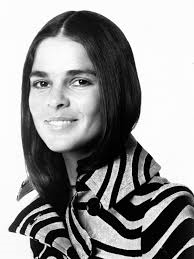
Ali MacGraw rose to fame with breathtaking speed, becoming one of the most recognizable faces in Hollywood at the dawn of the 1970s. With her striking natural beauty, emotional openness, and quiet intensity, she captivated audiences almost instantly. Everything about her suggested a long and dominant career at the center of the film industry.
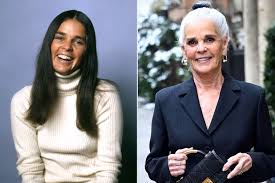
Yet just as her stardom reached its peak, she made a decision that surprised many—she stepped away. Today, at 85, Ali MacGraw lives far from red carpets and movie premieres. With silver hair, a calm presence, and a life rooted in simplicity, she represents a different kind of beauty—one shaped by lived experience, healing, and self-awareness. Her story is not merely about fame gained and fame left behind, but about endurance, reinvention, and choosing authenticity over expectation.
A Complex Beginning: Art, Trauma, and Instability
Ali MacGraw was born Elizabeth Alice MacGraw on April 1, 1939, in Pound Ridge, New York. She grew up in a household filled with creativity, but also marked by emotional turmoil and financial struggle. Her mother, Frances MacGraw, was a trained artist who had studied and worked in Paris before settling in Greenwich Village. She later married Richard MacGraw, also an artist, and together they had two children—Ali and her younger brother.
Ali’s father carried deep psychological wounds from his own childhood. Raised in an orphanage, he endured profound hardship and ran away at just 16 to work at sea before eventually studying art in Germany. Those early experiences left lasting scars. Ali later explained that her father lived with suppressed rage and unresolved pain, never forgiving his biological parents for abandoning him.
Poverty, Fear, and Emotional Scars
The family struggled financially for years. At one point, they lived in a house on a wilderness preserve, sharing the space with an elderly couple. There were no doors, little privacy, and constant tension. Ali later described the experience as deeply distressing.
While her mother worked tirelessly through commercial art jobs to support the household, her father’s inability to sell his paintings fueled frustration and anger. That anger often manifested in frightening ways. Ali witnessed her father physically abuse her younger brother—memories that stayed with her for life.
Education as an Escape
Despite the chaos at home, Ali thrived academically. She earned a scholarship to Rosemary Hall, an elite preparatory school, and later attended Wellesley College. Creativity had always been central to her identity, and she knew she wanted a life connected to the arts.
After college, she moved to New York City at 22 and secured a job as an assistant editor at Harper’s Bazaar, entering the fashion world from the bottom rung.
Fashion, Hard Work, and an Unexpected Turn
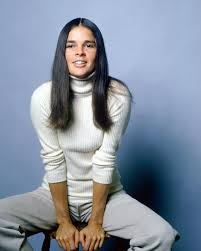
Working under legendary editor Diana Vreeland was demanding and relentless. Ali often compared the experience to a real-life version of The Devil Wears Prada. She worked long hours, stayed late, and proved herself through sheer dedication.
Her work ethic caught attention. Photographer Melvin Sokolsky recognized her striking appearance and offered her a better-paying role as a stylist. Soon after, she began appearing in front of the camera as a model, landing magazine covers and television commercials.
But despite her success, parts of the fashion world left her uneasy. One uncomfortable encounter with Salvador Dalí—who sketched her nude and later behaved inappropriately—cemented her desire to leave modeling behind and pursue acting instead.
A Sudden Rise to Stardom
With no formal acting training, Ali entered film almost by chance. Her unpolished, emotionally transparent style resonated immediately. Her first role came in A Lovely Way to Die (1968), but it was Goodbye, Columbus (1969) that changed her life, earning her a Golden Globe for Most Promising Newcomer.
Then came Love Story.
Love Story and Global Fame
Ali was deeply moved when she first read the script for Love Story. Determined to win the role, she met producer Robert Evans at the Beverly Hills Hotel. He believed she was perfect for the part—and soon became personally involved with her as well.
Starring opposite Ryan O’Neal, Ali portrayed Jenny Cavilleri, a working-class student whose romance ends in heartbreak. The film became a cultural phenomenon, topping the box office in 1970 and earning Ali an Academy Award nomination and another Golden Globe.
Overnight, she became an icon.
Marriage, Motherhood, and a Turning Point
Ali married Robert Evans in 1969, and their son Josh was born in 1971. But the marriage quickly deteriorated when Ali met Steve McQueen while preparing for The Getaway. She later admitted that the attraction was instant and overwhelming.
She left Evans and moved to Malibu with McQueen, bringing her young son with her.
Life With Steve McQueen
What began as an intense romance soon became restrictive. McQueen, shaped by his own troubled past, struggled with control and trust. He discouraged Ali from working and expected her to focus entirely on domestic life.
She later described feeling isolated and constrained, unable even to attend art classes. The relationship ended in divorce in 1978. She honored their prenuptial agreement and walked away without financial compensation.
Career Struggles and Personal Reckoning
By the late 1970s, several of Ali’s films underperformed. Hollywood’s harsh treatment of aging actresses took a toll, and she struggled with alcohol and self-worth. In 1986, she checked into the Betty Ford Clinic, later admitting that drinking worsened every aspect of her life.
Reinvention and a New Life
After treatment, Ali began rebuilding. In 1993, a wildfire destroyed her California home—prompting her to leave Los Angeles for good. She relocated to Tesuque, near Santa Fe, New Mexico, embracing a quieter, community-centered life.
There, she became known not as a movie star, but as a volunteer, animal rights advocate, and supporter of folk art. She also created widely popular yoga videos, finding fulfillment through creativity rather than fame.
Legacy and Peace
Ali made a brief return to the stage in 2006, reuniting with Ryan O’Neal on Broadway, but largely remained out of the public eye. She has often said that creativity—not celebrity—is what sustains her.
Her son Josh followed a creative path of his own, becoming an actor and director. Ali has spoken with deep pride about him, calling him the most important person in her life.
A Life Chosen, Not Lost
Ali MacGraw’s life is not a story of failure or faded fame. It is a testament to choosing self-respect over stardom, healing over validation, and purpose over applause.
She may have stepped away from Hollywood—but she never stepped away from herself.