“This Is What Homelessness Looks Like in America Today”
For most of her adult life, Johnika Jamison believed she had done everything right.

She had a steady career as a school counselor, spending nearly a decade helping students navigate anxiety, family struggles, and uncertain futures. Her salary — about $60,000 a year — was modest but stable, right in line with the median income for American workers. Together with her husband, Tristian Harris, she built a life centered around their three children, believing that hard work and responsibility would protect them from the worst hardships.
That sense of security vanished in a single year.
Fifteen months ago, Tristian suffered a severe flare-up of multiple sclerosis, a chronic illness that had long lingered in the background but suddenly took center stage. The flare left him unable to work consistently, requiring medical appointments, rest, and care that disrupted the family’s routine and income. At the same time, Johnika’s pregnancy became increasingly complicated, draining her physically and emotionally just as her household needed stability the most.
The timing could not have been worse.
Summer arrived, and with it came job disruptions, unpaid time off, and mounting medical bills. Savings that had taken years to build disappeared in a matter of months. Rent fell behind. Notices arrived. Despite her professional background and years of service in education, Johnika found herself unable to keep up with the accelerating costs of living.
Then came the eviction.
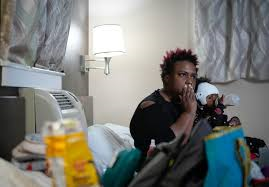
Today, the Jamison family — two parents and three children aged 1, 15, and in between — live packed into a single small hotel room. What once was a temporary solution has stretched into more than a year of instability. Beds are shared. Privacy is nonexistent. Homework, meals, and bedtime all happen within the same cramped space.
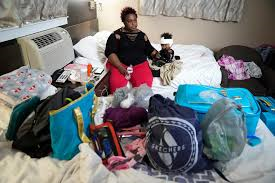
For the children, the change has been especially jarring. A teenager who once had a bedroom of their own now navigates adolescence without quiet or consistency. A toddler takes their first steps on hotel carpet. Normal childhood routines — inviting friends over, having space to play, feeling rooted — have been replaced by uncertainty.
For Johnika, the irony is painful.
As a counselor, she spent years telling families that they were not alone, that help existed, that stability could be rebuilt. Now she lives the reality she once feared for others. Despite her education, work history, and dedication, she has learned how thin the line truly is between stability and homelessness.

According to the U.S. Interagency Council on Homelessness, most Americans are just one crisis away from losing their housing. The Jamisons’ story reflects that reality with brutal clarity. It was not recklessness or neglect that brought them here — it was illness, pregnancy complications, and a system that offers little margin for error.
Their experience shatters the myth that homelessness only affects the unemployed or irresponsible. Just two years ago, Johnika Jamison was a middle-class professional with a stable income. Today, she is a mother trying to create a sense of home within four hotel walls.
Still, the family holds onto hope.
They continue searching for permanent housing, medical stability, and a way back to normal life. Each day is an act of endurance — getting the children to school, managing health challenges, and believing that this chapter will not define their future.
Their story is not unique. But it is urgent.
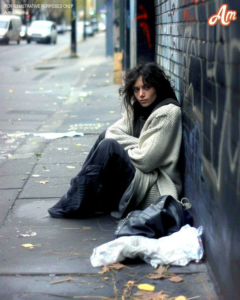
It is a reminder that homelessness in America does not always look like life on the streets — sometimes, it looks like a family of five quietly surviving in a hotel room, one crisis away from being forgotten.