The Envelope That Ended My Marriage
The Envelope That Ended My Marriage
The day my husband tried to take my daughter away from me began like any other Tuesday.
At 10:17 that morning, I was sitting at my desk in a crowded Mexico City office, correcting figures on a financial report while phones rang around me and printers hummed in the background.
Then the receptionist approached and placed a yellow envelope beside my keyboard.
There was a small note attached to it.
The handwriting was neat, controlled, and instantly familiar.
Please don’t make this more difficult than it needs to be.
There was no signature.
There didn’t need to be.
Only Ricardo could make a threat sound like a polite request.
My hands went cold before I even opened the envelope.
Inside were divorce papers.
But Ricardo wasn’t simply ending our marriage.
He was requesting full custody of our ten-year-old daughter, Emilia.
According to the documents, I was emotionally unstable, financially irresponsible, unpredictable, and incapable of providing our daughter with a safe home.
Ricardo described himself as the patient parent.
The reliable parent.
The father who prepared lunches, paid school fees, attended meetings, and never raised his voice.
On paper, he looked perfect.
That was what made him so dangerous.
Ricardo rarely shouted.
He didn’t need to.
He could destroy someone while speaking gently, adjusting his cuff links, and asking everyone around him to remain reasonable.
By the time I finished reading the petition, I could barely breathe.
He wasn’t only leaving me.
He was rewriting our entire marriage so that he looked like the victim—and I looked like a threat to my own child.
The Man Everyone Believed
Six months before Ricardo filed for divorce, money had begun disappearing from our joint account.
At first, the amounts were small enough to overlook.
Then larger transfers appeared.
Whenever I questioned him, he gave me calm, rehearsed answers.
“It’s for an investment.”
“It’s a temporary business expense.”
“You worry too much, Mariana.”
Eventually, he began accusing me of forgetting conversations we had supposedly already had.
If I asked twice, he sighed.
If I became upset, he told me I was proving his point.
There were also late nights.
Business meetings in Santa Fe.
Shirts carrying traces of perfume that wasn’t mine.
Messages deleted before I could read them.
And a strange distance in his eyes whenever Emilia entered the room.
Still, I tried to protect our daughter.
I told myself that whatever was happening belonged between two adults.
I did not want Emilia to feel forced to choose sides.
I didn’t realize Ricardo had already begun choosing for her.
The First Day in Court
The Family Court stood on Juárez Avenue, surrounded by traffic, vendors, and people hurrying toward lives that had nothing to do with mine.
I arrived wearing a gray blazer that pulled awkwardly across my shoulders.
It was the most professional thing I owned, but that morning it felt like a costume.
My lawyer, Patricia Rivas, met me outside the courtroom.
She was sharp, calm, and direct.
“Whatever he says, don’t react,” she warned me.
“What if he lies?”
“He will.”
“What if he says something about Emilia?”
“He probably will.”
My throat tightened.
Patricia placed a hand on my arm.
“You breathe. You let me speak. In court, the person who stays composed often appears more believable than the person who is hurting.”
That frightened me because Ricardo had spent years mastering composure.
He could stand in the middle of a disaster he had created and look like the only calm person in the room.
Ricardo had insisted that Emilia attend the hearing.
He told the court that she was old enough to “understand the truth.”
But when I saw my daughter sitting on a wooden bench, her feet barely reaching the floor, I knew she did not belong there.
She wore her black school shoes and a pale cardigan.
Her back was unusually straight.
Her hands rested tightly together on her knees.
Beside her was an old tablet inside a purple protective case.
I wanted to cross the room, take her into my arms, and carry her somewhere far away from lawyers, accusations, and adult cruelty.
Before I could approach her, Ricardo stepped between us.
“Please don’t upset her before the hearing,” he said quietly.
He sounded concerned.
He even gave me a sympathetic smile.
I hated him most when he smiled like that.
His Version of Our Life
When the hearing began, Ricardo’s lawyer stood and addressed the judge in a soft, almost comforting voice.
She explained that Ricardo had become Emilia’s primary caregiver.
She said I had mood swings.
She mentioned unpaid bills, unexplained debts, and emotional outbursts.
She claimed Emilia often felt anxious around me.
Each sentence felt like another stone placed on my chest.
The debts were real—but only because Ricardo had emptied our joint savings.
The arguments were real—but they usually began when I questioned missing money or asked where he had been.
The anxiety was real—but I had assumed Emilia was reacting to the tension between us.
I had never imagined that Ricardo might be feeding that fear.
Then Ricardo spoke.
“Your Honor, I don’t want to insult my wife,” he began. “She is Emilia’s mother, and I respect that. But my daughter needs stability.”
He paused as though the words were painful.
“She needs a parent who can put her needs first.”
My face burned.
I wanted to stand.
I wanted to tell the judge about the transfers, the lies, the nights Ricardo disappeared, and the way he twisted every disagreement until I questioned my own memory.
Patricia touched my wrist beneath the table.
Not yet.
Ricardo continued speaking in his careful, measured tone.
He never looked at me.
He arranged his papers neatly, as though the decision had already been made.
Then I noticed Emilia moving.
She picked up her purple tablet.
Her fingers tightened around the case.
Slowly, she raised her hand.
At first, no one noticed.
Then the judge looked toward her.
My heart stopped.
“Emilia,” I whispered. “Sweetheart, you don’t have to”
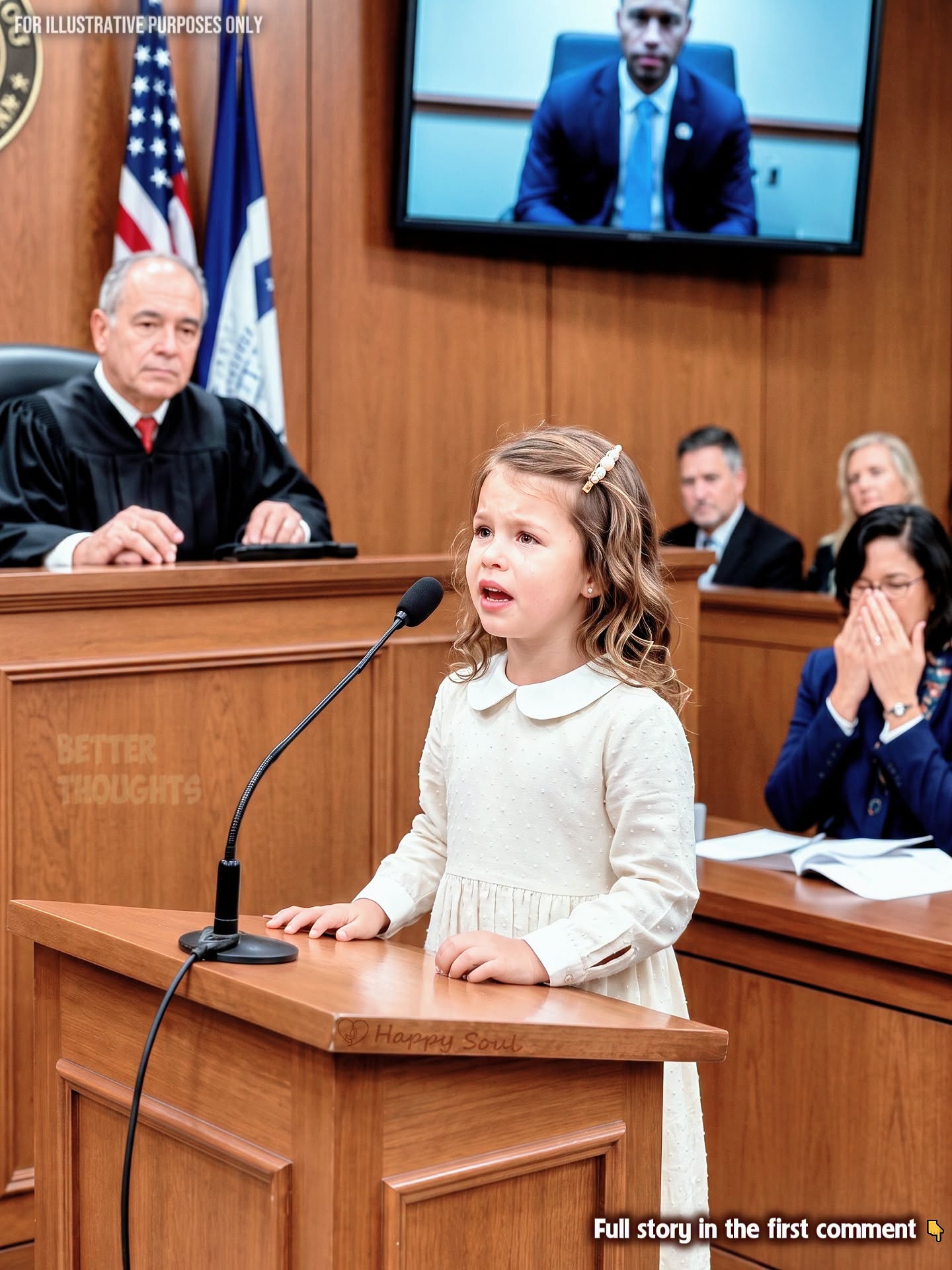
She stood.
Ricardo turned so quickly that his chair scraped against the floor.
For the first time that day, the calm expression vanished from his face.
“Sit down, Emilia,” he said.
His voice was low and sharp.
It was not the voice he used when other people were watching.
Emilia remained standing.
Her knees were trembling, but she looked directly at the judge.
“Your Honor,” she said, “may I show you something my mom has never seen?”
The entire courtroom fell silent.
The Purple Tablet
The judge removed his glasses and placed them on the desk.
“What would you like to show the court?”
Emilia held the tablet against her chest.
“A video,” she answered. “Actually… more than one.”
Ricardo rose immediately.
“This is inappropriate,” he said. “She is a child. Someone has influenced her.”
The judge’s expression hardened.
“Mr. Salgado, sit down.”
Ricardo hesitated until his own lawyer pulled gently at his sleeve.
Emilia swallowed.
“I saved everything because Dad told me not to talk,” she continued. “He said if I told Mom, she would end up alone, and it would be my fault.”
I covered my mouth.
For months, I had believed I was shielding my daughter from our problems.
All that time, she had been carrying secrets heavy enough to frighten an adult.
The judge asked the court clerk to collect the tablet.
As the clerk connected it to a monitor, Emilia showed her where to find a hidden folder buried among school applications and games.
The folder had a title.
For the Day I’m Brave Enough to Tell.
Something inside me broke.
No ten-year-old should ever need to create a folder like that.
The First Recording
The video opened with a crooked view of our dining room.
The tablet must have been leaning against something near the floor.
Ricardo stood beside the table holding a coffee cup.
He was wearing casual clothes.
There was no courtroom suit.
No pleasant smile.
No patient expression.
His real voice filled the room.
“If anyone asks tomorrow, say your mother screamed and threw things.”
Emilia’s voice came from somewhere behind the tablet.
“But Mom didn’t throw anything.”
Ricardo gave a small, irritated laugh.
“That isn’t the point. Sometimes children have to help adults understand what is happening.”
“But it didn’t happen.”
“Your mother isn’t well, Emilia.”
There was a pause.
Then he asked, “You want to live with me, don’t you?”
Emilia answered quietly.
“I want both of you to stop fighting.”
Ricardo struck the cup against the table hard enough to make her gasp.
“Then do what I’m asking.”
I looked toward him.
He was staring at the screen, his jaw clenched.
The man who had spent years telling me I was too emotional suddenly looked terrified of his own voice.
No one in the courtroom moved.
Even Ricardo’s lawyer lowered her eyes.
The Second Recording
The next file had been captured late at night.
The image was dark, but Ricardo’s voice was clear.
He was speaking on the phone in our living room, believing Emilia was asleep.
“I transferred another one hundred and eighty thousand,” he said. “Mariana hasn’t noticed.”
My stomach turned.
He laughed softly.
“When the hearing starts, we’ll show that she can’t manage money.”
A woman’s voice answered faintly through the phone.
Ricardo continued.
“Be patient, love. Once I have custody, I’ll sell the apartment. Then we can move to Querétaro and start over before the baby arrives.”
There it was.
The truth I had suspected but never been able to prove.
The missing money.
The perfume.
The late-night meetings.
The other woman.
The baby.
I closed my eyes, not because I was surprised, but because hearing betrayal spoken aloud gave it a new kind of weight.
It now had a voice.
A date.
A time.
A plan.
Patricia began writing rapidly.
Ricardo pushed back his chair.
“That conversation is being misunderstood.”
The judge did not look at him.
“We are not finished.”
What He Told Our Daughter
The next file was a screenshot of messages between Ricardo and his sister, Tania.
Ricardo had written:
I need Emilia to tell the social worker that Mariana frightens her.
Tania replied:
What happens if she refuses?
Ricardo’s answer appeared beneath it.
I’ll tell her Mariana could be taken away. Fear will make her cooperate.
I stood without realizing it.
My chair nearly fell behind me.
“You told her that?” I asked.
My voice sounded unfamiliar.
Ricardo finally turned toward me.
He didn’t apologize.
He didn’t deny it.
Instead, he said, “You have no idea what I’ve done to protect my daughter.”
Emilia looked at him.
Her face was pale, but her eyes no longer held the same fear.
“You weren’t protecting me, Dad,” she said. “You were using me to make Mom lose.”
Those words changed the entire room.
A lawyer had not spoken them.
An angry wife had not spoken them.
His own daughter had.
And for the first time, Ricardo had no prepared answer.
The Secret Called “Blue Thursday”
The judge called a recess and ordered a court psychologist to accompany Emilia.
I wanted desperately to hug her, but I was afraid any movement from me would be seen as pressure.
I stayed beside my chair.
Emilia made the choice for me.
She crossed the room, wrapped both arms around my waist, and buried her face against me.
“I’m sorry, Mom,” she whispered.
I held her as carefully as I could.
“No, sweetheart. You have nothing to be sorry for.”
“I should have told you sooner.”
“No.” Tears blurred my vision. “I’m sorry you thought you had to handle this alone.”
While Emilia spoke with the psychologist, the court reviewed the remaining files.
There were photographs of bank transfers.
Messages telling Emilia which phrases to repeat during interviews.
An audio recording in which Ricardo threatened to stop paying her school tuition if she refused to cooperate.
He also told her he would sell the piano her grandmother had given her.
Then the clerk opened a seven-minute recording labeled Blue Thursday.
The tablet had apparently been hidden inside Emilia’s backpack.
Ricardo was arguing with Octavio, his accountant.
“I can’t continue covering this,” Octavio said. “Those transfers came directly from the family account. If Mariana requests an audit, everything will come out.”
Ricardo answered with a laugh.
“She won’t request anything. She’s too busy trying not to look unstable.”
Octavio lowered his voice.
“What about Emilia?”
Ricardo’s response froze the courtroom.
“She’s my protection. As long as she doubts her mother, Mariana won’t fight too hard.”
I looked at my daughter.
Her head was lowered.
She had been forced to hear the person she trusted most describe her as insurance.
Not as a child.
Not as someone he loved.
As leverage.
That was the moment I understood the full truth.
Ricardo had not simply planned a divorce.
He had built a campaign.
He had drained our finances, damaged my reputation, frightened our daughter, and created a version of our family in which he appeared to be the only safe person left.
He was trying to erase me from Emilia’s life and he had tried to make her help him do it.
The Hearing Changed Direction
When court resumed, the judge looked different.
The tired expression was gone.
He ordered the tablet and all its contents preserved as evidence.
He requested a full financial investigation into our shared accounts.
He arranged an urgent psychological evaluation for Emilia.
And he postponed any final custody decision until the recordings, transfers, and messages could be examined properly.
Ricardo attempted one final performance.
“My daughter has clearly been influenced,” he said. “A child does not collect evidence like this without an adult directing her.”
Emilia lifted her head.
Her eyes were swollen from crying, but her voice remained steady.
“I saved it because you taught me that grown-ups can lie while looking honest.”
Ricardo went silent.
There are truths that do not need to be shouted.
They simply enter a room and leave nowhere for a lie to hide.
The Case He Never Expected
Over the following weeks, the language in the court documents changed.
I was no longer described only as an unstable mother.
Now the case included allegations of emotional manipulation, coercion of a child, concealment of marital assets, and possible financial fraud.
Temporary custody was granted to me.
Ricardo was allowed to see Emilia only through supervised visits.
The hidden accounts were frozen.
An independent accountant began tracing the missing money.
The divorce petition Ricardo had designed to destroy me became the beginning of an investigation into him.
People later told me I must have felt victorious.
I didn’t.
There was no victory in learning that my ten-year-old daughter had been recording conversations because she believed nobody would trust her words.
There was no triumph in hearing that she had gone to sleep afraid that one parent might disappear if she said the wrong thing.
Justice did not feel like applause.
It felt like grief mixed with relief.
It felt like finally being believed after months of being quietly dismantled.
Our Smaller Home
Emilia and I moved into a modest apartment in Del Valle.
It was much smaller than our old home in Narvarte.
I could no longer afford the rent there, and most of our savings remained tied up in the investigation.
Our new apartment had narrow windows, an unreliable water heater, and a kitchen so small that opening the oven blocked one of the cabinets.
But it was peaceful.
There were no whispered phone calls at midnight.
No sudden accusations.
No feeling that every mistake might later be used as evidence against me.
One afternoon, I stood at the stove stirring soup while Emilia worked on long division at the table.
Her school uniform was hanging over the back of a chair.
She was decorating a plastic bracelet with tiny star-shaped beads.
The purple tablet sat beside her.
For months, that device had been her shield, her witness, and her burden.
I looked at it and felt my chest tighten.
“Do you need to save anything today?” I asked gently.
Emilia looked confused.
“Save what?”
“Anything you heard. Anything that happened.”
She studied my face for a moment.
Then she shook her head.
“I don’t think I have to watch everything anymore.”
I gripped the counter to steady myself.
That sentence meant more to me than any court order.
My daughter was beginning to feel like a child again.
Frijol Arrived
That evening, we ate soup with lime, watched an old cartoon, and argued for five minutes because Emilia wanted a dog.
I told her we could barely afford groceries, much less pet food and veterinary bills.
She crossed her arms.
“A small dog doesn’t eat much.”
“A small dog still needs money.”
“What about a very, very small dog?”
“No.”
Two days later, a muddy mixed-breed puppy appeared near the entrance of our building.
He had oversized ears, uneven paws, and the saddest brown eyes I had ever seen.
Emilia crouched beside him.
“He followed me upstairs,” she said.
I looked at the dog.
Then at my daughter.
“This is temporary.”
“Of course.”
“We are finding him another home.”
“Definitely.”
She named him Frijol before we reached the elevator.
Frijol never left.
Soon the purple tablet was being used for homework again.
Emilia watched silly animal videos, called her grandmother, and filmed Frijol chasing his own tail.
She did not delete the hidden folder.
Instead, she moved it to the last screen behind a drawing app.
“I don’t want to look at it,” she explained. “But I don’t want to act like none of it happened.”
I understood.
Healing does not always mean forgetting.
Sometimes it means remembering without allowing the memory to control every decision you make.
The Last Time He Tried
Ricardo called repeatedly.
At first, he cried.
Then he became angry.
Later, when anger failed, his voice became soft again.
The familiar voice.
The one that made cruelty sound reasonable.
During one call, Emilia agreed to speak with him.
“Emi,” he said, “Dad made mistakes. But your mother is putting ideas into your head.”
In the past, Emilia would have reached for the tablet.
She would have tried to preserve every word.
That day, she did not record him.
She took one slow breath, looked at me, and held out the phone.
“I don’t want to carry adult conversations anymore.”
I accepted the phone.
My hands were steady.
“Ricardo, anything concerning the case can be discussed through our lawyers.”
“Mariana, don’t be dramatic. I’m trying to speak to my daughter.”
“You are asking her to manage your guilt. She is ten years old.”
“You always twist everything.”
“No. I’m simply not arguing with you anymore.”
Then I ended the call.
Emilia returned to her bracelet.
Frijol slept under the table.
And for the first time in years, the world inside our home felt like it had returned to its proper size.
What Winning Really Meant
People said I won custody.
They said Emilia saved me.
They said Ricardo finally received what he deserved.
But I never thought of it that way.
No mother truly wins when her daughter has to become evidence before adults will listen.
No child should have to record threats, save screenshots, or hide files behind homework applications.
The real victory came later.
It was the first night Emilia slept without waking to check whether I was still there.
It was the afternoon she forgot where she had left the tablet.
It was hearing her laugh so loudly at Frijol that the neighbor downstairs knocked on the ceiling.
It was watching her complain about homework, ask for extra dessert, and spend twenty minutes choosing beads for a bracelet.
Ordinary moments became miracles.
Ricardo had always told me not to complicate things.
He said it when I questioned the missing money.
He said it when I asked about the other woman.
He wrote it on the note attached to the divorce papers.
But the truth did not complicate anything.
The truth untangled what he had twisted.
It returned stolen money to the investigation.
It returned my voice to the courtroom.
Most importantly, it returned my daughter to herself.
And that truth did not arrive wearing a suit or carrying a briefcase.
It arrived in black school shoes.
It held a purple tablet against its chest.
And in a trembling voice stronger than every adult lie in the room, my ten-year-old daughter raised her hand and said:
“Your Honor, I have something my mom has never seen.”