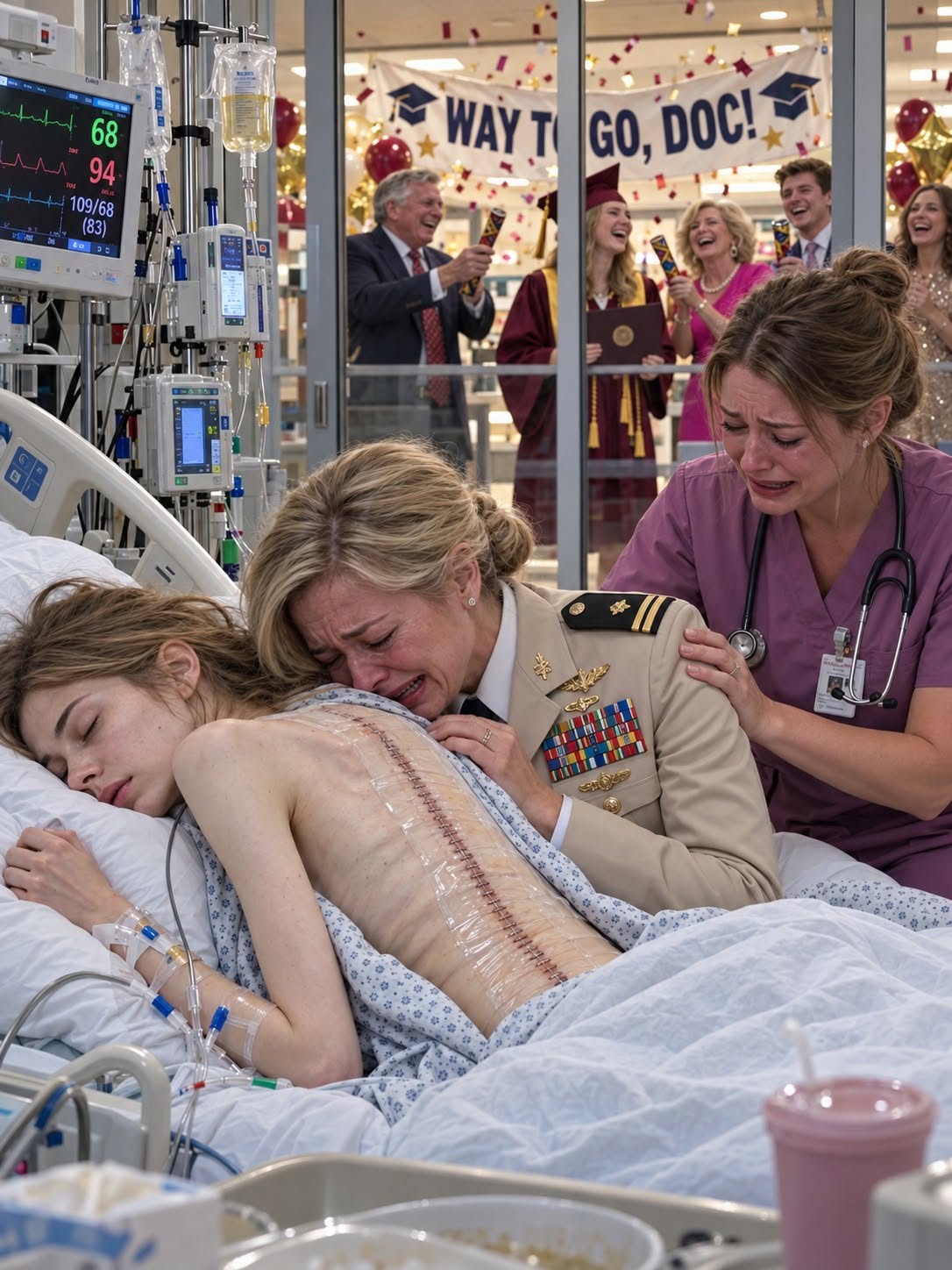
FULL STORY: While my eight-year-old daughter was undergoing spinal surgery, my sister called just to gloat. “Guess what? Mom and Dad chose my PhD graduation party over your useless child.” Minutes later, my mother called with an order: “We’re short-staffed at the party. Get over here and help!” They expected me to walk away from my daughter during the most critical moment of her life. That was when I finally made a decision I’d been putting off for years.
While my eight-year-old daughter was undergoing spinal surgery, my sister called just to gloat.
“Guess what?
Mom and Dad chose my PhD graduation party over your useless child.”
Minutes later, my mother called with an order: “We’re short-staffed at the party.
Get over here and help!”
They expected me to walk away from my daughter during the most critical moment of her life.
That was when I finally made a decision I’d been putting off for years.
A harsh crimson light burned above the double steel doors of OR-3, looking like a terrifying countdown.
On the other side, pediatric neurosurgeons were racing to relieve the pressure on my eight-year-old daughter Maya’s shattered spine.
A commercial truck had crushed our car on the interstate, leaving her with three fractured vertebrae.
Just a few millimeters could determine whether she survived, spent the rest of her life paralyzed, or died.
I sank onto the cold hospital corridor floor, my hands shaking as I tried calling my parents for the twelfth time.
Once again, nobody answered.
At exactly 7:15 PM, my phone lit up with a FaceTime call from Chloe, my younger sister and the golden child who had never been capable of doing anything wrong in our family’s eyes.
Desperate for help, I answered immediately.
But instead of a concerned face, I saw the shimmering golden glow of crystal chandeliers inside the most exclusive country club in the city.
Chloe stood there wearing a custom emerald gown, a glass of vintage champagne in her hand and a smug smile on her face.
Behind her, thirty wealthy relatives celebrated her newly earned PhD at a six-figure party, laughing, eating, and raising their glasses.
“Enough with your tragic opera, Elena,” Chloe snapped, her voice thick with contempt.
“Mom and Dad chose my celebration over your defective kid.
Nobody here gives a damn about your drama.
And don’t even think about posting some pathetic sympathy-bait nonsense that ruins my aesthetic tonight.”
Then she hung up without warning.
The silence of the ICU corridor seemed to close around me, suffocating and merciless.
I hadn’t even begun to absorb what my sister had said when my mother’s name flashed across my screen.
She didn’t ask whether Maya had made it through surgery.
She didn’t ask if her eight-year-old granddaughter was even alive.
Instead, her piercing voice burst through the phone.
“Elena!
Two of the catering waitresses canceled at the last minute!
The university provost’s table is covered in dirty dishes and empty glasses!
Get in your car right now, come through the kitchen loading dock, put on an apron, and start clearing tables for Chloe’s guests!”
“Mom…”
I whispered, my voice hollow and strained.
“Maya is lying on a neurosurgical table with her spine opened up.
She might never be able to walk again…”
“Sitting around in some plastic chair isn’t going to change what the doctors can do!”
my mother yelled, showing no sympathy whatsoever.
“You’ve got twenty minutes to get to the scullery!
If those dishes aren’t cleared before they serve the main course, you’re finished with this family!
By Monday morning, I’ll make sure everyone knows I’ve disowned you!”
Click.
The call ended.
And with it, the last invisible thread connecting me to the family I’d spent my entire life trying to please finally snapped.
My relatives genuinely believed I was a barely employed, low-level disappointment earning around thirty-five thousand dollars annually from data transcription work.
What they didn’t know was that my supposed “freelance data work” was actually a forty-million-dollar medical logistics software empire serving four hundred hospital systems.
And the biggest secret?
They had no idea that their expensive cars, exclusive country club memberships, and even the extravagant graduation gala they were enjoying were all funded through my personal bank accounts.
My tears dried up, replaced by a cold, unforgiving calm.
I opened my canvas bag, took out my military-grade encrypted titanium laptop, and settled it across my knees outside the operating room.
My fingers moved across the keyboard with a steadiness that surprised even me.
For nearly fifteen years, I had built my company around one principle: when a hospital faced a crisis, every second mattered.
Our systems tracked emergency medical supplies, coordinated operating room equipment, and ensured critical resources arrived exactly where they were needed.
I had spent my professional life preventing other people’s emergencies from becoming tragedies.
Yet when my own daughter needed help, the people who called themselves my family had decided that dirty champagne glasses were more important than her life.
I opened the encrypted financial dashboard and entered my authorization code.
The screen displayed dozens of accounts, corporate investments, recurring transfers, and private expenditures.
At the top was the account I had created seven years earlier.
HAYES FAMILY SUPPORT TRUST — PRIVATE DISBURSEMENTS.
I stared at those words.
What an innocent name for something that had quietly consumed so much of my life.
Every month, thousands of dollars flowed from my personal funds into the comfortable existence my parents and sister enjoyed.
Mortgage payments.
Vehicle leases.
Insurance premiums.
Country club dues.
Household expenses.
All of it carefully disguised as income from investments my family believed my late grandfather had established.
In reality, those investments had never existed.
I was the money.
And tonight, I was finished pretending otherwise.
I selected the recurring transfers and initiated cancellation requests for every payment that hadn’t already been processed.
Then I opened the country club’s billing agreement.
The graduation celebration was being charged to a private account under my name.
The event itself had already begun, and I knew I would remain responsible for legitimate charges incurred under the agreement.
I wasn’t interested in cheating the staff, the vendors, or anyone who had worked to make the evening possible.
But I could make certain my family never used that account again.
I sent an authenticated instruction to the club’s billing office terminating all future authorization for my parents and Chloe to charge expenses to my account.
I requested an immediate accounting of outstanding charges and confirmation that no additional purchases could be authorized without my direct approval.
Then I forwarded the entire financial arrangement to my attorney, Rebecca Stanton.
It was 7:28 PM.
Rebecca answered my encrypted call on the second ring.
“Elena?
What’s wrong?”
For a moment, I couldn’t speak.
Rebecca had been my legal counsel for nine years.
She knew the financial arrangements, the elaborate secrecy, and the extraordinary lengths I’d gone to so my family could maintain their illusion of superiority.
But she had never heard my voice like this.
“My daughter was in a car accident,” I finally said.
“She’s in emergency spinal surgery.”
“Oh, God.
Elena, is she—” “We don’t know yet.”
Rebecca became silent.
Then her voice softened.
“What do you need?”
“I need you to dismantle the arrangements we created for my parents and Chloe.
Every voluntary payment.
Every personal guarantee we can legally terminate.
Every future benefit I’ve been providing.”
“All of them?”
“All of them.”
She hesitated.
“Did something happen?”
I told her about Chloe’s FaceTime call.
I repeated my mother’s demand that I abandon the hospital and clear tables at the graduation party.
When I finished, Rebecca didn’t respond immediately.
Finally, she said, “I’ll start tonight.
Some obligations will require formal notice, and anything legally binding will have to be handled properly.
But we can stop the discretionary transfers now.”
“Good.”
“Elena, there’s something else.”
“What?”
“Your parents have become more dependent on your support than you realize.
Your father’s business has been operating at a loss for almost three years.
Your mother has been using the household allowance to cover expenses that should have been paid by his company.”
My stomach tightened.
“How much?”
“Enough that removing your support will force them to make serious decisions.”
I closed my eyes.
There was a time when that knowledge would have terrified me.
I would have reached for my checkbook, swallowed another insult, and quietly rescued them.
Not tonight.
“Then they’ll finally have to make those decisions themselves.”
Rebecca exhaled.
“I’ll prepare everything.”
“One more thing.
I want a full audit.
Every dollar they’ve received, every account they’ve been authorized to use, and every financial obligation attached to my name.”
“Understood.”
When I ended the call, I looked at the double operating room doors.
The red light still burned.
I would have traded every dollar of my fortune to hear Maya laugh again.
A nurse approached carrying a paper cup of water.
“Ms. Hayes?”
I stood so quickly that the laptop nearly slipped from my knees.
“Is Maya okay?”
“She’s still in surgery,” the nurse said gently.
“The surgeons are working carefully.
I just wanted to check on you.”
I nodded, unable to hide my disappointment.
She offered me the water.
“Do you have anyone coming to sit with you?”
I looked down at my phone.
Twenty-seven family members had attended Chloe’s party.
Every one of them had known about the accident.
Not one had come.
“No,” I whispered.
The nurse pulled a chair closer.
“Then I’ll stay for a few minutes.”
And that was when I finally cried.
Not because of the money.
Not even because of my mother’s words.
I cried because a woman who had known me for less than ten minutes had shown more compassion than my family had managed in thirty-eight years.
At 8:04 PM, my phone began vibrating again.
Chloe.
I ignored it.
She called twice more.
Then a message appeared.
CHLOE: What did you do to the club account?
Another followed.
CHLOE: They’re telling Dad the additional champagne service needs a new payment authorization.
Fix this NOW.
I stared at the messages.
She still hadn’t asked about Maya.
I placed the phone facedown.
A minute later, my father called.
I almost let it ring out.
Then I answered.
“Elena!”
he barked.
“What kind of stunt are you pulling?”
“Hello, Dad.”
“Your mother says you’ve been causing problems with the graduation expenses.
The club manager is asking questions about payment authorization.
Your sister is humiliated.”
I glanced toward the operating room doors.
“My daughter is having emergency spinal surgery.”
A pause.
Then he said, “We know that.”
“Do you?”
“Don’t start this emotional manipulation.
Chloe has worked incredibly hard for her doctorate.
Tonight is important.”
I felt something settle permanently inside me.
“So is whether your granddaughter survives.”
“Nobody said otherwise.”
“Then why aren’t you here?”
He gave an irritated sigh.
“There’s nothing we can do at the hospital.
We’d only be sitting around.”
I remembered how many evenings I’d spent watching Maya practice walking on a balance beam at gymnastics.
How she would hold her arms out, wobble, and laugh.
How she’d shout, “Mommy, look!
I can do it!”
And now doctors were trying to preserve the nerves that allowed her legs to move.
“You’re right,” I said quietly.
“There’s nothing you can do here.”
“Good.
Then stop creating problems and sort out the club bill.”
“No.”
Silence.
“What did you say?”
“I said no.”
His voice hardened.
“Elena, don’t forget who raised you.”
“I haven’t forgotten a single thing.”
“Then show some gratitude.”
I looked down at my hands.
“Dad, have you ever wondered where your monthly investment payments actually come from?”
“What?”
“Or who pays your mortgage?
Your car leases?
Your club membership?”
“What nonsense are you talking about?”
“Ask your financial adviser.”
“Elena—” “And while you’re doing that, ask yourself why the account you’re using tonight has my name on it.”
I ended the call.
For the first time in my adult life, I hadn’t tried to convince my father that my feelings mattered.
I had simply told him the truth.
At 9:16 PM, the operating room doors finally opened.
A surgeon wearing blue scrubs stepped into the corridor.
I was on my feet before he could speak.
“Dr. Morrison?”
He removed his surgical cap.
“Maya made it through the procedure.”
My legs nearly collapsed.
“She’s alive?”
“Yes.”
I pressed my hand over my mouth.
He continued carefully.
“We stabilized the damaged vertebrae and relieved the pressure on the spinal cord.
There was significant swelling, and the injury is serious.”
“Will she walk?”
His expression became solemn.
“It’s too early to say.
We’ve preserved as much neurological function as possible, but spinal cord injuries are unpredictable.
The next several days will tell us more.”
I nodded, trying desperately to absorb every word.
“Can I see her?”
“Once she’s settled in the pediatric intensive care unit.”
“Thank you,” I whispered.
Dr. Morrison touched my shoulder.
“She’s a fighter.”
I almost smiled.
“You have no idea.”
Forty minutes later, I stood beside Maya’s hospital bed.
She looked heartbreakingly small beneath the blankets.
Her face was pale.
A breathing tube remained in place while the medical team monitored her recovery.
Machines tracked her heart rate, oxygen levels, and blood pressure.
I took her hand carefully.
The same hand I’d held on her first day of kindergarten.
The same hand that had clung to mine whenever thunder frightened her.
“I’m here, baby,” I whispered.
“Mommy’s right here.”
Her fingers didn’t move.
But the monitor continued its steady rhythm.
And for that moment, it was enough.
My phone vibrated again.
This time, it was Rebecca.
REBECCA: Initial review complete.
We need to discuss the trust documents.
There’s a significant issue.
I stepped just outside Maya’s room, remaining where I could see her through the glass.
Rebecca answered immediately.
“Elena, I found something in the authorization records.”
“What kind of something?”
“Your mother tried to increase the family trust distributions three weeks ago.”
I frowned.
“How?”
“She submitted a request to the trust administrator asking for an additional $250,000 disbursement.
She claimed it was for a family educational investment.”
“Chloe’s doctorate?”
“That’s what the documentation suggests.”
I stared at the floor.
“Did anyone approve it?”
“No.
The administrator flagged it because your mother wasn’t authorized to request additional distributions.”
A cold sensation spread through my chest.
“She knew she wasn’t authorized?”
“She was informed of that limitation in writing.
But apparently she believed her long-standing access meant she could request more.”
“Did she know the money was mine?”
“There’s no indication she knew the source.
But she clearly believed she had control over the distributions.”
Rebecca paused.
“Elena, there’s more.
The graduation event’s original estimate was approximately $86,000.
The projected total, including upgrades and additional services, is now over $110,000.”
I stared at Maya through the glass.
“One hundred and ten thousand dollars.”
“Yes.”
My daughter had been frightened of spending fourteen dollars on a stuffed rabbit at a pharmacy last month because she’d thought it was too expensive.
My sister had spent more than a hundred thousand dollars celebrating herself.
With money I had earned.
“Pay the legitimate invoices,” I said.
“Directly to the vendors, after they’re verified.
No cash goes to my family.”
“Of course.”
“And Rebecca?”
“Yes?”
“I want them informed in writing that the financial support has ended.
No ambiguity.
No threats.
Just the facts.”
“I’ll arrange formal delivery.”
I returned to Maya’s bedside.
For the next several hours, I ignored my phone.
At 2:37 AM, Maya began showing signs of waking.
The nurse called the physician, and after the medical team assessed her breathing and responsiveness, they carefully removed the breathing tube.
Maya blinked slowly.
Her eyes searched the room.
“Mom?”
I leaned forward.
“I’m here, sweetheart.”
Her lips trembled.
“Did we crash?”
“Yes, baby.
But you’re safe now.”
She looked frightened.
“My back hurts.”
“I know.
The doctors fixed what they could, and they’re taking care of you.”
Tears formed in her eyes.
“Can I go home?”
I kissed her forehead.
“Not yet.
We need to let your body heal.”
She was quiet for a moment.
Then she whispered the question I’d been dreading.
“Can I still dance?”
Maya loved dancing.
She danced while brushing her teeth, while helping me fold laundry, while waiting for pancakes to cook.
Sometimes she’d dance for no reason other than hearing a song in her head.
I swallowed hard.
“We’re going to work with the doctors and therapists, sweetheart.
We don’t know everything yet.”
Her eyes filled.
“What if I can’t?”
I held her hand.
“Then we’ll learn what your body can do, one day at a time.
And whatever happens, you won’t face it alone.”
She looked toward the empty chair beside my bed.
“Where’s Grandma?”
The question struck harder than anything my mother had said.
I could have lied.
I could have told her Grandma was busy or had been delayed.
But I’d spent too much of my life teaching Maya to make excuses for people who didn’t deserve them.
“Grandma isn’t here tonight,” I said.
“Why?”
“She made a different choice.”
Maya stared at me.
Then she squeezed my finger, just slightly.
“You’re here.”
I leaned down and kissed her hair.
“Always.”
Three days later, my family received the first letters.
By then, Maya’s medical team had begun cautious neurological assessments.
She had regained some sensation in both legs, though movement remained limited and inconsistent.
The doctors were encouraged by certain responses but careful not to promise an outcome.
I celebrated every tiny improvement as if it were a national holiday.
A twitch of her toes.
The ability to recognize a gentle touch.
A morning when she managed to smile despite the pain.
While Maya fought through those exhausting days, Rebecca coordinated the legal and financial separation I’d requested.
My parents’ discretionary monthly allowance was terminated.
Future vehicle lease payments would no longer be funded by me beyond obligations I was legally required to honor.
Their country club membership would be their own responsibility when the current paid period expired.
My sister’s luxury apartment subsidy ended with the notice required by our agreement.
The automatic payments supporting my father’s business were canceled.
And every financial institution involved received updated authorization instructions.
Nothing was seized.
No accounts were hacked.
No property was taken away unlawfully.
I simply stopped paying for a lifestyle that had never been mine to maintain.
The consequences began almost immediately.
My mother’s first voicemail arrived Thursday afternoon.
“Elena, there seems to be some ridiculous misunderstanding.
Our financial adviser says the next distribution has been canceled.
Call me immediately.”
The second came twenty minutes later.
“Your father is furious.
You have no right to interfere with our investments.”
The third was from Chloe.
“Are you seriously doing this because of what I said at the party?
Grow up.
You can’t punish an entire family just because you’re sensitive.”
I saved every message.
By Friday evening, their tone had changed.
My father demanded to know why his company’s emergency funding agreement had been terminated.
My mother wanted an explanation for the financial documents Rebecca had delivered.
Chloe wanted her apartment payments restored.
None of them asked how Maya was recovering.
On Saturday morning, my father appeared at the hospital.
I was sitting beside Maya, reading her favorite book, when a nurse stepped into the room.
“Ms. Hayes?
There’s a man downstairs claiming to be your father.
He’s demanding to speak with you.”
My body stiffened.
Maya looked up.
“Grandpa?”
I forced my expression to remain calm.
“Just a minute, sweetheart.”
I asked the nurse to remain with Maya, then went downstairs.
My father stood near the reception desk wearing an expensive charcoal suit and the gold watch I’d given him for his sixtieth birthday.
He looked furious.
“There you are.”
I stopped several feet away.
“Why are you here?”
He glanced around the lobby.
“Not here.
We need privacy.”
“Then say what you need to say quietly.”
His jaw tightened.
“Your lawyer sent us a mountain of paperwork.
She claims you’ve been funding our accounts for years.”
“That’s correct.”
“She says you control the trust distributions.”
“I do.”
“And she says you’re the sole owner of some medical technology company.”
“That’s also correct.”
He stared at me.
For several seconds, he seemed incapable of speaking.
Then he gave a disbelieving laugh.
“You’re telling me you’ve been sitting on forty million dollars while letting us believe you were doing clerical work?”
“I built a company worth approximately forty million dollars.
That doesn’t mean I have forty million dollars sitting in a checking account.”
“Don’t lecture me!”
Several people turned toward us.
He lowered his voice.
“Why didn’t you tell us?”
I studied his face.
“Because whenever I tried to tell you about my work, you said it wasn’t important.”
“That’s not an excuse.”
“When I launched my first software product, you called it a hobby.
When I signed my first hospital contract, you said I should find a real job.
When I hired employees, Mom told everyone I was doing data entry.”
He looked away.
“I thought that was what you did.”
“Because you never asked.”
He rubbed his forehead.
“And all this time, you were the one sending us money.”
“Yes.”
His expression changed.
I knew that look.
For most of my life, it had preceded a request.
“Elena, then you understand that we have expenses.
Commitments.
Your mother’s social obligations.
My business can’t simply absorb this kind of disruption.”
I waited.
He stepped closer.
“You’re wealthy enough to help.”
“I have been helping for years.”
“Then why stop now?”
I felt my voice begin to shake, but I didn’t look away.
“Because your granddaughter was fighting for her life, and you chose a party.”
His face tightened.
“That again?”
“Yes.
That again.”
“You’re acting as though we caused the accident.”
“No.
You didn’t cause the accident.”
I stepped toward him.
“But you made it very clear that when Maya needed her grandparents, celebrating Chloe mattered more.”
He looked uncomfortable.
“Your mother was upset.
People say things.”
“She told me to leave my daughter in surgery so I could wash dishes.”
“She didn’t mean it like that.”
“Then what exactly did she mean?”
He had no answer.
I pointed toward the elevators.
“Maya is upstairs learning how to move her legs again.
The doctors still don’t know what her recovery will look like.
And you haven’t once asked me how she’s doing.”
He opened his mouth.
Closed it.
Then said, “Well, how is she?”
The question came so late that it hurt more than his silence.
“She’s alive,” I answered.
“And that’s all you need to know today.”
I turned to leave.
“Elena!”
I stopped.
“If you cut us off, your father’s business could go under.”
I looked back.
“Then I suggest you speak with your accountant.”
He stared at me as though I were a stranger.
Perhaps, for the first time, he was actually seeing me.
Over the following weeks, the truth spread through my family.
It didn’t happen through a dramatic announcement or a public confrontation.
It happened through bank statements.
Through rejected requests for additional trust money.
Through conversations with attorneys and financial advisers.
Through the realization that the daughter they’d mocked as unsuccessful had quietly been supporting nearly everything they valued.
My mother’s social circle learned that the family’s wealth was not what she’d claimed.
My father began meeting with lenders and business advisers to restructure his company’s debts.
Chloe discovered that a doctoral degree, however impressive, did not automatically provide enough income to maintain the luxury apartment, leased sports car, and extravagant spending habits she’d grown accustomed to.
At first, she reacted with outrage.
Then came bargaining.
CHLOE: Fine.
I shouldn’t have said what I said.
Happy now?
I didn’t respond.
CHLOE: You’re seriously going to destroy my life over one joke?
Still nothing.
CHLOE: Mom says you’re mentally unstable from the accident.
We should probably talk to someone about your finances.
That message went directly to Rebecca.
Two days later, Rebecca sent a formal response explaining that my financial affairs were independently managed, that I retained full legal capacity, and that any false allegations used to interfere with my business would be addressed appropriately.
Chloe stopped making that particular threat.
But the most important change in my life had nothing to do with them.
It happened on a rainy Tuesday morning, six weeks after the accident.
Maya was sitting in a rehabilitation chair, her hair tied back with a purple ribbon.
A physical therapist named Sarah knelt in front of her.
“Okay, Maya.
Let’s try lifting your right foot.”
Maya concentrated.
Her little face tightened.
Nothing happened.
She tried again.
Her eyes filled with frustration.
“I can’t.”
Sarah smiled gently.
“Your muscles and nerves are healing.
We’re practicing, remember?
You don’t have to get it right every time.”
Maya looked at me.
“Mommy, I want to walk.”
I knelt beside her.
“I know, baby.”
“What if I never can?”
I took both her hands.
“Then we’ll find every possible way for you to get wherever you want to go.
But right now, we’re going to keep working.”
She looked down.
Then she tried again.
For a moment, nothing happened.
And then— Her toes moved.
Just a little.
A small, unmistakable movement.
Sarah leaned forward.
“Wait.
Maya, do that again.”
Maya stared at her foot.
Her toes moved a second time.
Sarah’s face lit up.
“That’s it!
Excellent work!”
Maya looked at me.
“Mommy?”
I couldn’t speak.
“Did you see?”
I laughed through my tears.
“I saw, sweetheart.”
She began crying, too.
Not because she was frightened.
Because for the first time since the accident, she had made her foot move on purpose.
The rehabilitation team documented the improvement and reminded us that spinal cord recovery remained uncertain.
But that morning, we had something tangible to hold onto.
Hope.
Three months after the accident, I received an unexpected letter.
Not from my mother.
Not from Chloe.
From my father.
It arrived at my company’s headquarters in a plain white envelope.
Inside were two handwritten pages.
He told me he’d sold his luxury vehicle and begun restructuring the business.
He’d accepted that the company could no longer operate on money someone else provided without question.
Then he wrote something that made me stop reading.
I spent so much time telling people how proud I was of Chloe that I never noticed how often I made you feel ashamed of yourself.
I read that sentence twice.
He continued.
When Maya was hurt, I told myself there was nothing useful I could do at the hospital.
That was an excuse.
I didn’t want to miss the party.
I didn’t want to disappoint your mother.
So I disappointed my granddaughter instead.
For the first time, he didn’t blame me.
He didn’t demand anything.
He didn’t ask me to restore the payments.
At the bottom, he wrote: I know I haven’t earned forgiveness.
I would like to know how Maya is doing, if you’re willing to tell me.
I won’t come unless you invite me.
I folded the letter carefully.
Then I placed it in my desk drawer.
I wasn’t ready to answer.
But I didn’t throw it away.
A week later, Chloe tried a different approach.
She came to my office without an appointment.
My assistant called to tell me she was downstairs.
“She’s insisting she’s your sister,” my assistant said.
“She is.”
“Would you like me to send her up?”
I looked at the stack of rehabilitation reports on my desk.
“Give me five minutes.”
When Chloe entered, she barely resembled the woman who’d called me from the graduation celebration.
Her expensive clothes were still immaculate, but her expression was strained.
She sat across from me.
For several seconds, neither of us spoke.
Then she glanced around the office.
“This is really yours?”
“Yes.”
She shook her head.
“Forty million dollars.”
I didn’t correct her understanding of the company’s valuation.
She sighed.
“You could have told us.”
“You could have asked what I did for a living.”
Her eyes narrowed.
“Are we seriously going to do this?”
“Why are you here, Chloe?”
She hesitated.
“Mom’s struggling.
Dad’s business is a mess.
My apartment lease is ending, and I can’t afford to renew it.”
I waited.
“I was hoping we could work something out.”
“What kind of arrangement?”
She leaned forward.
“You’re not using all that money.
You could help us get back on our feet.”
I looked at my younger sister.
For thirty years, I’d watched her receive praise for achievements while mine were dismissed.
I’d attended her graduations, bought her gifts, paid for her vacations, and quietly helped her pursue her education.
Even after everything that had happened, she still believed my primary responsibility was to make her life comfortable.
“Chloe, do you remember what you said about Maya?”
Her expression tightened.
“Elena, I was drinking.”
“You called my daughter defective.”
“I was upset that you were trying to make the night about yourself.”
“My daughter was in surgery.”
She looked away.
“I know.”
“You said no one cared about her.”
“I didn’t mean it literally.”
I leaned forward.
“Then tell me what you meant.”
She said nothing.
“You didn’t call afterward.
You didn’t ask whether she survived.
You only contacted me when the money stopped.”
Her eyes filled with angry tears.
“Do you enjoy humiliating me?”
“No.”
“Then what do you want?”
I sat back.
“I wanted my sister.”
She blinked.
“Not someone impressed by my money.
Not someone afraid of losing her apartment.
I wanted the person I grew up with to care that my little girl might never walk again.”
For the first time, Chloe seemed to have no prepared answer.
She lowered her eyes.
“I don’t know what you want me to say.”
“Something true.”
A long silence followed.
Finally, she whispered, “I was jealous of you.”
I stared at her.
She rubbed her hands together.
“You always acted like you didn’t care what Mom and Dad thought.
You went away, built your own life, and never needed them.
I spent years doing everything they wanted because I was terrified they’d stop being proud of me.”
I felt an unexpected ache in my chest.
“You think I didn’t need them?”
She looked up.
“I don’t know.”
“I needed them every time they told me I wasn’t enough.
Every time they treated Maya like she mattered less than your latest accomplishment.
Every time I sent money because I thought maybe helping them would finally make them love me.”
Chloe began crying.
“I’m sorry.”
I watched her carefully.
“Are you sorry about what you said?
Or sorry you lost the money?”
She covered her face.
“I don’t know,” she admitted.
It was the first completely honest thing she’d said to me in years.
And strangely, that honesty mattered more than another polished apology would have.
“Then figure it out,” I said.
She lowered her hands.
“Will you help me?”
“I’ll help you find a financial adviser.
I’ll help you make a realistic budget.
But I won’t finance your lifestyle anymore.”
She nodded slowly.
“And Maya?”
My throat tightened.
“She’s working hard.”
“Can I see her?”
“Not yet.”
Chloe wiped her eyes.
“Okay.”
For once, she didn’t argue.
After she left, I sat alone for a long time.
I didn’t feel victorious.
I felt exhausted.
But beneath that exhaustion was something unfamiliar.
Relief.
Five months after the crash, Maya reached another milestone.
With support from a rehabilitation therapist, specialized braces, and parallel bars, she managed to bear some weight through her legs.
Her first attempt lasted only a few seconds.
The second lasted longer.
Over the following weeks, she practiced standing, shifting her weight, and taking assisted steps.
Her recovery was uneven.
There were difficult days when pain and fatigue made her cry.
There were mornings when she could do less than she’d managed the previous afternoon.
Sometimes she threw her therapy pillow across the room and declared that she hated hospitals.
I didn’t blame her.
I hated seeing her suffer.
But I stayed beside her through every frustrating session.
One afternoon, she looked up at me from her wheelchair.
“Mommy?”
“Yes, sweetheart?”
“Can we have a party when I walk again?”
I smiled.
“Absolutely.”
She thought about it.
“Can we have cupcakes?”
“All the cupcakes you want.”
“And balloons?”
“Of course.”
She grinned.
“Not the fancy kind Grandma likes.
The ones with puppies.”
I laughed.
“Puppy balloons it is.”
She became serious.
“And can we invite Sarah and the nurses?”
I brushed a strand of hair from her forehead.
“They’d love that.”
She nodded with satisfaction.
Then she said something that stayed with me.
“I want to invite the people who helped me.”
Not the people with important titles.
Not the people who wore expensive clothes.
Not the people who expected admiration.
The people who had shown up.
Six months after the accident, Maya came home.
She still needed a wheelchair for longer distances, and walking required assistance and careful supervision.
Her doctors expected rehabilitation to continue for a long time, and nobody could predict her eventual level of mobility.
But she was home.
I had already arranged the modifications she needed.
A ramp replaced the front steps.
The bathroom had accessible fixtures.
Her bedroom had been rearranged so she could move safely.
And on the wall above her bed, I’d hung a framed photograph taken during physical therapy.
In the picture, Maya stood between two parallel bars, supported by braces, with the biggest smile I’d ever seen.
Underneath, a small plaque read: ONE STEP AT A TIME.
That evening, as we settled into our living room, someone knocked on the front door.
It was my father.
He stood on the porch holding a small gift bag.
His hair looked grayer than I remembered.
He seemed nervous.
“Elena.”
I stepped outside and closed the door behind me.
“Dad.”
He glanced toward the house.
“I heard Maya came home.”
“She did.”
“I’m glad.”
We stood in an uncomfortable silence.
Then he held out the bag.
“I brought her something.”
I looked inside.
A small stuffed rabbit.
Nothing expensive.
Nothing extravagant.
Just a soft brown rabbit wearing a purple ribbon.
“Her old one was damaged in the crash,” he said.
“I remembered she liked rabbits.”
I stared at him.
He had remembered.
“I didn’t come to ask for anything,” he added quickly.
“I just wanted to leave that.”
I looked at his face.
“How’s the business?”
He sighed.
“Smaller.
We had to sell one of the warehouses.
But we’re managing.”
“And Mom?”
“She’s angry.”
“At me?”
“At a lot of things.”
He looked down.
“Mostly at the fact that things have changed.”
I nodded.
Then he surprised me.
“She still thinks you should apologize.”
“For what?”
“For embarrassing the family.”
I almost laughed.
“And you?”
He looked me straight in the eyes.
“I think I owe you an apology.”
I didn’t answer.
He swallowed.
“Not just for that night.
For years of making you feel like you didn’t matter.”
The words were quiet.
No audience.
No expensive venue.
No dramatic performance.
Just my father standing on my porch, finally acknowledging what he’d done.
“I don’t expect you to forgive me,” he said.
“I wanted you to know I’m trying to understand.”
I looked at the stuffed rabbit.
Then back at him.
“That’s a start.”
He nodded.
“Would you tell Maya I love her?”
I hesitated.
“She needs people who show her that, Dad.”
His eyes reddened.
“I know.”
When he left, I carried the rabbit inside.
Maya was watching a cartoon.
“Who was it?”
“Grandpa.”
She sat up.
“Grandpa came?”
“Yes.”
I showed her the rabbit.
Her face brightened.
“That’s like Mr. Hops!”
I smiled.
“He remembered you liked rabbits.”
She hugged it carefully.
“Can I call him?”
The question caught me off guard.
I sat beside her.
“Would you like to?”
She nodded.
“I want to tell him I stood up today.”
I held her close.
“Then we can call him.”
That night, I allowed a brief video call.
My father cried when Maya excitedly described her therapy exercises.
She showed him her rabbit.
He listened.
He asked questions.
For once, he didn’t mention Chloe.
He didn’t mention money.
He didn’t talk about himself.
He simply listened to his granddaughter.
I didn’t mistake one phone call for a repaired relationship.
But I saw the possibility of something different.
My mother, meanwhile, remained unwilling to acknowledge what had happened.
Her messages alternated between accusations and invitations that pretended nothing was wrong.
She claimed I’d overreacted.
She complained that people were asking embarrassing questions about the family’s finances.
She insisted that a daughter had obligations to her parents.
I replied once.
MOM, MAYA’S HEALTH AND SAFETY COME FIRST.
I WILL NOT DISCUSS MONEY OR RECONCILIATION UNTIL YOU CAN ACKNOWLEDGE WHAT YOU SAID AND RESPECT OUR BOUNDARIES.
She responded with a lengthy message about everything she’d sacrificed raising me.
I didn’t answer.
For the first time, silence was not something she could use to punish me.
It was a boundary I had chosen.
Nearly a year after the accident, Maya’s rehabilitation hospital invited her to participate in a small celebration honoring children who had reached meaningful recovery milestones.
It wasn’t a glamorous event.
There were no crystal chandeliers.
No champagne towers.
No wealthy guests competing for attention.
Just families, medical professionals, balloons, and children whose lives had been changed by illness or injury.
Maya wore a lavender dress and silver sneakers.
She had practiced for weeks.
With her braces, a lightweight walker, and her therapist close beside her, she planned to cross a short stretch of the rehabilitation gym.
She was nervous.
“Mommy, what if I fall?”
I knelt in front of her.
“Sarah will be right beside you.
And nobody here expects you to do anything you’re not ready for.”
“What if I can’t finish?”
“Then we’ll celebrate how far you went.”
She thought about that.
“Even if it’s one step?”
“Especially if it’s one step.”
When her name was called, the room filled with applause.
Maya moved forward slowly.
Her walker clicked against the floor.
One careful step.
Then another.
Her face tightened with concentration.
Sarah stayed close, ready to support her.
Halfway across the marked distance, Maya stopped.
For a second, I thought she was exhausted.
Then she looked toward me.
“Mom!”
I smiled through tears.
“I’m watching!”
She took another step.
Then another.
And finally, with Sarah guiding her safely, she reached the finish marker.
The room erupted.
I didn’t remember standing.
I only remembered reaching her and wrapping my arms around her.
“You did it, sweetheart!”
She laughed and cried at the same time.
“I walked, Mommy!”
“Yes, baby.
You did.”
Behind us, nurses cheered.
Physical therapists wiped their eyes.
Other parents applauded.
It wasn’t a cure.
Maya would still need rehabilitation, mobility aids, and ongoing medical care.
Her future remained uncertain in ways no mother could entirely accept.
But the girl who had once whispered that she couldn’t feel her legs had crossed that gym floor through months of work and determination.
And I had been there for every step.
Afterward, we gathered around a small table decorated with purple balloons.
There were vanilla cupcakes.
A paper banner.
And a ridiculous number of stuffed rabbits.
Maya insisted that Sarah receive the first cupcake.
I watched her laugh with the people who had helped her through the hardest year of her life.
Then my phone vibrated.
A message from Chloe.
CHLOE: Dad told me about Maya’s event.
I hope she had a wonderful day.
I know I haven’t earned a place there.
Please tell her I’m proud of her.
I read it twice.
There was no request for money.
No complaint.
No accusation.
I typed a short reply.
SHE DID.
THANK YOU.
It wasn’t forgiveness.
But it was honest.
I slipped the phone into my purse.
Maya waved me over.
“Mommy!
Come take a picture!”
I walked toward her.
Sarah stood on one side of Maya, the nurses gathered behind her, and the little girl who had fought so hard to survive stretched her arms toward me.
I joined them.
The camera flashed.
And for a brief, perfect moment, I wasn’t thinking about my company, my fortune, my parents, or the family that had made me feel unworthy for so many years.
I was simply a mother holding her daughter.
Later that night, after Maya had fallen asleep clutching her stuffed rabbit, I opened my laptop one final time.
Not to cancel another account.
Not to review another financial statement.
Not to calculate how much money I’d spent trying to purchase a love that should never have been conditional.
I opened a new document.
At the top, I typed: MAYA HAYES CHILDREN’S REHABILITATION FUND.
Over the previous months, I’d met families who were struggling to afford transportation, adaptive equipment, and rehabilitation-related expenses not fully covered by insurance.
I’d seen parents sleeping in waiting rooms because they couldn’t afford nearby hotels.
I’d watched children miss therapy appointments because their families couldn’t arrange reliable transportation.
My company had given me the resources to help.
And unlike the money I’d spent maintaining my family’s illusions, this would serve a purpose I truly believed in.
Working with Rebecca and the hospital’s charitable foundation, I began establishing a properly administered fund to support children recovering from serious injuries.
Its first commitment would help families access rehabilitation services and necessary equipment.
I saved the document.
Then I walked into Maya’s room.
She was sleeping peacefully beneath her purple blanket.
On her bedside table stood the photograph of her first assisted steps.
Beside it was the stuffed rabbit my father had brought.
I sat down and brushed her hair away from her face.
For years, I’d believed that if I worked hard enough, earned enough, gave enough, and endured enough, my parents would finally look at me with pride.
But the night of Maya’s surgery had taught me something I could no longer ignore.
The people who truly loved us didn’t require us to sacrifice our dignity to earn their attention.
They showed up.
They stayed.
They cared even when there was nothing to gain.
My mother had demanded that I abandon my daughter to serve champagne to strangers.
My sister had celebrated while Maya fought for her life.
They believed I was powerless because I had spent years allowing them to mistake kindness for weakness.
But I hadn’t needed to humiliate them.
I hadn’t needed revenge.
I had only needed to stop financing their cruelty and start protecting the life that mattered most.
Maya stirred in her sleep.
“Mommy?”
“I’m here, sweetheart.”
Her eyes remained closed.
“Don’t go.”
I leaned forward and kissed her forehead.
“I’m not going anywhere.”
And as the room grew quiet again, I realized that the greatest decision I’d made that terrible night hadn’t been canceling the money, revealing my fortune, or walking away from my family’s demands.
It had been choosing, once and for all, where my love belonged.
Right there.
Beside my daughter.
Where it had always belonged.
THE END.