They Promised to Always Be There — And They Were
In the early years of their careers, long before they became global icons, Robin Williams and Christopher Reeve formed a bond that would define both of their lives. Their friendship, which began in the 1970s, was built not on fame or ambition, but on loyalty, trust, and a deep sense of care for one another that endured through triumph and tragedy.
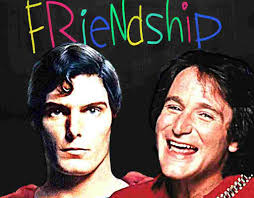
The two first met in 1972 at Juilliard School in New York City, one of the most prestigious performing arts institutions in the world. That year, Williams and Reeve stood out immediately: they were the only two students awarded the highly selective John Houseman Scholarship. Surrounded by intense competition and towering expectations, they found comfort in each other. As roommates, they became inseparable, sharing late-night conversations, creative dreams, and an unspoken understanding of what it meant to pursue art with heart.
During those early years, they made a quiet promise—to always show up for one another, no matter where life took them. It was a promise neither of them would ever break.
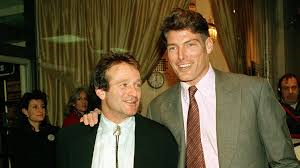
As their careers took off, the paths they walked looked very different. Christopher Reeve became the face of Superman, embodying strength, heroism, and grace on the big screen. Robin Williams rose to fame through comedy, bringing rapid-fire wit, vulnerability, and joy to audiences around the world. Despite the distance, busy schedules, and enormous pressures of Hollywood, their friendship remained constant. Fame never replaced friendship.
Robin’s trust in Christopher ran so deep that he later named him the godfather of his son, Zachary—an intimate gesture that reflected how closely their lives were intertwined beyond the spotlight.
That bond was tested in the most profound way in 1995, when Christopher Reeve was thrown from a horse during a riding competition and left paralyzed from the neck down. The accident changed everything. As Christopher lay in the hospital, facing an uncertain future, Robin arrived not just as a friend—but as a lifeline.
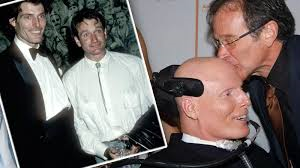
True to who he was, Robin entered Christopher’s hospital room disguised as an exaggerated Russian doctor, delivering jokes and absurd humor in an effort to break through the fear and despair. For Christopher, it was the first time since the accident that he truly laughed. He later said that in that moment, he realized he wanted to live.
But Robin’s support went far beyond humor. He quietly helped with medical expenses, stood by Christopher and his family, and became one of the most vocal advocates for spinal cord research. He used his fame to raise money, awareness, and hope—often without drawing attention to himself. His loyalty was constant, unwavering, and deeply personal.
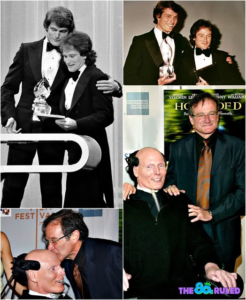
When Christopher Reeve passed away in 2004, the loss devastated Robin Williams. He spoke openly about his grief, describing it not as losing a colleague or a friend, but as losing a brother. The promise they made as young men at Juilliard had been honored in full.
Their story is not just about two famous actors. It is about showing up when it matters most. It is about using laughter as medicine, compassion as strength, and friendship as something sacred. In a world often dazzled by celebrity, the bond between Robin Williams and Christopher Reeve remains a powerful reminder that genuine loyalty and love can outlast fame—and carry people through even the darkest chapters of life.