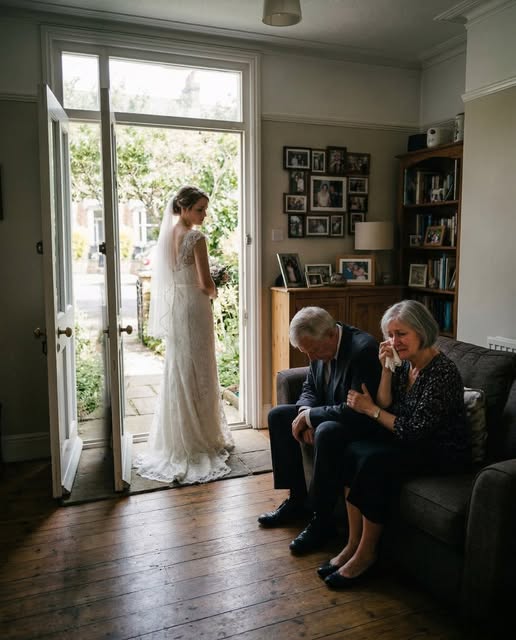
The Tragic Decision: The Reasons These Parents Had to Leave Their Daughter on Her Wedding Day
The dawn of what was intended to be the most joyous milestone of Emily’s existence arrived with a suffocating, heavy silence that permeated every corner of her childhood home. For nearly her entire life, she had played out this morning in her mind, envisioning a vibrant house overflowing with laughter, shared stories, and the unbreakable bond of family unity as she prepared to marry. Instead, as she carefully stepped into the intricate folds of her white silk gown, the atmosphere felt more like a wake than a wedding. Downstairs, her parents the two people who had served as her unwavering foundation through every trial—sat motionless in the living room, their faces etched with a profound and unspoken agony. They were trapped in a psychological cage, caught between an undying devotion to their only daughter and a brutal, devastating ultimatum that had finally reached its breaking point.

This bitter conflict had not appeared out of thin air; it had been simmering and boiling for many months, beginning the very moment Emily announced her engagement to David. To Emily, David was the personification of kindness—a supportive, gentle man who cherished her above all else and promised a bright future. However, through the eyes of her parents, he represented a dangerous bridge to a dark past they had spent thirty years trying to outrun and bury. A multi-generational family feud, stemming from a forgotten tragedy involving the previous lineage, had cast a long, suffocating shadow over their blessing. This culminated in a final, ruthless confrontation with the extended clan, where they were explicitly warned: attending the ceremony would result in their immediate and permanent exile from the community, the seizure of their family business ties, and total social erasure.

As the clock ticked closer to the scheduled hour of the ceremony, the sheer psychological weight of the decision became physically unbearable for everyone in the house. Emily’s father, a man who had always been the pillar of strength and a voice of reason, found himself unable to maintain eye contact with his daughter as he sat on the edge of the sofa. With a voice cracked by suppressed emotion, he tried to explain that their physical presence at the altar would trigger a catastrophic domino effect of legal and social retribution.
This retaliation would not only destroy their current lives but would also liquidate the financial security and inheritance intended for the entire family’s future. They were not choosing to stay away out of malice, stubbornness, or a lack of affection; rather, they were acting out of a desperate, forced necessity to shield the very legacy that Emily was meant to inherit.
Emily stood motionless by the window of her old bedroom, her breath fogging the glass as she watched the gleaming wedding car pull into the driveway to take her to the church. A profound and hollow sense of abandonment washed over her, even though her mind fully grasped the impossible, soul-crushing position her parents had been backed into by their peers.
The house, which only a year ago echoed with the sounds of planning and excitement, now felt like a cold fortress of regret and missed opportunities. Her mother walked over with leaden steps, reaching out a trembling hand to touch the delicate lace of Emily’s veil one final time. In a barely audible whisper, she offered an apology a plea for forgiveness that no amount of white roses, expensive music, or celebratory champagne could ever truly soften or erase.
Ultimately, the wedding ceremony moved forward, but the air in the church was thick with the presence of two glaringly empty seats in the very first row. Those vacant chairs served as a silent, heartbreaking testament to a sacrifice that almost no one in the congregation could truly fathom or understand.
Emily walked down the long, lonely aisle without an arm to lean on, carrying the immense burden of her parents’ forced absence right alongside her bridal bouquet. It was a day defined by a cruel and tragic paradox: the formal beginning of her new family was being sanctified by the violent, forced fragmentation of her old one. This left a permanent, invisible scar on the celebration, a reminder that some unions come at a cost that changes the shape of a family forever.