The Secret on the Dashboard: How a Forgotten Bus Driver’s Hidden Grief Brought an Entire Town to Its Knees
The yellow bus was a sanctuary for every child in town, but the man behind the wheel was a ghost passing through our lives. For thirty years, Mr. Walter had meticulously memorized every student’s birthday, leaving handwritten notes and small treats on their seats, ensuring no child ever felt invisible. We took his kindness for granted, never stopping to wonder who remembered the man who remembered everyone else. But one freezing winter afternoon, my son discovered the devastating truth: the man who poured love into our children was spending his own birthday completely alone. The heartbreaking secret he had been hiding shattered our community.
Ben came home that Tuesday with a heavy silence that draped over him like a cloak. Usually, our kitchen was filled with the boisterous, rapid-fire chatter of his school day, but today, he just set his backpack down and stared at the table, his eyes shimmering with unshed tears. When I pressed him for answers, he whispered about Mr. Walter. He had glanced at the small, taped-up calendar on the bus driver’s steering wheel and realized it was his birthday. There was no card, no gift, and no celebration—just the quiet, crushing loneliness of a man who had dedicated his life to making others feel seen while he remained entirely overlooked.
The image hit me with the force of a physical blow. Mr. Walter wasn’t just a driver; he was an institution. He was the constant rhythm of our town, as reliable as the morning bell. Generations had passed through his bus, yet we had let him become part of the landscape—a fixture we noticed only when he wasn’t there. We knew him in the lazy, convenient way communities know those they deem permanent. We never stopped to think about the man behind the thermos, the man whose wife, June, had passed away over a decade ago, leaving him in a house that had grown far too quiet.
That night, I took to our local parents’ Facebook group, intending to suggest a simple card. I expected a few polite likes, but what happened next was nothing short of a miracle. Within minutes, the post exploded. One mother shared how Walter had waited with her scared daughter in a torrential downpour; a teacher recounted him bringing gloves to a student in need; former students, now grown adults, chimed in with memories of his gentle guidance. It turned out that Mr. Walter had been quietly weaving a tapestry of compassion across our town for decades, one birthday note at a time. The cards weren’t just random acts of kindness; they were a ritual he had once shared with his late wife, a way to keep her spirit alive by celebrating the children they never had.
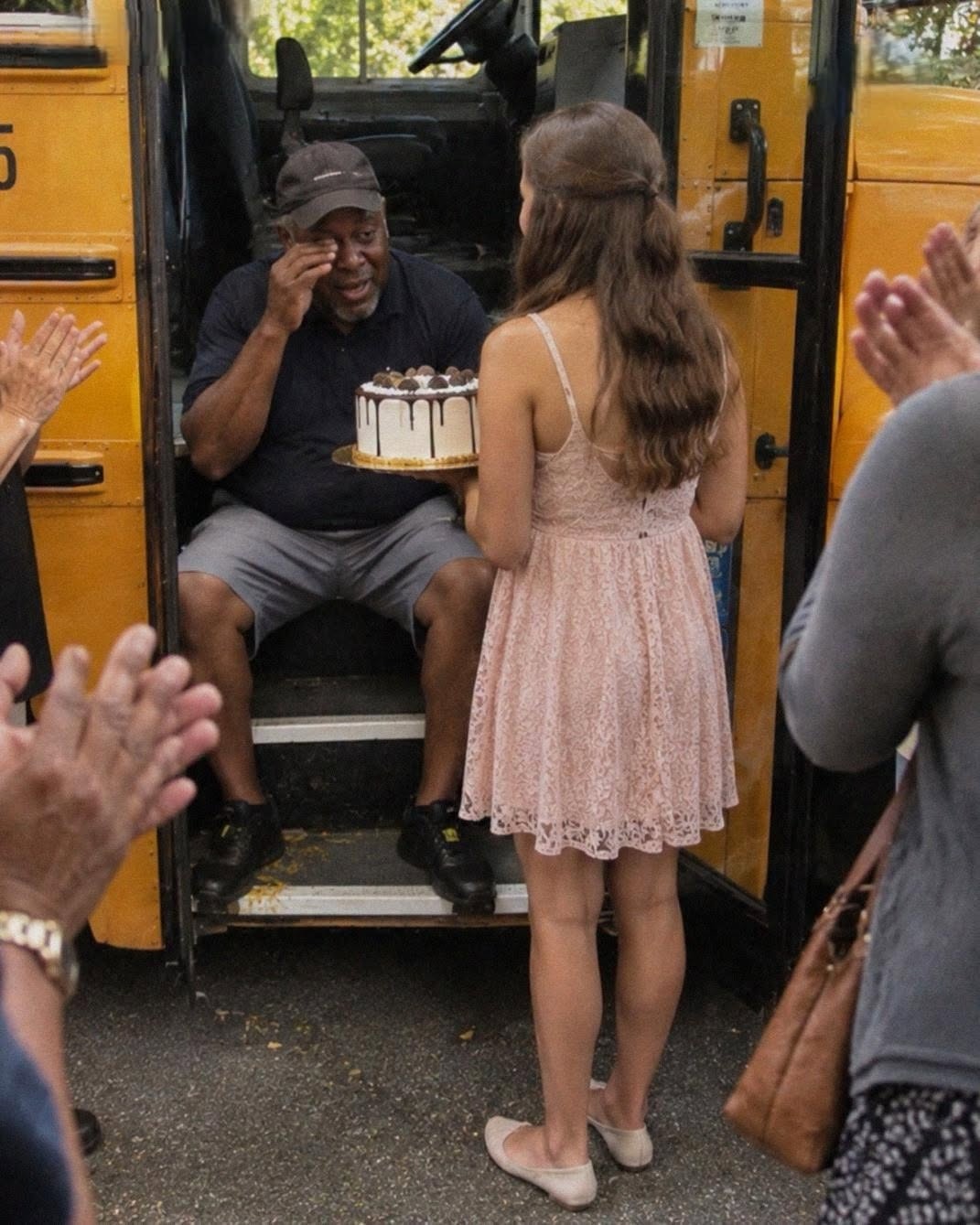
By Friday, the simple plan for a few cupcakes had transformed into a town-wide operation. The high school art club designed banners, the local bakery donated a massive cake, and people who didn’t even have children in the district showed up, drawn by the legend of the bus driver who cared too much to be forgotten. As the final school route ended and the familiar yellow bus rolled into the parking lot, the air was thick with anticipation. When Mr. Walter stepped down from the stairs, expecting another solitary evening, the sudden roar of applause and cheers froze him in his tracks.
He stood there, stunned, his thermos slipping from his hand as he realized the sheer scale of the tribute. He had spent years ensuring our children felt like the most important people in the world, and now, the world was finally showing up for him. As the crowd swarmed him with hugs and handwritten cards, I watched him weep—not with the sorrow of a lonely man, but with the overwhelming relief of a man who finally felt seen.
Then, the moment that stopped time. A young woman named Hannah, whom the school secretary had quietly invited, stepped forward. She carried a small, worn box. When she spoke, her voice trembling, she revealed a secret that had been buried for twenty-five years: she was the little girl whom Walter and June had once tried to adopt, a dream that had been cruelly interrupted by June’s illness. She opened the box to reveal a tiny, tattered stuffed rabbit and an old birthday card—the last tangible pieces of a love she had held onto through years of foster care.
“I spent years wondering about the couple who almost took me home,” she told him, her tears mingling with his. “I wanted you to know that the love you had for me mattered. I carried it.”
Mr. Walter collapsed onto the bus steps, clutching the rabbit to his chest as if he were holding a piece of his lost life. The parking lot fell into a profound, reverent silence as he finally understood that his impact was not small, and it was certainly not forgotten. The love he had poured into those little cards had been returned to him a thousandfold.
As the sun began to set, painting the sky in hues of amber and violet, the celebration continued. It wasn’t just a birthday party anymore; it was a homecoming. We realized then that community isn’t built on grand gestures or public accolades, but on the accumulation of small, quiet acts of kindness. Mr. Walter had taught our children that everyone deserves to be celebrated, and on that cold winter afternoon, he finally received the lesson in return. Watching my son hug the man who had looked after him for years, I realized that we hadn’t just saved a man’s birthday; we had reclaimed our own humanity. We left that parking lot knowing that as long as we were a town that looked out for one another, no one would ever have to be invisible again.