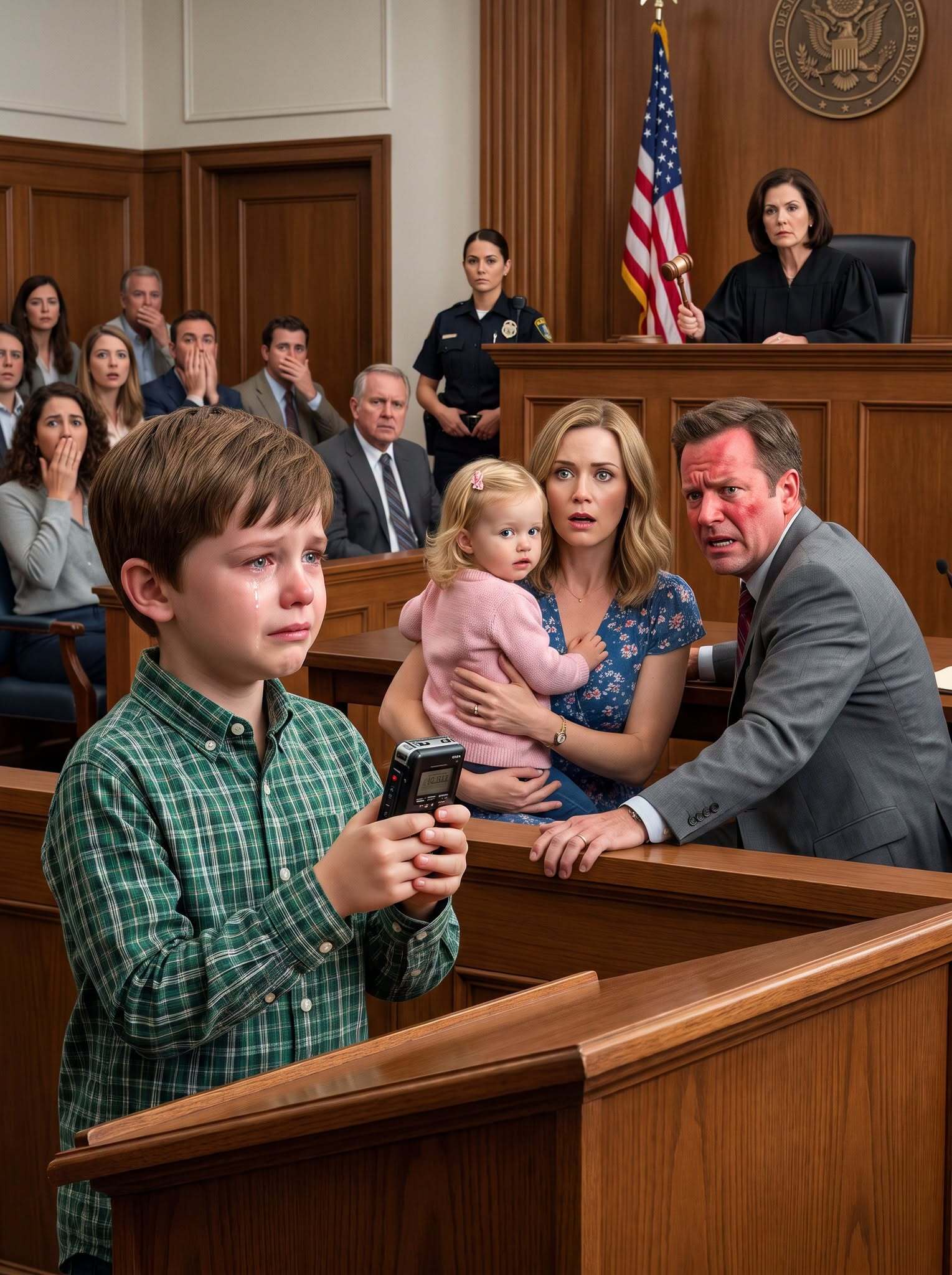
The judge asked my nine-year-old twin sons which parent they felt safest with. Daniel leaned back like he already knew the answer, surrounded by documents proving he had the house, the money, and the better schools. Then Lucas stood up in his green plaid shirt, reached into his jacket pocket, and pulled out his grandfather’s old voice recorder. “I kept it,” he whispered, “because I thought nobody would believe Mom.
They felt like exhaustion with paperwork.
There were interviews.
Court appointments.
Financial subpoenas.
Child advocate meetings.
Therapy referrals.
Audio verification.
And more tears than I can count.
A forensic specialist confirmed the recorder had not been altered.
That mattered.
Daniel’s attorney tried to question whether a nine-year-old understood what he had captured.
The specialist did not care about motive.
Only sound.
The audio was authentic.
The voices were identifiable.
The timestamps matched the weekend Lucas had spent at Daniel’s house.
After that, the rest of Daniel’s story began to come apart.
Subpoenas revealed emails from private accounts.
My former manager admitted receiving anonymous “concerns” about my reliability shortly before I lost my job.
The school counselor produced messages Daniel had sent, describing me as overwhelmed, unpredictable, and possibly unable to provide emotional stability at home.
Every message sounded careful.
Concerned.
Responsible.
That was Daniel’s gift.
He could make control sound like care.
But once the recording existed, people read his words differently.
Not as concern.
As construction.
He had not been observing my instability.
He had been building the appearance of it.
Then came the trust documents.
My father had created an educational and housing trust for Lucas and Mason before he died.
I knew there was some money set aside.
I did not know the full amount.
Dad had never wanted me to depend on it too early. He wanted it protected until the boys needed it most — for school, healthcare, housing stability, and future college costs.
Daniel found out through paperwork after Dad’s passing.
He never told me.
Instead, he studied the trust language and realized that if he gained primary custody, he could petition for control over certain funds as the boys’ managing parent.
That was the secret hiding beneath his speeches about better schools and stability.
Daniel had not fought so hard because he loved Lucas and Mason more than I did.
He fought because losing control terrified him.
And because some of his wealth was not as solid as it looked.
The financial review revealed risky investments, leveraged assets, and debts hidden behind polished statements. Daniel still had money, but not the effortless security he had displayed in court.
He needed access.
My sons were the doorway.
When Karen — my attorney — explained it to me, I sat in her office and stared at the table.
For months, I had believed Daniel wanted to take my children because he thought I was unworthy.
The truth was worse.
He knew I was worthy.
He simply needed the court to believe I wasn’t.
The second hearing felt different.
I was still afraid.
Any mother who says she enters a custody courtroom without fear is either lying or numb.
But I was no longer ashamed.
Daniel sat across from me again, but he did not look like the same man.
The tailored suit remained.
The watch remained.
The perfect documents remained.
But the confidence was gone.
He looked exposed.
The child advocate spoke first.
She described Lucas and Mason as bright, sensitive children who had been placed under inappropriate emotional pressure. She noted their attachment to me, their anxiety around disappointing their father, and the fear both boys expressed about “choosing wrong.”
The phrase made my stomach turn.
Choosing wrong.
Children should choose cereal, shoes, Halloween costumes, what color marker to use.
Not which parent’s love might disappear if they tell the truth.
Then the recording was formally addressed.
Only portions were played.
The judge did not need to hear it all again.
I did.
Every word landed differently the second time.
The first time, I had been too stunned to understand.
The second time, I heard the architecture.
Daniel had built a trap from missed payments, job concerns, school messages, legal filings, and fear.
And my nine-year-old son had been carrying the key in his pocket.
When Daniel finally testified, he tried to sound remorseful.
He said the conversation had been taken out of context.
He said divorce made people say things they did not mean.
He said he wanted what was best for the boys.
The judge let him finish.
Then she asked, “Is threatening to withdraw support from their mother if they express a preference for her what you consider acting in their best interests?”
Daniel’s mouth opened.
Closed.
No polished answer came.
That silence told the courtroom more than any speech could have.
The ruling came two weeks later.
I received primary physical and legal custody of Lucas and Mason.
Daniel received supervised visitation at first, along with required counseling, parenting classes, and strict restrictions around financial discussions with the children.
The trust was placed under independent oversight.
Daniel was ordered to repay improperly moved funds and barred from petitioning for control of the boys’ trust without court approval.
It was not the dramatic punishment some people expected.
No shouting.
No collapse.
No courthouse revenge scene.
But it was justice.
More importantly, it was safety.
When Karen called with the final written order, I sat on the kitchen floor of our small apartment and cried.
Mason found me first.
“Mom?”
I wiped my face too quickly.
“I’m okay.”
He looked unconvinced.
Then Lucas came in from the hallway.
He saw the phone in my hand.
“Did we lose?”
I held out both arms.
“No,” I whispered. “You’re staying home.”
They both climbed into my lap, too big for it and still exactly small enough.
For several minutes, none of us moved.
That was how our new life began.
Not with celebration.
With three people sitting on a kitchen floor, finally able to breathe.
Healing did not arrive overnight.
Perfect endings are usually told by people who have never cleaned up after real damage.
Lucas had nightmares.
Mason hated raised voices.
I startled every time an official-looking envelope arrived in the mail.
For months, I carried guilt like a second purse.
How had I not known?
How much had my sons heard?
How long had Lucas believed it was his job to protect me?
Our therapist was gentle but firm.
“You were surviving inside manipulation,” she told me. “Survival narrows your vision. That is not the same as failure.”
I repeated that sentence often.
Some days I believed it.
Some days I did not.
But slowly, our apartment became peaceful.
Saturday pancakes returned.
Not fancy.
Usually uneven.
Sometimes slightly burned on one side because Mason liked “crispy edges” and Lucas claimed that was not a real preference.
We bought secondhand books.
We built blanket forts.
We made a rule that any serious family conversation had to happen at the kitchen table with hot chocolate, because Lucas said courtrooms should not be the only places where people got to speak truth.
I agreed.
The recorder stayed in Lucas’s drawer at first.
He did not want to touch it.
I understood.
One evening, a few months after the final hearing, he came into my room holding it.
“Can I keep Grandpa’s recorder?”
I patted the bed beside me.
“Yes.”
He sat.
“But not because it saved us,” I said.
He frowned.
“Then why?”
“Because it belonged to someone who loved you. And because now you can use it for happy things.”
A week later, I heard laughter from the boys’ room.
I stood outside the door and listened.
Lucas was interviewing Mason about dinosaurs.
“Question one,” Lucas said in his best radio voice. “Would a T. rex be a good roommate?”
“No,” Mason said seriously. “Because rent would be high and he has tiny arms.”
Lucas laughed so hard the recorder thumped against the floor.
I stood in the hallway and cried quietly.
Not from fear this time.
From gratitude.
Daniel did not change quickly.
At first, he was angry.
Then defensive.
Then quiet.
Court-ordered counseling has a way of stripping performances down to their bones, if someone is willing to stay in the room long enough.
For a while, Daniel only stayed because he had to.
Then, slowly, something shifted.
He stopped sending messages through attorneys about small scheduling changes.
He stopped making every school event feel like a silent competition.
He attended the boys’ soccer game and sat in the back row instead of standing near the coach like an investor reviewing performance.
After one supervised visit, he asked to speak to me outside the family center.
My sister stayed nearby with the boys.
Daniel looked older than he had in court.
“I thought providing money made me the better parent,” he said.
I waited.
He swallowed.
“I was wrong.”
Those words did not undo anything.
They did not give Lucas his innocence back.
They did not erase Mason’s fear of raised voices.
They did not return the job I lost or the nights I spent thinking I was failing my children.
But they mattered.
Not for me.
For them.
“Then prove it,” I said softly. “Not to me. To them.”
To his credit, he tried.
Not perfectly.
But honestly enough that the boys noticed.
He attended his counseling sessions.
He apologized to Lucas without explaining it away.
He apologized to Mason for making him feel like love depended on answers in a courtroom.
He stopped speaking about me like an obstacle.
Trust returned slowly.
Not like a door swinging open.
More like water dripping into a dry well.
A birthday card written in Daniel’s own messy handwriting.
A parent-teacher meeting where he listened more than he talked.
A weekend visit where Lucas came home and said, “Dad asked me what I wanted to do. Not what he planned.”
That was a small sentence.
It carried a large repair.
Our family did not become what it had been.
That version was gone.
Maybe it had never been as real as I thought.
But we became something healthier.
Something honest.
People sometimes say Lucas was brave that day in court.
He was.
But I wish he had never needed to be.
No child should have to stand in a courtroom with evidence in his pocket because he thinks no one will believe his mother.
No child should have to listen to a parent turn love into leverage.
No child should have to understand trust funds, custody petitions, or emotional safety before he understands long division properly.
Still, when I remember that morning, I do not remember Daniel’s pale face most.
I remember Lucas’s trembling hands.
I remember Mason’s fingers gripping my sleeve.
I remember the judge looking at my boys not as prizes to be awarded, but as children to be protected.
And I remember the moment truth entered the room.
Small.
Black.
Held in both hands by a nine-year-old boy in a green plaid shirt.
Truth does not always arrive loudly.
Sometimes it comes from a recorder in a child’s pocket.
Sometimes it comes in a shaking voice.
Sometimes it comes after months of being told you are weak, unstable, and not enough.
For a long time, I thought I had lost everything Daniel took from me.
The house.
The car.
The life people admired from the outside.
But I had not lost the only things that mattered.
My sons still reached for me when they were afraid.
They still laughed in the hallway.
They still believed home was wherever we were together.
Daniel had money.
Influence.
Documents stacked high enough to hide behind.
But my children had the truth.
And once the truth was heard, no amount of wealth could silence it again.