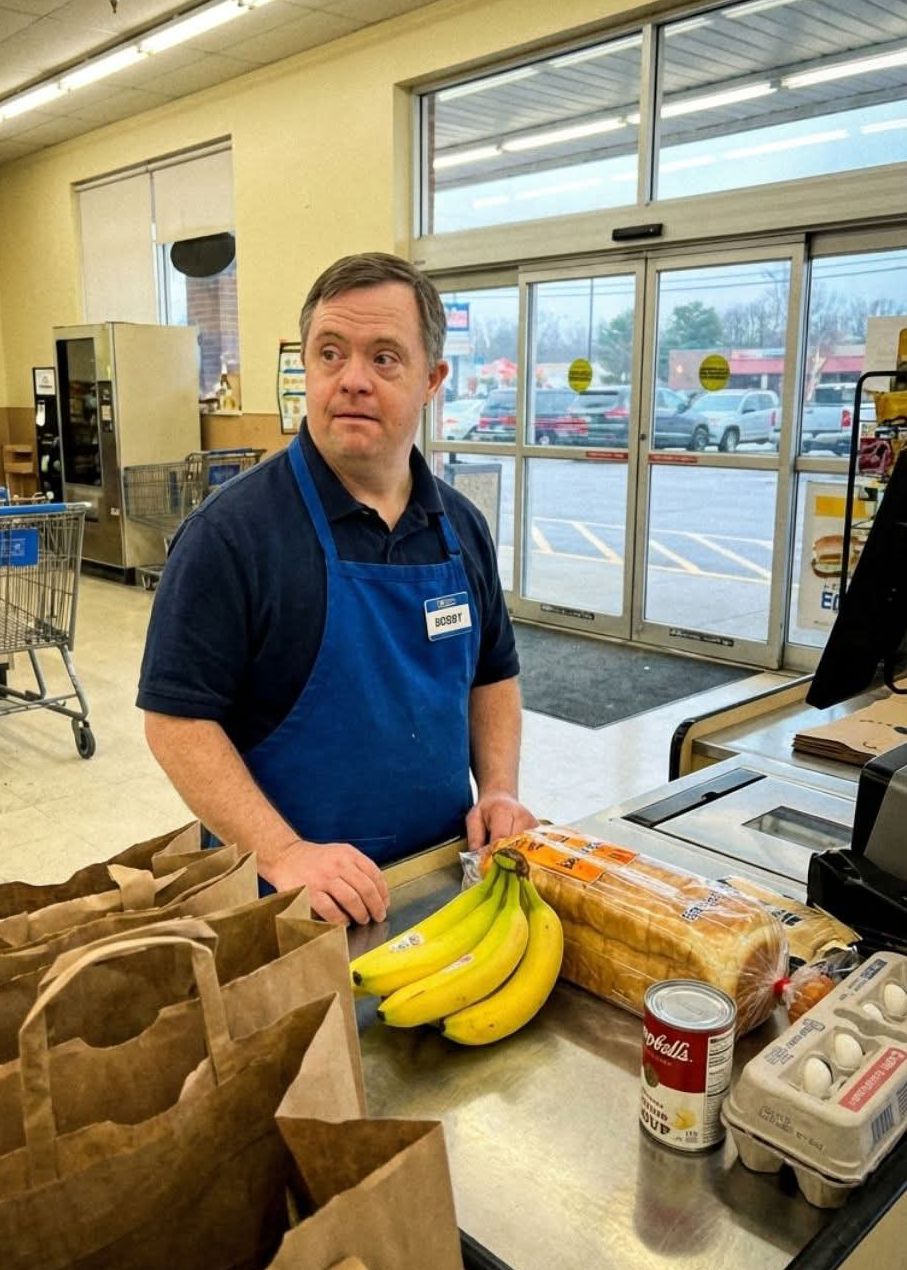
The bagger most people underestimated turned out to be the only one who noticed when an elderly woman disappeared—and what he discovered changed how everyone saw him.
Tommy was already reaching for the bags before the customer had finished unloading her items. For over a decade, he had worked at the small neighborhood grocery store wearing the same blue apron and name tag, moving with the same steady, deliberate care. He wasn’t the fastest cashier, and everyone knew it. But he handled every purchase with quiet respect eggs nestled safely, bread placed gently on top, cold items kept separate. To Tommy, it was never just a job. It was a chance to do something right.
He greeted people warmly, asked about their day, and offered to carry their groceries to the car. Some customers appreciated his kindness. Others barely noticed him. A few quietly asked for a faster cashier. Tommy never argued. He simply smiled and kept working.
Every Thursday at 3:15 p.m., Mrs. Alvarez would walk through the doors. A small, gentle woman in a light cardigan, she always clutched her purse with both hands. Her shopping list rarely changed: bananas, bread, milk, soup, and perhaps a frozen meal if it was on sale.
Whenever possible, Tommy made sure he was the one who served her. He packed her bags with extra care, walked her slowly to her car, and waited until she was safely inside before returning to the store. He never rushed her. He spoke to her with the gentle patience usually reserved for family.
Then, one Thursday, she didn’t come.
Tommy kept glancing at the entrance as the afternoon passed: 3:15… 3:30… 4:00. Still no sign of her.
“Maybe she changed her schedule,” a coworker suggested.
Tommy shook his head. “She always comes on Thursday.”
The next week, she was missing again. This time, the smile left Tommy’s face.
After his shift, he stood nervously outside the manager’s office, twisting the edge of his apron.
“I think something’s wrong with Mrs. Alvarez,” he said.
The manager looked up. “Who?”
“The older lady with the white cardigan. I always take her groceries to her car.”
The manager sighed. “People stop coming in sometimes, Tommy.”
“But she wouldn’t. Not without a reason.”
Tommy hesitated, then added quietly, “I remember where she lives. Maple Street. Third floor. Apartment 3B. I saw it on her checks over the years.”
The manager studied him for a long moment. He had long noticed that Tommy paid attention to things others overlooked. He noticed small changes in people. He noticed when something felt wrong.
“Alright,” the manager said, standing up. “Let’s go.”
The apartment building was faded and worn, with peeling paint and overflowing mailboxes. When they reached the third floor, Tommy knocked firmly on the door.
No answer.
He knocked again.
Finally, a weak voice came from inside. “Who is it?”
“Mrs. Alvarez? It’s Tommy… from the store.”
A long silence followed. Then the lock clicked, and the door opened just a crack.
She stood there, pale and frail, gripping the doorframe for support.
“Tommy?” Her voice trembled.
He smiled gently. “You missed two Thursdays.”
She began to cry—soft, quiet tears from someone who had been alone far too long.
Inside, the apartment was neat but bare. There was no fresh food, only the remnants of what she had left.
“I fell,” she admitted. “Hurt my hip. The doctor said I shouldn’t drive. I thought I’d recover quickly… but I didn’t.”
Tommy glanced toward the empty kitchen. “What have you been eating?”
She gave a faint, weary smile. “Crackers. Tea. Whatever was left.”
The manager stood speechless.
Tommy spoke softly. “What do you need from the store?”
“You don’t have to do that,” she said.
“I know,” he replied. “I want to.”
From that day on, Tommy brought her groceries every Thursday after his shift. At first, he paid for them himself. When the manager discovered this, he tried to object.
“You can barely afford your own bills,” he said.
“She still needs food,” Tommy answered simply.
That was enough.
Soon, others at the store began to chip in. A cashier left extra money in the till. A stock boy added a few dollars. Customers started contributing too. Before long, a small, quiet fund appeared at the counter—just for Mrs. Alvarez. No names. No recognition. Just kindness.
An elderly woman had vanished in plain sight, and the only person who noticed was the one most people overlooked.
For three years, Tommy visited her every Thursday. Sometimes she shared stories of her youth. Sometimes she spoke of family who lived far away. Sometimes they simply sat together while Tommy told her small tales from the store. He made her feel seen again. Connected. Remembered.
When Mrs. Alvarez passed away peacefully in her sleep, only a handful of people attended the funeral. Tommy sat quietly in the front row.
Afterward, her niece approached him with an envelope.
“She talked about you constantly,” the niece said. “She said you were the one who never forgot her.”
Inside was a note written in shaky handwriting:
Thank you for noticing when I disappeared. Thank you for making me feel remembered. Thank you for treating me like I still mattered.
Tommy read it slowly, folded the note, and tucked it away close to his heart.
He still works at the same store today. Still wears the same blue apron. Still packs groceries with care and offers to carry bags to cars. Still notices when someone stops showing up.
Because while others see him as the man who bags groceries, Tommy’s real gift has always been seeing the people everyone else forgets. ❤️