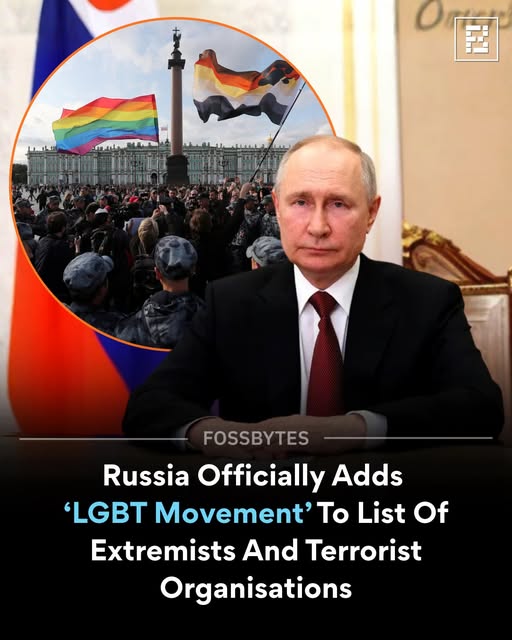
Russia has added the “LGBT movement” to its list of extremist and terrorist organisations, state media reported.
Russia has added the “LGBT movement” to its list of extremist and terrorist organisations, state media reported.
The move follows a November 2023 ruling by Russia’s Supreme Court designating LGBT activists as extremists.
The list is maintained by Rosfinmonitoring, which has the authority to freeze bank accounts of designated individuals and groups.
State news agency RIA said the listing refers to the “international LGBT social movement and its structural units.”
The designation comes amid broader restrictions under President Vladimir Putin on sexual orientation and gender identity, including bans on promoting “non-traditional” relations.
Russia Adds ‘LGBT Movement’ to List of Extremist and Terrorist Organizations, State Media Reports
In a significant escalation of restrictions on LGBTQ+ rights in Russia, authorities have officially added what they term the “international LGBT movement” to the country’s list of extremist and terrorist organizations. This designation, managed by Rosfinmonitoring—the Federal Financial Monitoring Service—allows the freezing of bank accounts and other severe financial restrictions for any individuals or groups linked to it.
The move, reported by state news agency RIA Novosti and other outlets, directly follows a landmark November 2023 ruling by Russia’s Supreme Court. In that decision, the court declared the “international public LGBT movement” an extremist organization and banned its activities nationwide. The ruling came after a petition from the Ministry of Justice, which argued that such a movement posed a threat to national security, traditional values, and public order. Notably, the Supreme Court’s decision did not identify specific organizations or individuals but effectively criminalized a wide range of LGBTQ+ activism, advocacy, and even visible expressions of identity.
Rosfinmonitoring maintains a public registry of over 14,000 entities and people classified as extremists or terrorists. This list already includes groups like Al Qaeda, the tech company Meta (parent of Facebook and Instagram), and associates of the late opposition figure Alexei Navalny. By adding the “international LGBT social movement and its structural units,” the agency extends its powers to impose immediate asset freezes and other punitive measures without necessarily naming specific targets on its website. The exact practical implications remain somewhat unclear, as no particular persons or entities were explicitly listed in the initial announcement.
This development fits into a broader pattern of policies under President Vladimir Putin that promote “traditional family values” while cracking down on what the government portrays as Western-influenced threats to Russian society. Since 2013, Russia has enforced a law banning the “promotion of non-traditional sexual relations” to minors—commonly known as the “gay propaganda” law. Over time, these restrictions have expanded dramatically: the ban now applies to adults as well, gender-affirming medical care has been prohibited, adoption by same-sex couples is restricted, and even displaying rainbow symbols or posting LGBTQ+-related content online can lead to fines, administrative detention, or criminal charges.
Following the 2023 Supreme Court ruling, enforcement has intensified. Reports indicate hundreds of administrative cases and several criminal prosecutions related to alleged involvement in the “LGBT movement.” Individuals have faced penalties for social media posts, attending private events, or showing support for LGBTQ+ causes. Police raids on bars, nightclubs, and publishing houses have occurred, with some operations targeting those accused of “recruiting” into the banned movement through books or events. In 2025, authorities detained publishers for distributing fiction with LGBTQ+ themes, charging them under extremism laws that carry prison sentences of up to 12 years.
Human rights organizations, including Human Rights Watch, Amnesty International, and ILGA, have condemned the measures as severe violations of freedom of expression, association, and personal identity. Critics argue that labeling a decentralized global human rights effort as an “extremist” or “terrorist” entity mischaracterizes it entirely and enables widespread persecution. The European Union, the United States, and other international bodies have criticized the policies as part of a larger campaign against dissent and minorities amid Russia’s ongoing geopolitical tensions.
Inside Russia, the LGBTQ+ community faces heightened risks of violence, discrimination, social isolation, and forced emigration. Many activists have fled the country or shifted to underground operations, providing anonymous psychological and legal support where possible. The addition to Rosfinmonitoring’s list further complicates any financial or organizational efforts, making even basic community support networks vulnerable to shutdowns or prosecutions.
As of early 2026, developments continue to unfold. Recent reports highlight ongoing attempts by the Ministry of Justice to designate specific Russian LGBTQ+ groups—such as the Russian LGBT Network and Coming Out (Vykhod)—as extremist entities, with court hearings scheduled. These actions build on the 2023 ruling and demonstrate how the vague designation is being used to target domestic initiatives.
The policy reflects Russia’s emphasis on conservative values as a counter to perceived external influences, framing LGBTQ+ rights as incompatible with national identity. While supporters of the measures claim they protect societal norms, opponents warn of deepening repression, increased underground activity, and further international isolation on human rights issues.
This latest step by Rosfinmonitoring solidifies the state’s control over expressions of sexual orientation and gender identity, sending a stark message: any perceived link to the “LGBT movement” can result in severe legal and financial consequences.