On the Very Night I Received One of the Greatest Promotions of My United States Army Career
THE MORNING THEY THOUGHT I WOULD VANISH
On the evening before I officially took command as a colonel, my husband and his mother decided it was time to teach me what they called obedience.
My name is Mara Ellison. I had spent twenty-two years serving in the Army, earning every promotion through commitment and sacrifice, while covering most of the financial responsibilities for the home my husband, Ryan, and I shared.
Rather than celebrating my promotion, Ryan viewed it as a personal betrayal.
“You’re always choosing the Army over your family,” he said during dinner.
His mother, Linda, sat beside him wearing her pearl necklace and the familiar wounded expression she always used when disguising cruelty as concern.
“A good wife should know when ambition has gone too far,” she added.
I chose not to argue. I had to report early the next morning and needed sleep.
Before sunrise, I woke with an uneasy feeling.
My scalp felt strangely cold.
When I reached up, I realized most of my hair had been shaved away.
While I slept, Linda had entered the bedroom with hair clippers, and Ryan had stood there watching without stopping her.
When I confronted him, he offered no apology.
“Hair grows back,” he said. “Maybe now you’ll learn to listen.”
They assumed humiliation would keep me inside the house.
They were convinced I would skip the command ceremony, ruin my professional reputation, and possibly lose the promotion altogether.
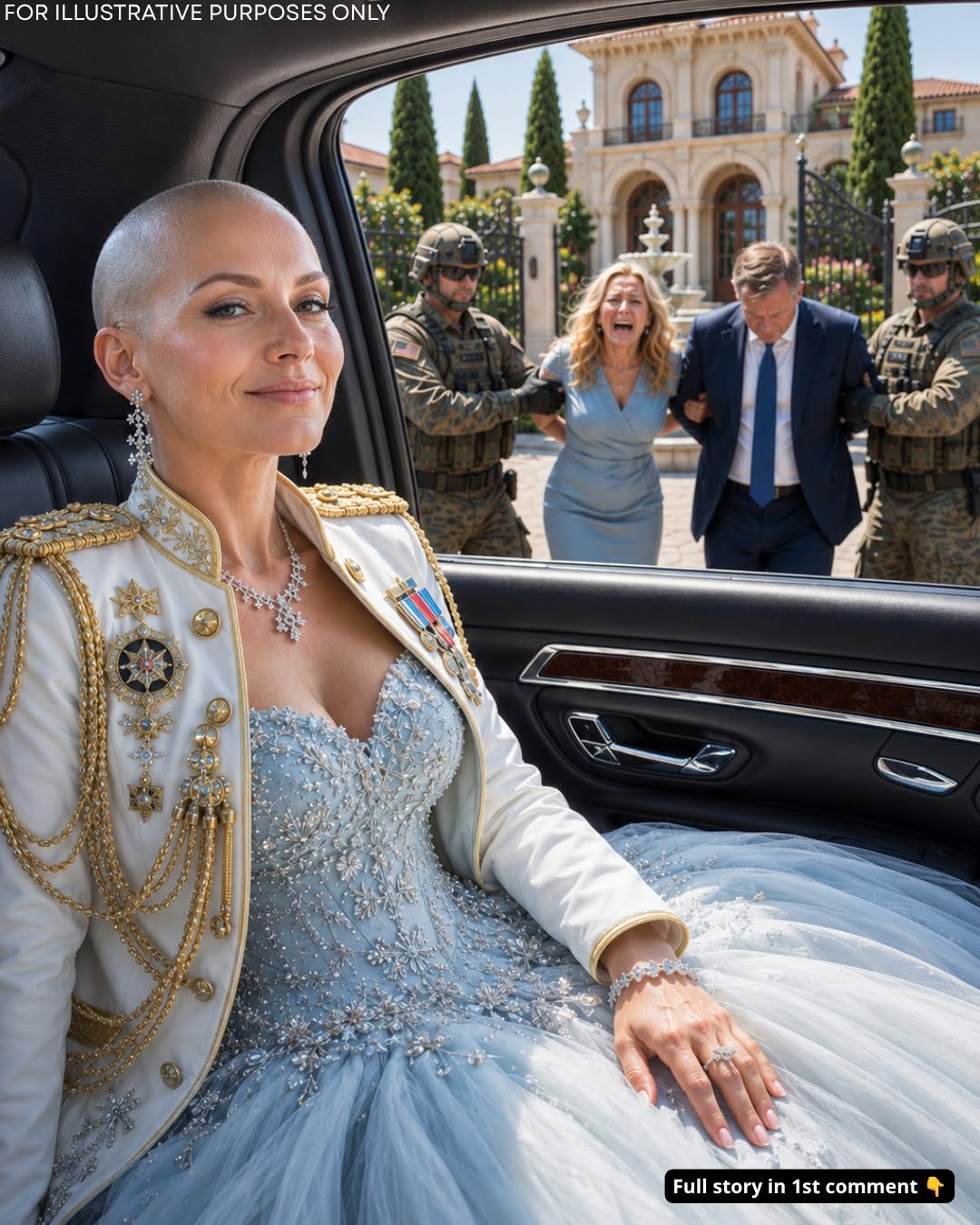
Instead, I showered, put on my uniform, and reported for duty without trying to hide what they had done.
At headquarters, no one stared or treated me like a spectacle. General Halvorsen greeted me by rank and immediately began discussing the transition of command.
Then military police entered the office.
A man identifying himself as my husband had attempted to access the installation using counterfeit federal credentials. He told security that I had become emotionally unstable after my promotion and needed to be taken home.
Ryan had been detained at the entrance.
When I saw him through the interview-room window, his first concern was not whether I was safe.
“The bank froze the cards,” he complained. “The mortgage payment failed. You locked me out of everything.”
“Interesting priorities,” I said.
Ryan claimed his mother had acted on her own.
“You approved it,” I replied.
“She went too far.”
“You said I needed to learn obedience.”
His confidence immediately began to fade.
While Ryan was being questioned, my attorney, Sarah Noland, called. She had uncovered forged powers of attorney, fraudulent property paperwork, fabricated medical statements declaring me emotionally unstable, and documents attempting to transfer portions of my retirement benefits.
Ryan and Linda had started creating those records eighteen months earlier.
My promotion had merely accelerated their plan.
They believed that if they humiliated me enough, I would miss my reporting date and become easier to portray as mentally incompetent.
Then Sarah uncovered something even more disturbing.
The legal identity Ryan had used throughout our marriage might never have belonged to him.
The real Ryan Michael Hale had died as an infant.
Years later, another child began appearing in school, medical, and financial records under that same identity.
That child eventually became my husband.
His true name was Evan Cole Varner.
Linda had concealed her biological son behind the identity of a deceased child to gain access to family benefits, insurance payments, and legal protections.
Ryan had not simply lied about his financial history.
He had entered our marriage under a stolen identity.
Later that evening, Sarah showed me security footage that had automatically uploaded before Ryan disabled our home surveillance system.
The recording showed Linda entering our bedroom while Ryan stood nearby as they tried to prevent me from attending my promotion ceremony.
For the first time, I almost cried.
Not because I felt ashamed.
Because having proof can feel like being rescued.
Investigators secured a warrant to search our home.
Linda stood on the porch wearing a cream cardigan, insisting strangers were invading her son’s house.
“My home,” I corrected. “And they have legal authorization.”
Agents seized forged financial records, computers, storage devices, and files containing copies of my identification documents.
But Ryan had already warned investigators that Linda kept her most valuable records “somewhere nobody would think to look.”
I suddenly remembered a narrow linen closet beside the guest bathroom.
Years earlier, Ryan had reacted with unusual anger when I touched the loose panel at the back of it.
An agent tapped against the wall.
The sound was hollow.
Behind the false panel was a concealed compartment filled with cash, passports, external drives, forged seals, photographs, and envelopes labeled with women’s names.
One envelope bore my name.
Inside were years of bank statements, military files, private correspondence, medical records, photographs taken without my knowledge, and handwritten notes explaining how I could be controlled.
One line read:
High resistance to dependency. Recommended pressure points: career isolation, marital guilt, financial entanglement and public humiliation.
Linda had never simply disliked me.
She had analyzed me.
Other folders belonged to widows, military spouses, retired service members, and women who owned property or received pensions.
Several had lost homes, careers, savings, or professional reputations after becoming involved with Linda and Ryan.
Investigators then uncovered a ledger documenting payments made to clerks, private investigators, bankers, attorneys, and officials willing to overlook suspicious records.
Beside my name appeared two words:

Linda’s operation extended far beyond our marriage.
For decades, she had collected leverage and identified vulnerable people whose finances could be manipulated.
Ryan was both the product of her scheme and her willing accomplice.
The search became even more urgent when smoke began rising from the basement.
Ryan, who had managed to leave temporary custody through one of Linda’s connections, had secretly returned to retrieve a metal lockbox and destroy evidence.
Agents extinguished the fire before it spread throughout the house.
Inside the lockbox were birth certificates, custody records, adoption paperwork, and proof that Linda had experimented with multiple identities before adopting the name Ryan Hale.
There was also an old document bearing my maiden name.
I had been only three years old when Linda first crossed paths with my family.
A private placement note described me as a possible child for one of her schemes. My father had refused to cooperate.
Written across the bottom were the words:
Candidate rejected. Father refused transfer. Monitor for future leverage.
For years, I believed Ryan chose me because he resented my military career and wanted access to my assets.
The truth was even darker.
Linda had noticed me decades before I ever met him.
She remembered my family, followed my life, and eventually placed Ryan directly in my path.
Investigators later uncovered records connected to several other women, including Captain Alina Price, an Army officer who had disappeared from military service years earlier after supposedly resigning.
Ryan and Linda had forged Alina’s resignation paperwork and attempted to steal her retirement savings.
Eventually, a witness helped investigators locate her living under another name at a women’s shelter.
Alina had escaped, but she stayed hidden because she believed Linda’s network could destroy what remained of her career.
After watching me publicly assume command without hiding my shaved head, she agreed to testify.
We were no longer isolated women trapped in separate lies.
We had become witnesses.
And witnesses shifted the balance of power.
During the preliminary hearing, prosecutors presented the bedroom security footage.
Ryan’s attorney argued the incident had merely been a private family dispute.
The recording proved it was a deliberate attempt to interfere with my command, destroy my credibility, and support fraudulent claims that I was mentally unstable.
Outside the courthouse, a reporter asked whether Ryan and Linda had only been trying to protect the family.
“Protection does not require forgery,” I answered. “Love does not require fear.”
Ryan eventually agreed to cooperate with prosecutors against Linda.
He admitted they had deliberately targeted women connected to military pensions, insurance benefits, property settlements, and survivor compensation.
When prosecutors asked why he allowed Linda to humiliate me before my promotion ceremony, he answered:
“She needed to miss it.”
“Why?”
“Because she listened to the Army more than she listened to me.”
That was the truth hidden beneath everything.
Ryan believed my obedience belonged to him. Every achievement I earned outside our marriage felt like something taken away from his control.
My annulment hearing lasted less than an hour.
Because Ryan had married me using fraudulent identification and forged documentation, the judge declared the marriage invalid.
Ryan appeared by video and tried to address me directly.
“I did love you,” he said.
“No,” I replied. “You loved access.”
He later pleaded guilty to identity fraud, forged credentials, conspiracy, and financial crimes.
Linda proceeded to trial.
Diane, Jenna, Alina, and several other women testified about how Linda and Ryan had isolated them, manipulated them, fabricated concerns about their mental stability, and gained control of their finances.
When I took the witness stand, Linda’s attorney suggested that my military training allowed me to hide resentment behind a calm expression.
“Yes, I feel resentment,” I answered. “I resent fraud, forged signatures, threats against my career, and attempts to steal my retirement. Composure does not mean I have no emotions. It means my emotions do not control the facts.”
He asked whether I had ever loved Ryan Hale.
“I loved the person I believed he was,” I said. “That person never existed.”
Linda was convicted on the major charges.
Years of stolen records were corrected, part of Alina’s professional history was restored, and assets recovered from the operation helped compensate several victims.
I kept the house because the mortgage records proved I had paid for it.
But I changed what the house represented.
Together with Sarah and the other survivors, I transformed it into a support center offering legal referrals, temporary assistance, and financial guidance to people escaping coercive relationships.
The plaque beside the entrance read:
ELLISON HOUSE
Dignity Is Not Negotiable
Ryan later sent me a letter from custody.
I never opened it.
My hair eventually grew back. One year after the morning Linda tried to shame me, I stood before the hallway mirror in that same house.
The woman looking back at me was a colonel, a homeowner, a witness, and someone whose life finally belonged to herself again.
Ryan had told me my hair would grow back and I would learn obedience.
He was partly right.
My hair returned.
My obedience never did.
END