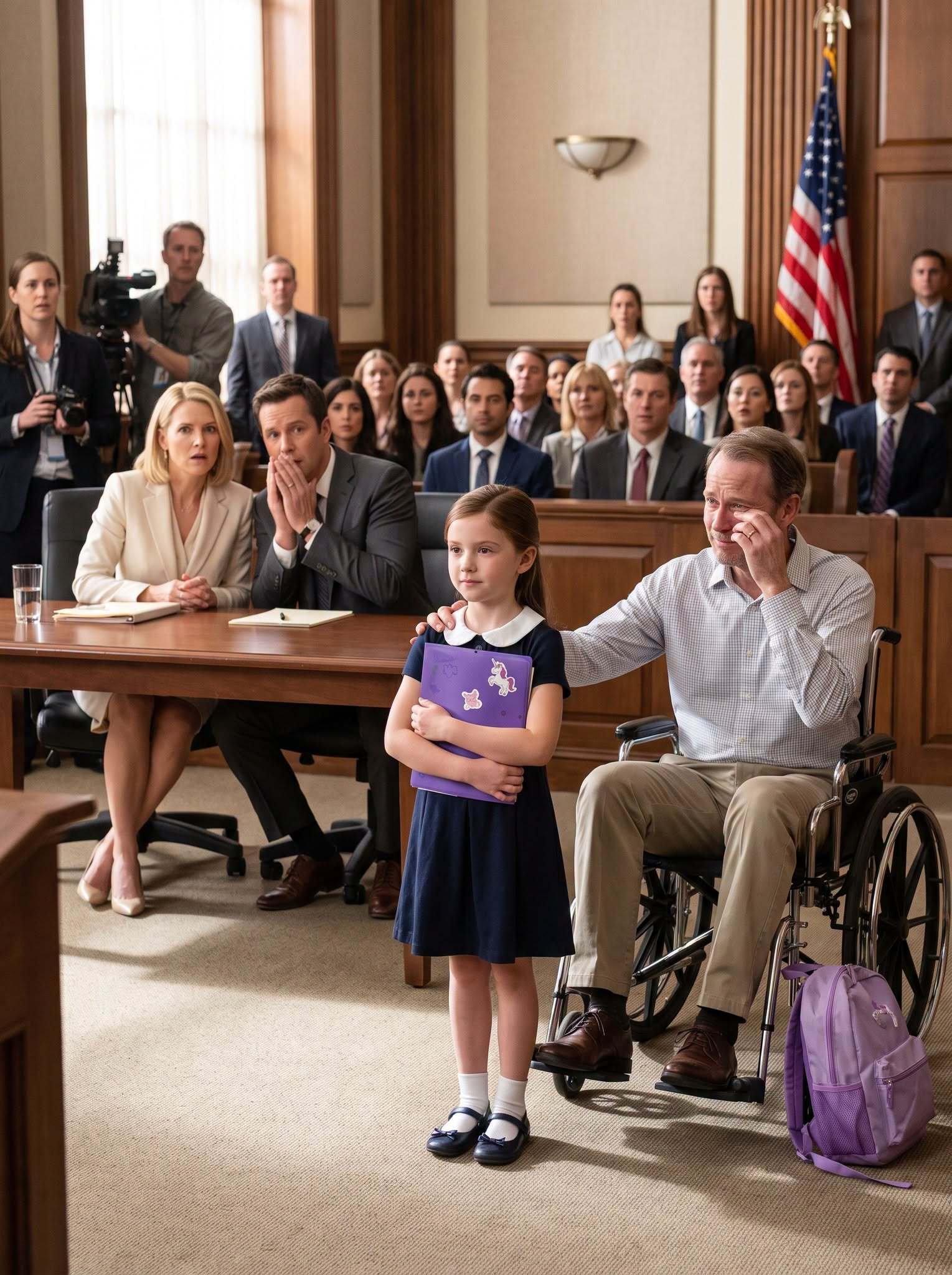
It was a purple folder full of
Part 3 – Ending:
The courtroom was full again when the second hearing began.
More reporters.
More whispers.
More people pretending they were there for law when really they wanted to watch a family break in public.
Judge Martinez saw all of it.
Before anyone testified, she looked over her glasses and said, “This is not a circus. This court’s concern is Lily Reynolds. Anyone who forgets that will leave.”
No one laughed after that.
The first witness was Dr. Lawrence Phillips, the neurologist Uncle James had recommended.
He was impressive on paper.
Harvard.
Mayo Clinic.
Published studies.
A calm voice that made statistics sound like destiny.
He admitted Daddy’s cognitive testing was normal.
Then he talked about what could happen later.
Future decline.
Possibility.
Risk.
Probabilities.
My mother’s attorney liked that word.
Probabilities.
Mr. Chen stood for cross-examination.
“Doctor, has Mr. Reynolds shown any cognitive impairment today?”
“No.”
“Can you state with certainty that he will experience cognitive decline?”
“No.”
“So what you are describing is a possibility, not a present fact.”
Dr. Phillips did not like that.
But he said yes.
Then Dr. Sarah Bennett testified about me.
She said I was not coached.
She said my attachment to Daddy was healthy.
She said I spoke about my mother with caution because my experiences had taught me caution.
My mother looked wounded when she heard that.
I did not know then whether the wound was real.
Some things take years to understand.
Then came the photographs.
My mother’s attorney displayed them across the courtroom monitors.
Me opening a door for Daddy.
Me reaching a shelf.
Me standing near his pill dispenser.
To someone who did not know our life, the pictures looked serious.
A little girl helping too much.
A sick father leaning too hard.
My stomach twisted when I saw them.
Because they were real moments.
But they were not true moments.
There is a difference.
Yes, I helped Daddy sometimes.
I liked helping.
He also told me no when I tried to do too much.
Rosa handled personal care.
Trevor helped with transport.
Nathan handled business emergencies.
I was not Daddy’s nurse.
I was his daughter.
During recess, Mr. Chen and his team filed an emergency motion to add the birthday video.
It was the video Nathan recorded the month before.
Daddy had built a treasure hunt through our apartment.
Each clue was hidden in a place I loved.
Inside a piano bench.
Under my astronomy book.
Behind the cookie jar.
In the balcony planter.
He followed in his wheelchair, laughing every time I ran too fast and forgot to read the clue properly.
When I got stuck, he did not solve it for me.
He helped me think.
At the end, I found the telescope I had wanted for a year.
In the video, I screamed so loudly that Rosa dropped a dish towel.
The judge watched the whole thing.
So did my mother.
So did Uncle James.
That video did what the photographs could not.
It showed the room between us.
The trust.
The playfulness.
The way Daddy had built a childhood around me, even while illness was taking pieces of his body.
That evening, before the ruling, my mother came to our building.
I was asleep when she arrived.
Daddy told me years later what happened.
She stood in the living room like someone who had entered her own past and found the furniture rearranged.
She saw my drawings on the refrigerator.
My desk in the corner.
The ramps.
The modified shelves.
The photographs Daddy kept everywhere.
She told him the truth.
At first, she came back for money.
Uncle James had found her and offered a plan. He would get control of Rain. She would get financial security and me.
She told herself I would adjust.
Children adjust, she said.
That was the lie she had used because it made her feel less cruel.
Then she saw me in court.
She saw that I knew who had stayed.
Who had left.
Who had learned my allergies and my favorite books and the way I hummed when I was nervous.
She told Daddy, “Taking her from you would be cruel to both of you.”
The next morning, before Judge Martinez could issue her ruling, my mother stood.
Her attorney tried to stop her.
She spoke anyway.
“Your Honor, I came to this court claiming concern for my daughter. The truth is that I returned for financial reasons.”
The courtroom went silent.
She said Uncle James had persuaded her.
She said she was not ready to be a mother when she left and had not magically become one because Daddy got sick.
She said Daddy was an extraordinary father.
Then she withdrew her petition.
Uncle James shot to his feet.
Judge Martinez cut him off before he could reshape the room.
Without my mother’s petition, his claim had almost no standing.
Then the judge said something I never forgot.
“Based on the evidence presented, I would have ruled in Mr. Reynolds’s favor regardless.”
She looked at Daddy.
“This court finds no reason to interfere with your guardianship of your daughter. Your support system is adequate. Your cognitive capacity is intact. Your daughter’s best interests are served by remaining in the home where she is loved, known, and protected.”
Then she called me forward.
My shoes squeaked on the courtroom floor.
I stood at the bench with my hands folded, trying not to tremble.
“Lily,” she said, “in all my years as a judge, I have rarely seen such courage and loyalty from someone so young.”
I looked at Daddy.
“I’m lucky to have him,” I said.
Judge Martinez smiled.
“Family is not just about biology. It is about who shows up, who stays, and who puts your needs before their own.”
My mother left through a side door.
Uncle James left angry.
Daddy and I left together.
That should have been the end.
It was not.
Eight years later, I stood before a state legislative committee wearing a navy blazer, my silver lily bracelet on my wrist, and my father sitting behind me in his motorized wheelchair.
His disease had advanced by then.
His voice was softer.
His body weaker.
But his mind still cut through nonsense like sunlight through glass.
I testified for a bill that would require courts to give children in custody and guardianship cases a meaningful way to be heard, with age-appropriate support and independent advocates.
People had started calling it the Lily Reynolds Act.
I hated the name at first.
Daddy loved it.
Senator Harrison challenged me.
“Children are easily influenced,” he said. “They cannot understand complex legal matters.”
I answered with the sentence I had carried since I was seven.
“Senator, you are confusing age with awareness. Children may not understand legal procedure, but they are experts in their own lived reality. They know who makes them feel safe.”
The bill passed committee.
Then the full state senate.
Then became law.
Years later, it inspired reforms beyond New York.
The foundation Daddy and I built helped children get advocates, therapists, legal support, and the simple dignity of being asked what had happened to them.
My mother changed in pieces.
Not beautifully.
Not quickly.
But enough.
She sent me my great-grandmother’s silver pen, the one Francis Williams had used as a journalist covering war trials in the 1940s.
She told me words have power when they come from conviction.
For the first time, I believed she was not asking me for anything.
Uncle James changed in a stranger way.
He sent the foundation a check for five million dollars with no conditions attached.
When I asked why, he said, “Watching my niece take apart a senator on C-SPAN made me wonder what might have happened if someone had fought for me when I was young.”
I did not forgive everyone at once.
I still have not.
Forgiveness is not required for growth.
But truth can make room where lies once lived.
At twenty-one, I stood on the steps of the Supreme Court after a ruling upheld the strongest parts of the child-advocacy law that began with my folder.
Reporters asked if I ever imagined my life would go from a courtroom interruption to national reform.
I thought of the purple backpack.
The glitter tabs.
The notebook.
Daddy’s trembling hand on my shoulder.
Then I said, “I learned early that speaking the truth can change more than your own story.”
That night, Daddy gave me the Reynolds family signet ring.
He said Rain Solutions was not his legacy.
I was.
The work was.
The children who would be heard because one small girl once stood up in a courtroom and refused to sit down.
Daddy passed two years later.
Peacefully.
At home.
I was holding his hand.
He lived long enough to see me graduate law school.
Long enough to see the foundation open clinics in twelve states.
Long enough to see the girl he raised become the woman he always believed I could be.
Five years after that, I stood outside the New York State Capitol, newly sworn into office, still wearing the silver lily bracelet and his signet ring.
A reporter asked what started it all.
I smiled.
Because the answer was not politics.
Not money.
Not ambition.
It was a sick father who still read bedtime stories.
It was a child who knew who loved her.
It was a purple folder full of proof no adult expected her to carry.
My name is Lily Reynolds.
At seven years old, I stood in court and said, “I am Daddy’s lawyer.”
I was not a lawyer then.
But I was telling the truth.
And sometimes, truth is enough to begin everything.