I Thought Selling My Late Husband’s Old Couch Would Be Simple, but the Next Day, I Discovered He’d Been Hiding Something
What He Sewed Inside
Part One: The Couch
For twenty years, I begged my husband to get rid of that couch.
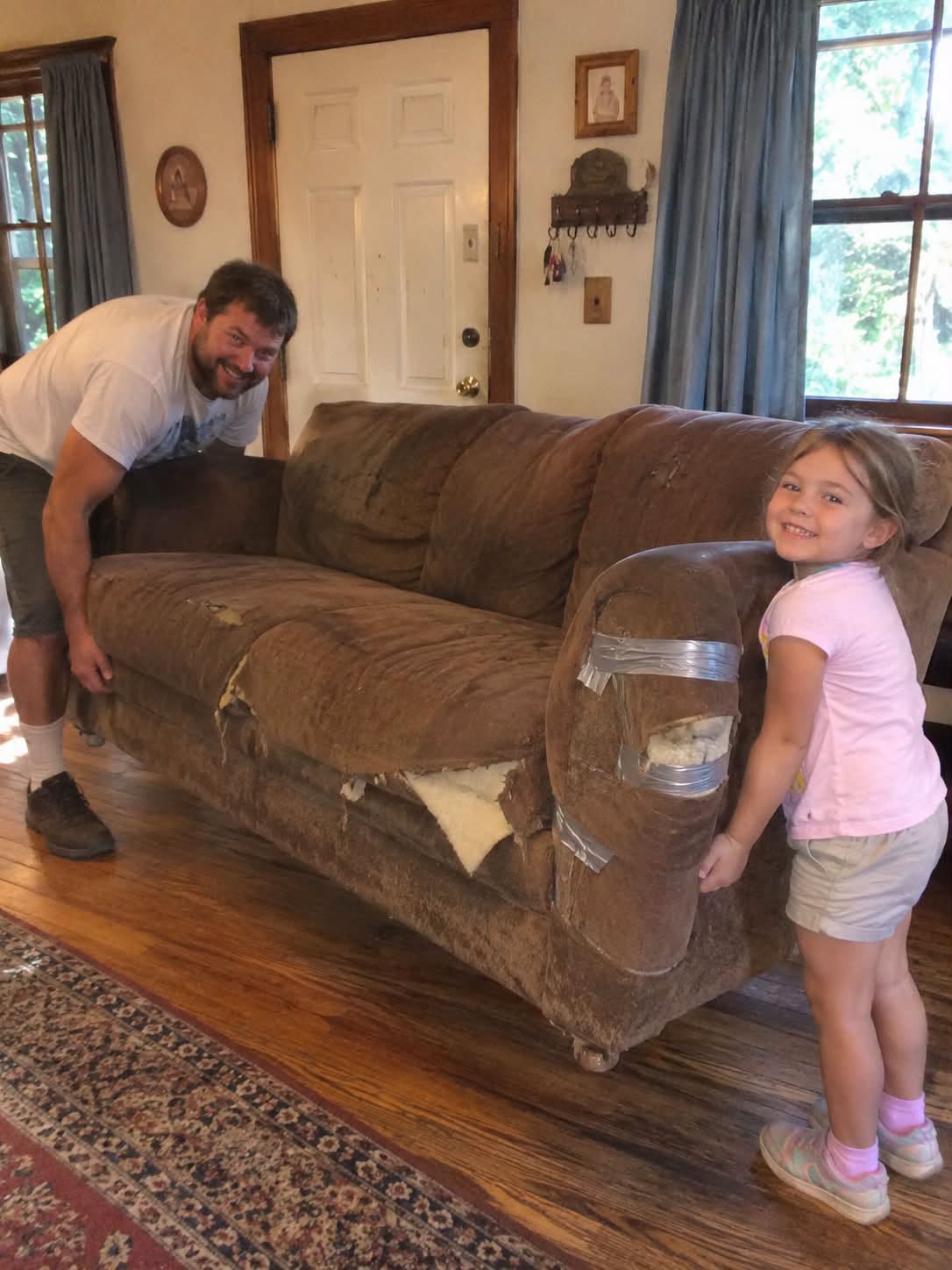
It was brown corduroy, the color of wet tree bark, with a sagging middle that swallowed you whole. The left armrest was worn through to the stuffing, and I’d patched it three times with fabric from the craft store that never quite matched. Sitting down was easy. Getting up required a running start, a rocking motion, and sometimes a prayer.
We bought it in 2005 from a furniture store in Dayton that went out of business the next year. I should have taken that as a sign.
“Let’s buy a new one, Arthur,” I’d say. Every spring, when the furniture ads came in the Sunday paper. Every Christmas, when our daughter came home and sank into it with a groan. Every time the springs poked through and tore another pair of my stockings.
Arthur would look up from his crossword. He’d pat the cushion beside him.
“This one makes you sit closer to me,” he’d say.
And I’d roll my eyes and sit down next to him, and the sagging middle would tip me right into his shoulder, and he’d smile like he’d won something.
My name is Frances Delaney. Everyone calls me Fran.
I’m seventy-one years old. I taught second grade at Fairborn Elementary for thirty-three years. I live in a small brick ranch house on Maplewood Drive in Fairborn, Ohio, a few miles from the air force base. It has a big backyard, a vegetable garden, and a maple tree that turns the color of fire every October.
I lived there with Arthur for forty-two years.
Arthur was a mechanic at Wright-Patterson Air Force Base. He worked on cargo planes for thirty-four years, the giant gray ones that rumble over our neighborhood so low you can feel them in your chest. He came home every night smelling of jet fuel and Lava soap.
He was a quiet man. Kind. Patient. He fixed everything in our house himself, from the dishwasher to the garage door to our daughter’s bicycle chain. He never raised his voice. He laughed with his whole face.
He liked crossword puzzles, Reds baseball, and black coffee. He liked to sing old Patsy Cline songs in the shower, terribly off-key. He liked that couch.
He liked it more than I ever understood.
Part Two: After
Arthur died in March.
It was a heart attack. He was seventy-four. He’d been out in the garage that morning, fixing the lawnmower so it would be ready for spring. He came inside, said he felt tired, and sat down on the couch.
I was in the kitchen making him a sandwich. When I came out with the plate, he was gone.
Just like that. Sitting on his side of the couch, with his crossword puzzle in his lap and his reading glasses pushed up on his forehead.
The funeral was at St. Luke’s on a gray Saturday. Our daughter, Kate, flew in from Denver with her husband and their two boys. Arthur’s old friends from the base came, a dozen gray-haired men in suits they hadn’t worn in years. They all told stories about Arthur that I’d never heard.
How he’d stayed late on Christmas Eve to fix a plane so a young airman could fly home to his newborn baby. How he’d quietly paid for a coworker’s dental surgery. How he’d taught half the base how to rebuild a carburetor.
I nodded and thanked them and didn’t really hear any of it.
After everyone left, the house was so quiet I could hear the refrigerator humming.
I tried sleeping in our bed. I lay there in the dark, on my side, staring at Arthur’s empty pillow. At the dent in the mattress where he’d slept for forty-two years. I didn’t sleep at all that first night. Or the second.
On the third night, I gave up and went to the living room.
The couch I’d hated became the only place in the house where I could fall asleep.
I’d curl up on Arthur’s side, the side with the patched armrest, wrapped in his old flannel blanket. The red and black one he’d had since the Air Force. It still smelled faintly like him, like Lava soap and coffee.
I’d turn on the television so I wouldn’t have to hear the silence. Old movies. Game shows. Infomercials for kitchen knives at three in the morning.
The sagging middle would tip me toward the spot where he used to sit. And somehow, that helped.
For six months, I slept on that couch.
I ate dinner on that couch, a plate balanced on my knees. I read on that couch. I cried on that couch more times than I could count. On bad nights, I’d put my hand flat on his cushion, the way you put your hand on someone’s back to make sure they’re still breathing.
The cushion was always cool. Of course it was.
Part Three: Kate
In September, Kate came back for a long weekend.
She’s thirty-six now. She’s a pediatric nurse in Denver. She has Arthur’s laugh and my stubbornness, which is a dangerous combination. She called every day after the funeral, sometimes twice, but I could hear in her voice that she was worried.
When she walked into the house and saw the pillow and blanket on the couch, she stopped in the doorway.
“Mom,” she said. “Are you sleeping out here?”
I didn’t answer.
She set down her suitcase. She came and sat beside me. The sagging middle tipped her toward me, the way it always tipped me toward Arthur.
She took my hand.
“Mom,” she said gently. “You don’t have to keep everything exactly the way it was.”
I looked around the living room. At Arthur’s crossword books stacked on the end table. At his reading glasses, still on the side table where I’d found them. At his work boots by the back door, which I hadn’t moved since March.
At the couch.
“I know,” I said.
“Do you?” Kate asked.
She didn’t push. That’s one thing about Kate. She learned from her father that sometimes the kindest thing you can do is say one true sentence and then be quiet.
But that night, after she went to bed in her old room, I sat on the couch for a long time looking at the patched armrest.
I thought about all the times I’d begged Arthur to get rid of it. All the times he’d patted the cushion and said, This one makes you sit closer to me.
He wasn’t here anymore to sit close to.
Part Four: Forty Dollars
The next morning, while Kate was at the grocery store, I took a picture of the couch with my phone.
It was a terrible picture. The light from the window made the brown corduroy look even browner. You could see every patch on the armrest. The sagging middle looked like a hammock.
I posted it on Facebook Marketplace. Old couch. Comfortable. Some wear. $40. Must pick up.
I almost deleted the listing three times.
The first time was ten minutes after I posted it. I stood in the kitchen with my thumb over the delete button for a full minute.
The second time was that afternoon, when Kate asked me what I was looking at on my phone. I told her nothing. She looked at me for a long moment and didn’t push.
The third time was that night, when I lay down on the couch for what I knew might be the last time. I put my hand on Arthur’s cushion. I almost deleted it right then.
I didn’t.
On Sunday morning, a message came.
Hi! Is the couch still available? I can pick it up today if that works. I’m furnishing an apartment and it looks perfect.
His name was Eli Navarro.
I wrote back: Yes, still available. Come by after 2.
At two-fifteen, a pickup truck pulled into my driveway. It was old and blue, with a dented tailgate and a child’s car seat in the back.
A young man climbed out. Mid-thirties, dark hair, a gray hoodie, and the tired eyes of someone who hadn’t slept well in a while. A friend got out of the passenger side, a bigger guy in a Bengals cap.
And from the back seat, a little girl.
She was maybe five or six, with curly dark hair in two puffs on top of her head and a purple T-shirt with a cartoon unicorn on it. She had a stuffed bunny tucked under one arm.
She marched right past her father, up my porch steps, and into the living room the second I opened the door.
She saw the couch. She climbed onto it. She bounced on the sagging middle.
“Daddy!” she shouted. “We both fit!”
Eli winced.
“Mila,” he said. “We don’t climb on people’s furniture without asking.”
“It’s all right,” I said. And it was. I couldn’t remember the last time someone had laughed in my living room.
He apologized anyway. He explained that he was furnishing an apartment over in Beavercreek after his divorce. He’d moved in two weeks ago. He had a mattress, a kitchen table, two chairs, and not much else.
“So far, we’ve been watching cartoons on the floor,” he said. He laughed a little, but it didn’t reach his eyes. “Mila says it’s like camping. But I wanted her to have somewhere to sit when she’s with me.”
He looked at the couch.
“It’s every other weekend,” he said quietly. “I want it to feel like home.”
Mila was lying on Arthur’s cushion now, with her bunny on her chest, looking up at the ceiling.
“This couch is squishy,” she announced. “It hugs you.”
I had to turn around and look out the window for a moment.
Eli handed me two twenty-dollar bills.
I took one of them. I handed the other one back.
“Buy her a treat,” I said.
He looked surprised. “Ma’am, you don’t have to—”
“I know,” I said. “I want to.”
He and his friend lifted the couch. It took them three tries to get it through the front door. The sagging middle scraped against the doorframe. The patched armrest caught on the screen door.
As they carried it down the porch steps, I almost asked them to put it back.
I stood in the doorway with my hand on the frame. The words were right there in my mouth. Wait. I’ve changed my mind.
I didn’t say them.
Mila waved at me from the back seat of the pickup as they pulled away. She was holding her bunny up to the window so it could wave too.
I waved back until the truck turned the corner.
Then I went inside and looked at the empty space on the living room carpet. There was a rectangle of darker carpet where the couch had been for twenty years, untouched by sunlight.
Kate came home from the store an hour later. She looked at the empty space. She looked at me.
She didn’t say anything. She just hugged me.
That night, for the first time in six months, I slept in my bed.
I lay on my side, facing Arthur’s pillow. I didn’t sleep well. But I slept.
Part Five: The Porch
The next morning, Kate drove to the airport early for her flight back to Denver. I made a pot of coffee and sat at the kitchen table with the newspaper, trying to get used to the quiet again.
At nine-thirty, the doorbell rang.
It was Eli.
He was standing on my porch in the same gray hoodie. Without his daughter. Without his friend. His blue pickup was parked at the curb.
He looked pale. Like he hadn’t slept at all.
“Mr. Navarro,” I said. “Did something break?”
He held out his hand. In it were two twenty-dollar bills. The forty dollars.
“I brought your money back,” he said.
I didn’t understand.
“After what I found,” he said, “I thought you might want the couch back too.”
My heart started beating faster.
“What did you find?” I asked.
He didn’t smile.
“Could I come in?” he said.
I made him a cup of coffee. He sat across from me at the kitchen table, the same table where Arthur used to do his crossword puzzles every morning.
Eli wrapped both hands around the mug. He didn’t drink it.
“Last night,” he said, “Mila dropped a pencil between the cushions. She was coloring. It slipped down the back, all the way to the bottom.”
He looked at the mug.
“I couldn’t reach it,” he said. “So I turned the couch over to get it out from underneath.”
“When I flipped it,” he said, “I noticed the fabric on the bottom. That black cloth they put under couches. It had been sewn shut. By hand. In a bunch of different places.”
He looked up at me.
“Some of the stitches were old,” he said. “Really old. Some of them looked new. Like somebody had opened it and sewn it shut over and over again. For years.”
I remembered.
Arthur, sitting on the living room floor with the couch tipped on its side. A needle and heavy black thread from his tackle box. His reading glasses on the end of his nose.
“What are you doing?” I’d asked. More than once. Over the years.
“Another seam split,” he’d say. “This thing’s falling apart, Franny.”
“Then let’s buy a new one.”
“I’ll fix it,” he’d say.
How many times had I seen him do that? Five? Ten? Always in the spring, I realized now. Always the same week in April.
I never once asked why.
Eli reached into the pocket of his hoodie.
He placed something on the kitchen table between us.
It was a thick package, about the size of a hardcover book. Wrapped in brown paper that had gone soft and yellow with age. Sealed all around with masking tape, layers and layers of it, some old and brittle, some newer.
Across the front, in faded blue ink, was my name.
Fran.
In Arthur’s handwriting.
“I cut the fabric open,” Eli said quietly. “Where it was sewn. This was tucked inside. Wedged up against the frame, right under the middle cushion. Where it sags.”
He looked at me.
“Did you know what he was hiding inside?” he asked.
I shook my head.
I couldn’t speak.
Eli carefully slid the package toward me.
“I only read the beginning,” he said. “The top page. It wasn’t sealed all the way. I thought maybe it was a receipt or a manual or something.”
He swallowed.
“It gave me chills,” he said. “I stopped reading. I didn’t think it was mine to read.”
I looked at the package.
At my name in Arthur’s handwriting. At the yellowed paper. At the layers of tape, some of it so old it had turned the color of tea.
With trembling fingers, I opened it.
Part Six: The First Page
The tape came away in brittle pieces. The paper underneath was soft as cloth.
Inside was a stack of envelopes. Dozens of them. Different sizes, different colors. Some white, some cream, some blue. Held together with a rubber band that snapped the moment I touched it.
On top of the stack was a single sheet of lined notebook paper. Folded in half. Arthur’s handwriting on the outside.
Fran. Read this first.
I unfolded it.
The first thing I saw was a date.
April 14, 1986.
I knew that date.
Every mother knows the dates.
It was the birthday of the daughter we’d lost.
Not Kate. Not the daughter who’d called me last week from Denver, who’d hugged me in this kitchen yesterday, who had Arthur’s laugh.
The other one.
The one we’d buried.
Her name was Rose Marie Delaney.
She was born on April 14, 1986, at Miami Valley Hospital in Dayton. She weighed five pounds, eleven ounces. She had dark hair like Arthur’s and tiny fingers that curled around his thumb.
She had a heart defect. Hypoplastic left heart syndrome, the doctors called it. The left side of her heart had never developed properly. In 1986, there was almost nothing they could do.
She lived for three days.
I’d had an emergency C-section. Something had gone wrong during labor. They put me under. When I woke up, Rose had already been taken to the neonatal unit.
I held her once. On the second day, for about twenty minutes, with tubes and wires everywhere. She opened her eyes and looked at me.
On the morning of the third day, I had a high fever. An infection from the surgery. They wouldn’t let me out of bed. They gave me something for the pain that made the room spin.
Arthur was with Rose when she died.
I wasn’t.
I’ve carried that for forty years. That I wasn’t there. That I was lying in a hospital bed down the hall, too sick and too drugged to hold my own baby when she took her last breath.
Arthur told me afterward that she’d been peaceful. That she hadn’t been in pain. That he’d held her and sang to her. Patsy Cline. “Crazy,” because it was the only song he could think of.
I made him promise me something that day.
I remember it exactly. Lying in that hospital bed, burning with fever, holding his hand so hard my knuckles went white.
“Promise me,” I said. “Promise me nobody cut her. Promise me nobody touched her after.”
Arthur looked at me for a long time.
“I promise, Franny,” he said.
Part Seven: What He Couldn’t Say
Beneath the date, in Arthur’s careful, blocky handwriting, the letter began.
Fran,
I couldn’t tell you this while I was alive.
I had to put the letter down. My hands were shaking too hard to hold it.
Eli was watching me from across the table. He didn’t say anything. He just slid his untouched coffee mug toward me.
I took a sip. It was cold. I didn’t care.
I picked up the letter again.
I’m writing this on April 14, 2005. Rose would have been nineteen today. I just bought the new couch from that store in Dayton. You hate it already. I can tell.
I’ve been carrying this for nineteen years, and I can’t carry it alone anymore. But I can’t put it on you either. So I’m putting it here, under the cushion where I sit. Where it’ll be close to me every day.
And someday, when I’m gone, I hope you find it. I hope you’ll forgive me.
On the morning Rose died, you were very sick. You had a fever of 104. The doctors were worried about you. They said you might need another surgery. I was going back and forth between your room and the nursery all night.
Around six in the morning, a doctor came to find me in the hallway. Dr. Hollings, the heart specialist. He took me into a little room with a box of tissues on the table.
He told me Rose had only a few hours. Maybe less.
Then he told me something else.
He told me there was a baby boy upstairs. Born two weeks earlier, in Cincinnati. Transferred to Dayton because they had a special surgeon. The boy was born with a different heart problem. His pulmonary valve hadn’t formed right. He was dying too.
Dr. Hollings said that babies like Rose sometimes had healthy valves. Even though the rest of her heart couldn’t work, the valve on the right side might be perfect. And if we agreed, after she was gone, they could take that valve and give it to the little boy.
He said it might give him a chance. Not a guarantee. But a chance.
He said I had about an hour to decide. He said I didn’t have to.
I went back to your room, Fran.
You were asleep. Burning up. Mumbling things that didn’t make sense. The nurse said they’d given you something strong for the pain and the fever. She said you wouldn’t be awake for hours.
I sat beside your bed and held your hand. I tried to wake you. I said your name over and over. You opened your eyes once and looked right through me.
I didn’t know what to do.
I went back to the nursery. I held Rose. She was so small. She curled her fingers around my thumb like she did the first day.
I sang to her. Patsy Cline. “Crazy.” I know you remember.
And while I was holding her, I could see through the window into the next room. The little boy. His mother was sitting next to his bed with her head down. His father was standing behind her with his hand on her shoulder. They looked exactly like we looked.
I kept thinking, Rose can’t stay. No matter what I do. She can’t stay.
But maybe some of her could.
I signed the papers at 7:15 that morning.
Rose died at 8:40. In my arms. She didn’t hurt. I promise you that part was true.
They took her afterward. They were gentle. Dr. Hollings promised me they’d be gentle. They gave her back to me in a little white blanket, and you couldn’t tell. You couldn’t tell anything had been done.
The little boy had surgery that afternoon.
You woke up the next morning. Your fever had broken. You asked for her. I had to tell you she was gone.
And then you held my hand, and you said, “Promise me nobody cut her. Promise me nobody touched her after.”
Fran, I’d already done it. I’d already signed. It was already over.
And you were looking at me like you’d break into a thousand pieces if I said anything else.
So I said, “I promise.”
It’s the only lie I’ve ever told you. In nineteen years of marriage. I’ve never lied to you about anything else. Not once.
But I lied about that.
And I’ve been sorry every single day.
I put the letter down.
I couldn’t see anymore. The words had gone blurry.
Across the table, Eli had his hand over his mouth.
Part Eight: The Envelopes
It took me a long time to pick up the letter again.
Eli didn’t leave. He didn’t say anything. He got up and made a fresh pot of coffee in my kitchen without asking, and he poured me a cup, and he sat back down across from me and waited.
I don’t know what I would have done if he’d left.
There’s more, the letter said. Look at the envelopes.
Dr. Hollings told me the little boy’s family wanted to say thank you. The hospital had a program. Families could write to each other through the hospital. No names. No addresses. Just letters, passed back and forth.
I told them I didn’t want any letters. I was afraid you’d find them.
But on the first anniversary, April 14, 1987, a letter came to the hospital for me. The social worker, Mrs. Abbott, called me at work. I picked it up on my lunch break.
It was from the boy’s mother.
I’ve gotten one every year since.
I looked at the stack of envelopes.
There were dozens. I counted them later. Thirty-nine.
The oldest one was on the bottom. It was white, gone yellow, with the Miami Valley Hospital return address printed in the corner. Someone had written on the front in neat cursive: To Rose’s father. Thank you.
I opened it.
Inside was a single sheet of stationery with small blue flowers along the border. And a photograph.
A baby boy, about a year old. Chubby cheeks. Wispy blond hair. Sitting in a high chair, covered in birthday cake, grinning with four teeth.
There was a scar on his chest. You could just see it above the collar of his little shirt. A thin pink line.
Dear Rose’s father,
Today is my son’s first birthday. A year ago, the doctors told us he wouldn’t live to see two weeks.
He walked for the first time on Tuesday. He fell down and laughed and got up and did it again.
I don’t know your name. I don’t know your daughter’s name except for “Rose,” which the nurse told me. I don’t know how you made the choice you made on the worst day of your life.
But I want you to know that I think about her every day. I think about you. I think about her mother.
Every time I hear my son laugh, I say thank you to a little girl named Rose.
His name is Daniel.
With love and gratitude forever,
Daniel’s mother
I set the letter down. I picked up the photograph. I held it for a long time.
A little boy covered in birthday cake. With four teeth. And a thin pink scar.
And somewhere inside him, a piece of my daughter.
Part Nine: Thirty-Nine Years
I read every envelope.
It took me all morning and most of the afternoon. Eli stayed. I told him he didn’t have to. He said he’d called in to work. He said he wasn’t going anywhere.
Around noon, he made me a grilled cheese sandwich in my own kitchen. I ate half of it.
They were all there. Every year. In order.
Daniel is three. He loves trucks. He sleeps with a toy fire engine.
Daniel is five. He started kindergarten. He told his teacher his heart is special because a little girl named Rose gave him part of it.
Daniel is eight. He hit his first home run in Little League. He ran the bases so fast he fell down at third.
When Daniel was twelve, there was a different kind of letter.
Dear Rose’s father,
I need to tell you something, and I hope it doesn’t hurt you. Daniel had surgery again this year. The doctors replaced the valve. They said Rose’s valve was never going to grow with him. They always knew it would need replacing someday.
But they told us something I want you to know. They said if he hadn’t had Rose’s valve as a baby, he never would have lived long enough to get this one. They said she gave him twelve years. Twelve years of birthdays and Little League and learning to read and riding his bike and laughing at cartoons.
She gave him the time to grow big enough to be saved again.
I think that’s what a gift is. Not something that lasts forever. Something that gets you to the next part.
I read that one four times.
Something that gets you to the next part.
Daniel is fifteen. He’s taller than his father. He’s taking biology and says he wants to be a doctor.
Daniel is eighteen. He graduated high school. Valedictorian. In his speech, he thanked a family he’s never met.
Daniel is twenty-two. He graduated from Ohio State. Biology. He’s going to nursing school.
At some point, the handwriting changed.
Starting in 2008, the letters weren’t from Daniel’s mother anymore. They were from Daniel.
Dear Rose’s father,
My mom passed away in February. Breast cancer. She asked me to keep writing to you. She made me promise.
So here I am. I’m twenty-two. I’m in nursing school at Wright State. I want to work with babies who are born with heart problems.
I’ve never met you. But I feel like I’ve known you my whole life.
There were photographs in almost every envelope.
Daniel in a cap and gown. Daniel in scrubs. Daniel standing next to a young woman in a white dress, both of them laughing. Daniel holding a newborn baby girl in a pink hospital blanket.
On the back of that photograph, in his handwriting:
Our daughter. Born April 14, 2016. We named her Rose.
I put my head down on the kitchen table and cried.
Eli came around the table and put his hand on my back. He didn’t say anything. He just left it there, warm and steady, the way Arthur used to.
Part Ten: The Last Envelope
The last envelope was different.
It was newer, bright white, dated April 14 of last year. Just eleven months before Arthur died.
There was no hospital address on it. Instead, there was a real return address. A street in Kettering, Ohio. Twenty minutes from my house.
And underneath it, a name.
Daniel Hartwell.
Dear Arthur,
I’m finally writing with my real name. I hope that’s all right.
After my mom died, I asked the hospital if they’d help me find you. They said they couldn’t give me your information without your permission. So I asked them to pass along a letter asking if you’d be willing to meet.
I never expected you to say yes.
When you called me last September, I couldn’t believe it. And when we met at that diner in Fairborn, and you showed me the picture of her, the only one you had, I finally knew what she looked like.
She had your hair.
I stopped reading.
When we met at that diner in Fairborn.
Arthur had met him. Arthur had sat across from this man at a diner, maybe a mile from our house. Maybe the Waffle House on Broad Street, where he went every Saturday morning to do his crossword.
And he’d never said a word.
I know you haven’t told your wife, the letter continued. You told me why. I understand. I really do.
But Arthur, I want to say this as gently as I can. I think she deserves to know. Not because of me. Because of Rose. Because her daughter did something extraordinary, and her mother doesn’t know about it.
I’m not going to push. I would never show up at your door. That’s your choice, not mine.
But if you ever decide to tell her, I’d be honored to meet her. I’d like her to meet my Rose. I’d like her to know that her daughter’s name is still being said out loud every day in our house.
Thank you for everything. For forty years of everything.
Daniel
And beneath that last envelope, tucked against the back of the stack, was one final sheet of notebook paper. Arthur’s handwriting again. Shakier this time. The ink was darker. Newer.
It was dated January of this year. Two months before he died.
Franny,
I met him. I should have told you. I’ve been trying to find the words for four months.
I’ve decided I’m going to tell you on April 14th. Rose’s birthday. I’ll take you to the Waffle House and order you the pecan waffle you like, and I’ll tell you everything.
But I’m scared. I’m scared you’ll never forgive me. I’m scared you’ll look at me the way you looked at me in that hospital bed, like you’re about to break.
So I’m writing it down here too. Just in case I can’t get the words out.
If you’re reading this, I didn’t make it to April.
I’m sorry, Franny. I’m sorry I broke my promise. I’m sorry I didn’t wake you up. I’m sorry I made that choice without you.
But I’m not sorry I made it.
She was ours for three days. And now she’s part of a man who takes care of babies with broken hearts. And she’s part of a little girl named Rose who loves unicorns and pancakes.
I hope you can forgive me. Even if you can’t, please call him. His number is on the last envelope. He’s been waiting a long time.
That’s why I never let you get rid of this couch. I needed her close. I needed to sit on top of her every day, so I’d remember I wasn’t the only one carrying her.
I love you. I’ve loved you since the day you corrected my grammar at the Dayton public library.
Sit close to me,
Arthur
Part Eleven: Eli
It was almost four o’clock when I finally set the last letter down.
The kitchen was full of afternoon light. The maple tree outside the window was just starting to turn, a few leaves at the very top gone orange.
Eli was still sitting across from me. His coffee had gone cold three times.
“I’m so sorry,” he said quietly. “I should never have read that first page.”
“No,” I said. “I’m glad you did.”
He looked at me.
“If you hadn’t,” I said, “you’d have kept the couch. And the package would have stayed inside it. And I’d never have known.”
I touched the stack of envelopes.
“You brought her back to me,” I said.
Eli looked down at the table.
“My grandmother died when I was ten,” he said. “My parents sold everything in her house at an estate sale. Two weeks after the funeral. I remember standing in her kitchen watching strangers carry out her rocking chair.”
He swallowed.
“Last night, when I found that package with your name on it,” he said, “all I could think was, somebody’s grandmother is going to lose something important. And nobody’s going to bring it back.”
“Do you want the couch back?” he asked. “I can bring it tonight. I’ll get my buddy.”
I thought about it.
I thought about Mila, bouncing on the sagging middle. Daddy, we both fit. About Eli and his daughter watching cartoons on the floor of an empty apartment, every other weekend.
About Arthur patting the cushion beside him. This one makes you sit closer to me.
“No,” I said. “Keep it.”
Eli started to protest.
“It was always meant to make people sit closer,” I said. “Arthur said so for twenty years. You and Mila need that more than I do right now.”
I smiled at him.
“Just sew the bottom back up,” I said. “And maybe leave a little room.”
Eli laughed. It was the first time I’d seen him laugh all day.
He picked up the forty dollars from where he’d set it on the table. He tried to give it back to me.
I pushed it back across.
“Buy Mila some crayons,” I said. “So she has something to drop between the cushions.”
Part Twelve: The Phone Call
I didn’t call Daniel that night.
I sat at the kitchen table until long after dark, with the letters spread out around me. I read them again. And again. I looked at every photograph.
A baby with four teeth and cake on his face. A boy with a toy fire engine. A teenager in a baseball uniform. A man in scrubs. A little girl named Rose.
At midnight, I went to bed. I didn’t sleep.
I didn’t call the next day either.
I was angry. I’ll be honest about that. I was angrier than I’d ever been in my life.
Arthur had lied to me. For forty years. He’d made a decision about our daughter’s body without me. And then he’d looked me in the eye in that hospital bed and promised me something that wasn’t true.
He’d met this man. Sat across from him at a diner. Shown him the only picture we had of Rose. And come home and done the crossword puzzle like nothing had happened.
I called Kate on the third day.
I told her everything. It took an hour. She didn’t interrupt once.
When I finished, she was quiet for a long time.
“Mom,” she said finally. “I’m a pediatric nurse.”
“I know, honey.”
“I work in the NICU,” she said. “I’ve seen parents make that choice. I’ve been in the room.”
She was crying now. I could hear it.
“Mom, it’s the hardest thing I’ve ever watched anyone do,” she said. “Standing in a hallway with a doctor, an hour to decide, while your baby is dying in the next room.”
She took a breath.
“Dad was alone,” she said. “You were unconscious. He couldn’t ask you. He had to decide by himself. On the worst morning of his life.”
“He lied to me,” I said.
“I know,” Kate said. “And he was wrong to lie. But Mom, think about what you asked him. You asked him for a promise he’d already broken. While you were lying in a hospital bed looking like you’d shatter.”
She was quiet for a moment.
“What would you have done?” she asked. “If you’d been him? Standing next to that bed?”
I didn’t answer.
I didn’t have to. I knew.
I would have lied too.
On the fourth day, I called the number on the last envelope.
It rang three times. Then a man’s voice answered. Warm. Careful.
“Hello?”
I couldn’t speak. I just held the phone.
“Hello?” he said again. “Is somebody there?”
“Is this Daniel?” I finally said. “Daniel Hartwell?”
“Yes,” he said. “Who’s calling?”
I took a breath.
“My name is Fran Delaney,” I said. “I’m Rose’s mother.”
The line went completely silent.
For a long moment, I thought the call had dropped.
Then I heard something. A sound like a man trying not to cry and failing.
“Mrs. Delaney,” Daniel said. His voice broke on my name. “I’ve been waiting forty years to hear you say that.”
Part Thirteen: The Waffle House
We met the next Saturday at the Waffle House on Broad Street.
It was Arthur’s Waffle House. The one he went to every Saturday morning for twenty-two years with his crossword puzzle and his black coffee. The waitress, a woman named Darlene who’d worked there since 1998, saw me walk in and came around the counter to hug me.
“I’ve been missing your Arthur,” she said. “He always sat right there. Booth by the window.”
“I know,” I said.
Daniel was already sitting in that booth.
I recognized him from the photographs. He was forty now. Tall, with blond hair going a little gray at the temples. He wore a blue button-down shirt and had a pair of reading glasses tucked in his front pocket.
Beside him sat a little girl.
She was nine, with long blonde hair in a braid and a gap where her front tooth had fallen out. She was coloring on the back of a paper placemat with crayons the restaurant had given her.
When she saw me, she put down her crayon.
Daniel stood up when I reached the booth.
He didn’t say anything at first. He just looked at me. His eyes filled with tears.
“Mrs. Delaney,” he said.
“Fran,” I said. “Please.”
He held out his hand. Then he seemed to change his mind. He opened his arms instead.
I walked into them.
He was very tall, and I’m very short, and my face came up to the middle of his chest. I could hear his heart beating through his shirt. Steady and strong.
I stood there and listened to it for a long time.
“Arthur told me you were a second-grade teacher,” Daniel said when we finally sat down. “He said you were the best one in Fairborn.”
“He said that?”
“He talked about you the whole time,” Daniel said. “Every time we met. Four times. He’d ask me questions about my work, and then he’d find a way to tell me something about you.”
He smiled.
“He said you corrected his grammar at the library the day you met,” he said. “And he went back every day for a month until you agreed to have coffee with him.”
I laughed. Then I cried. Darlene brought a box of tissues and a pot of coffee without being asked.
The little girl had been watching all of this very seriously. She slid her placemat across the table toward me.
“I drew you something,” she said.
It was a picture in crayon. A house with a red roof. A big orange tree in the yard. A woman with gray hair standing in front of it, holding hands with a little girl with dark hair.
Above it, she’d written in careful purple letters:
GRANDMA FRAN AND BABY ROSE.
I looked up at her.
“How did you know about Baby Rose?” I asked.
She looked at her father. Daniel nodded.
“Daddy told me,” she said. “My whole life. He said a baby named Rose helped fix his heart when he was little. So he named me after her.”
She smiled with her missing tooth.
“He says I have to take extra good care of the name,” she said. “Because it’s borrowed.”
Part Fourteen: What I Said
Daniel and I talked for three hours.
Darlene kept the coffee coming. Little Rose ate a waffle and a side of bacon and colored three more pictures. At one point, she fell asleep with her head on her father’s arm.
Daniel told me about his mother. About his surgeries. About nursing school and his wife, Megan, and the NICU at Dayton Children’s Hospital, where he’s worked for fourteen years.
“I work with babies who are born with heart defects,” he said quietly. “Like Rose. Like me.”
He looked down at his hands.
“Some of them make it,” he said. “Some of them don’t. And sometimes I’m standing in the hallway with a family when the doctor asks them the question. The same question Dr. Hollings asked your husband.”
He swallowed.
“Some families say yes,” he said. “Some say no. Both answers are right. I tell them that every time.”
“Daniel,” I said. “Can I ask you something?”
“Of course.”
“When Arthur met you,” I said. “Was he—did he seem sorry? For lying to me?”
Daniel was quiet for a long time.
“Every single time,” he said. “He’d tell me about the promise in the hospital. About how you held his hand and asked him. He said it was the only time in his whole life he ever lied to you.”
He looked at me.
“He said he’d been sorry for forty years,” Daniel said. “But he said the thing he was most afraid of wasn’t that you’d be angry.”
“What was it?”
“He said he was afraid that if he told you, you’d have to carry it too,” Daniel said. “And he’d rather carry it alone than make you hurt like that again.”
I looked out the window. At the parking lot. At the Saturday morning traffic on Broad Street.
At the booth where my husband sat every week for twenty-two years, doing his crossword puzzle, carrying the heaviest thing a father can carry.
Alone.
“I was so angry at him,” I said. “This week. When I read it. I’ve never been so angry.”
Daniel nodded.
“That’s fair,” he said. “He’d have understood.”
“I’m still angry,” I said.
“That’s fair too,” Daniel said.
I looked across the booth at him. At his blue shirt. At his reading glasses. At the little girl asleep on his arm, with her braid and her missing tooth and a name that was borrowed.
At his chest, rising and falling. Steady and strong.
“But I think,” I said slowly, “if I’d been standing in that hallway, I’d have done the same thing.”
Daniel put his hand over his mouth.
“And I think,” I said, “I’d have lied to me too.”
Part Fifteen: The Grave
The next Sunday was October fifth.
Daniel drove me to Calvary Cemetery in Dayton, where Rose is buried. Arthur is there now too. I had them put him right beside her. It was what he would have wanted.
Rose’s headstone is small and gray, about the size of a shoebox, set flat into the grass. It says Rose Marie Delaney, April 14 – April 17, 1986. Our Little Flower.
Daniel had never seen it. Arthur had never brought him here.
He knelt in the grass beside the little stone. He was quiet for a long time. Then he reached out and touched it with his fingertips, the way you’d touch a sleeping baby’s cheek so you wouldn’t wake her.
“Hi, Rose,” he whispered.
Little Rose knelt beside her father. She was holding a small bunch of flowers she’d picked from her grandmother’s garden. Late roses, pink and yellow, wrapped in a paper towel.
She set them on the stone.
“These are for you,” she said. “I’m Rose too. I’m taking care of the name.”
I sat down on the little folding stool Daniel had brought for me. I looked at the two stones side by side. My daughter. My husband.
Arthur Michael Delaney. 1951–2026. He fixed everything.
“Arthur,” I said out loud. “I found it. Under the cushion. Where you sat.”
The wind moved through the maple trees along the cemetery road. A few orange leaves drifted down onto the grass.
“I’m still angry at you,” I told him. “I’m going to be angry at you for a while.”
I took a breath.
“But I forgive you,” I said. “And I understand. And I’m so proud of what you did.”
Daniel was crying quietly beside me.
I reached over and took his hand.
“And I want you to know something, Arthur,” I said. “I’m sitting close to him now. Like you wanted.”
Part Sixteen: The Next Spring
It’s April now.
April 14. Rose’s fortieth birthday.
The maple tree in my backyard is just starting to bud. The garden is turned over and ready for tomatoes. Arthur’s work boots are still by the back door. I’m not ready to move them yet. Kate says that’s all right.
This morning, I went to the Waffle House on Broad Street.
Darlene had saved Arthur’s booth by the window. She’d put a little vase of pink roses on the table.
Daniel was there. And Megan, his wife, a cheerful woman with red hair and a laugh like a wind chime. And little Rose, who’s ten now and has her front tooth back.
And Kate. She flew in from Denver last night with her husband and the boys. She wanted to be here.
And Eli and Mila.
I invited them. Eli and I have become friends this past year. He calls every other Sunday to check on me. He fixed my garbage disposal in January. Mila calls me Grandma Fran too now. She says she has enough grandmas for two, but she has room for one more.
We crowded into two booths pushed together. Darlene brought pecan waffles for everyone without being asked.
When everyone had their coffee, Daniel stood up.
He’s not a speechmaker. He’s a nurse. He’s used to talking softly to frightened parents in hospital hallways.
But he cleared his throat and raised his coffee mug.
“Forty years ago today,” he said, “a baby girl named Rose was born in Dayton. She lived for three days.”
The whole restaurant went quiet. Even the cook stopped flipping waffles.
“On her last morning,” Daniel said, “her father made the bravest choice I’ve ever heard of. By himself. In a little room with a box of tissues.”
He looked at me.
“And because of that choice,” he said, “I got twelve years to grow up. Twelve years to get big enough for the next surgery. Twelve years that led to everything else.”
He looked down at his daughter.
“Everything,” he said.
He raised his mug a little higher.
“To Rose,” he said.
“To Rose,” everyone said.
Little Rose raised her orange juice. Mila raised her chocolate milk.
“To Rose,” they said together.
Afterward, outside in the parking lot, Daniel handed me a small package.
It was wrapped in brown paper. Tied with string.
“It’s not much,” he said. “But I wanted you to have it.”
I opened it there in the parking lot.
Inside was a stethoscope. A real one. Navy blue, a little worn, with a small engraved plate on the chestpiece.
D. Hartwell, RN. Dayton Children’s NICU.
“My first one,” Daniel said. “From nursing school. I’ve used it on every baby I’ve ever taken care of. Hundreds of them.”
He put the earpieces gently in my ears. He took the chestpiece and placed it against his own chest. Right over his heart.
“Listen,” he said.
I closed my eyes.
There, in the middle of the Waffle House parking lot on Broad Street, with traffic going by and the smell of pancakes in the air, I heard it.
Ba-bum. Ba-bum. Ba-bum.
Steady and strong.
“The valve that’s in there now is mechanical,” Daniel said softly. “Rose’s valve has been gone since I was twelve.”
I nodded. My eyes were still closed.
“But this heart wouldn’t be beating if she hadn’t been there first,” he said. “Every beat. Every single one. She got me to the next part.”
I opened my eyes. I looked up at him.
“Thank you,” I said. “For taking care of it.”
He smiled.
“Thank you,” he said, “for letting me.”
Part Seventeen: Close
I went to Eli’s apartment that afternoon.
It’s not empty anymore. He has a bookshelf now, and a little table with three chairs, and curtains Mila picked out with purple flowers on them. There are crayon drawings taped to the refrigerator.
And there, in the middle of the living room, sits a brown corduroy couch with a sagging middle and a patched armrest.
Mila ran to it the moment I walked in.
“Grandma Fran!” she said. “Sit with me!”
I sat down. The sagging middle tipped me toward her, the way it used to tip me toward Arthur.
She snuggled into my side with her stuffed bunny.
“This couch hugs you,” she said. “Remember?”
“I remember,” I said.
Eli sat down on the other side of her. The couch sagged even more. All three of us tipped toward the middle.
“I sewed the bottom back up,” Eli said quietly. “Like you said. But I left a little pocket. Right under the middle cushion.”
He looked at me.
“In case somebody ever needs to put something there,” he said.
That night, before I went home, Mila handed me a folded piece of paper.
“For the pocket,” she said. “Daddy said I could.”
I unfolded it. It was a drawing in purple crayon. A brown couch with three people on it. A man, a little girl, and a lady with gray hair. All of them squished together in the middle.
Above it, she’d written in big uneven letters:
THIS COUCH MAKES YOU SIT CLOSER.
I gave it back to her. She tucked it carefully into the little pocket under the middle cushion.
Then she sat back down beside me and leaned her head on my arm.
I sat on Arthur’s couch for a long time that evening, with a little girl asleep on one side and a kind young man on the other, in an apartment that didn’t feel empty anymore.
I thought about forty years of letters, sewn into the place where he sat every day.
I thought about a promise he broke to protect me, and a choice he made so a stranger’s son could live.
For twenty years, I begged him to get rid of that couch.
Now I understand why he never would.
It wasn’t the couch he couldn’t let go of.
It was the reason to sit close.