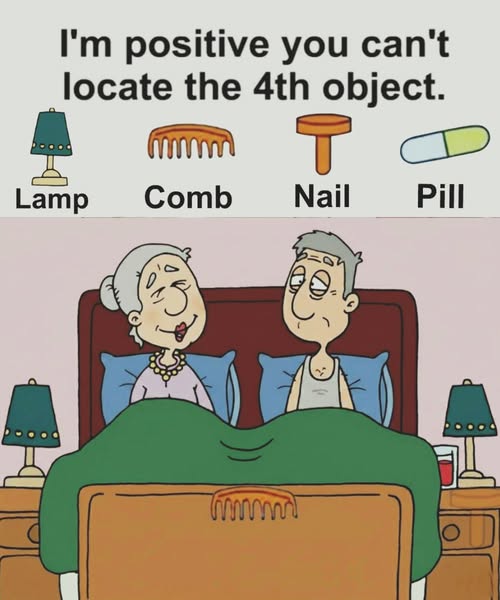
Can you see the pill, lamp, comb, and nail?
This cartoon-style visual puzzle looks simple at first glance, but it is carefully designed to challenge how the human brain processes detail and attention. The scene shows an elderly couple peacefully resting in bed, surrounded by ordinary bedroom items that seem familiar and harmless. Soft colors, gentle lighting, and cozy composition all work together to create a calm atmosphere that makes viewers relax too quickly. That sense of comfort is exactly what makes the hidden-object challenge more difficult than expected.
Most people begin by noticing the most obvious elements in the scene. The bed, pillows, bedside tables, and lamps immediately stand out because they are large, clearly shaped, and placed in predictable positions. The brain naturally prioritizes these objects first, building a quick understanding of the environment. However, this early recognition often creates a false sense of completion, leading viewers to believe they have already found most of what they need before carefully examining smaller details.
The puzzle specifically asks viewers to locate four hidden items: a lamp, a comb, a nail, and a pill. At first, this list seems straightforward, almost too easy for a visual challenge. But the difficulty lies not in the names of the objects, but in how they are visually integrated into the artwork. Each item is deliberately blended into its surroundings using color similarity, positioning, and partial concealment to reduce immediate visibility.
The lamps are usually the easiest to identify because they are part of the natural bedroom setup. They sit on both bedside tables and match the environment so well that they feel like background elements rather than hidden objects. Even though they are clearly visible, many people overlook them simply because their attention moves too quickly toward more unusual details elsewhere in the image.
The comb requires slightly more focus. In many versions of this type of puzzle, it is placed near the lower portion of the scene, often close to the bed or partially integrated into fabric folds or furniture edges. Its shape is simple enough to be recognizable, but its color and alignment with surrounding objects make it easy for the eye to skip over it without conscious recognition.
The nail is significantly more challenging because it is designed to blend almost seamlessly into structural lines within the illustration. Instead of appearing as a distinct metallic object, it may be hidden within shadows, wooden textures, or decorative outlines. This forces the viewer to slow down and examine parts of the image they would normally ignore. It is a classic example of how small details can disappear when they match the visual rhythm of their environment.
The pill is often considered the most difficult element in the entire puzzle. This is because it relies heavily on perceptual blindness rather than simple hiding. The human brain is naturally drawn to larger shapes and familiar objects, while very small items that lack strong contrast tend to be ignored. In many cases, the pill is placed near objects such as cups, glasses, or bedside items, where its shape and color subtly merge into the surroundings, making it nearly invisible at first glance.
This type of visual challenge demonstrates how attention works in a selective way. The brain does not process every detail equally; instead, it filters information based on relevance, size, and expectation. As a result, even clearly visible objects can remain unnoticed if they do not immediately stand out from their environment. This is why many people need multiple attempts before successfully identifying all hidden items in the scene.
One effective strategy for solving puzzles like this is to divide the image into smaller sections rather than scanning it as a whole. By slowing down and focusing on one area at a time, the viewer reduces the chance of overlooking subtle details. Hidden objects are often not truly invisible—they are simply positioned in ways that discourage rapid detection.
These visual puzzles are widely enjoyed because they combine relaxation with cognitive engagement. They help train observation skills, improve attention to detail, and strengthen visual memory over time. Even when people fail to find all objects on the first attempt, the process of re-examining the image often leads to satisfying “aha” moments when previously missed details suddenly become clear.
Ultimately, the challenge is not just about finding objects, but about understanding how perception works. What seems hidden is often simply overlooked due to how the brain prioritizes information. With patience and careful observation, even the most subtle details eventually reveal themselves, turning confusion into clarity.