An Army Sergeant Mocked an 81-Year-Old Woman Eating Alone in the Dining Hall,
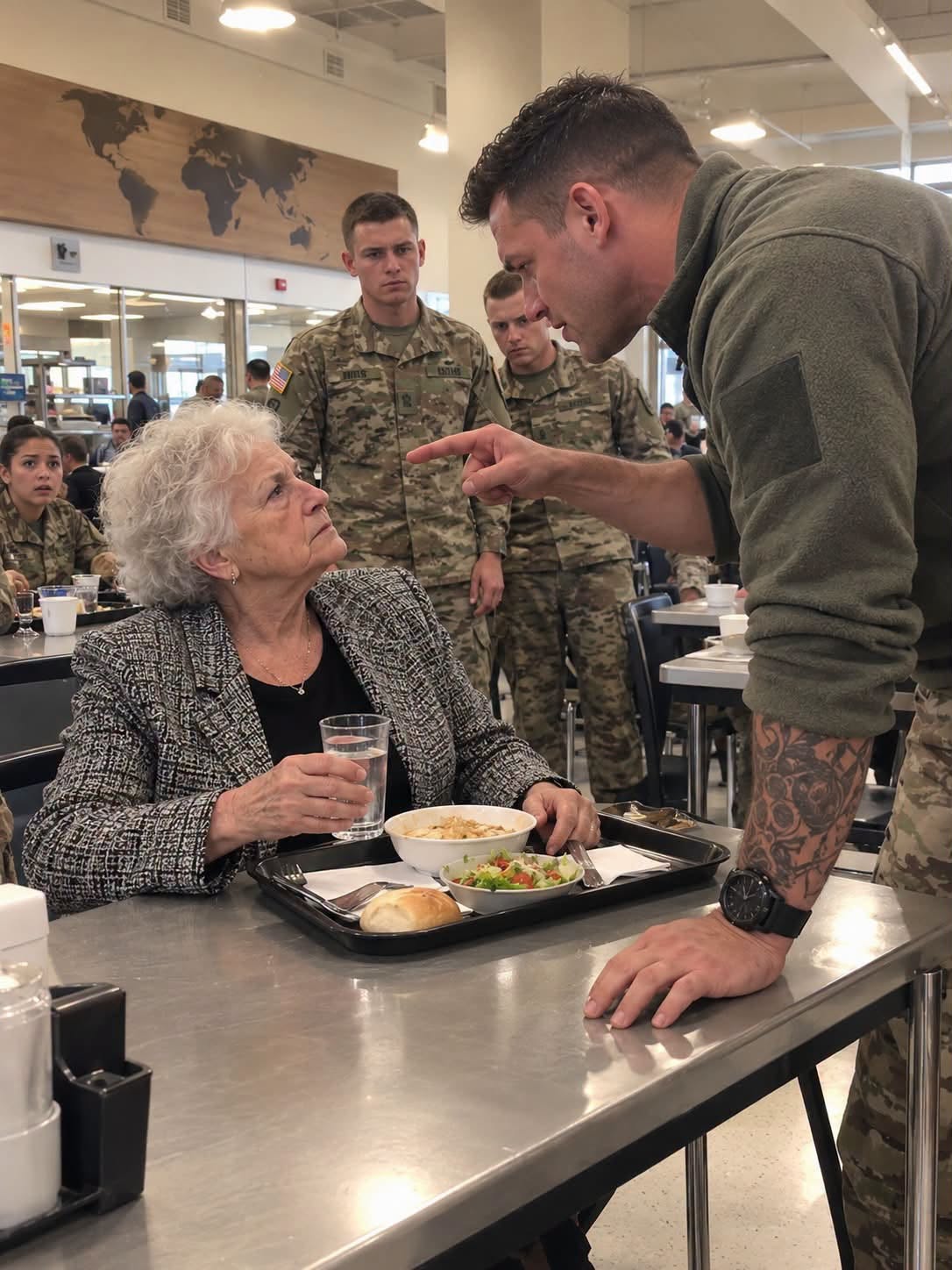
“Hey, Grandma. What was your rank back in the Stone Age?”
I didn’t look up. I’d driven forty minutes for that chili.
Three soldiers stood over my table at Fort Campbell, Kentucky. The one speaking was Staff Sergeant Reese, a young man who seemed to enjoy making others feel small.
“I’m talking to you, ma’am,” he said. “You need a pass to be here. Or did you wander over from the old folks’ home for a free lunch?”
His friends laughed.
My name is Quinn Braddock. I’m eighty-one years old, a retired school nurse living in Clarksville, Tennessee. But long before I spent thirty-one years caring for children, I served as a first lieutenant in the Army Nurse Corps during Vietnam.
Reese slapped his hands on my table.
“Who are you, and what are you doing on my post?”
I had a visitor’s pass in my purse, but I refused to show it to someone who had already decided I didn’t belong.
Then his eyes fell on the little brass pin on my gray coat.
A blue shield with a white heron.
It was the same crest he wore on his uniform.
“Where did you get that?” he demanded. “Men died for that. Take it off before I do it for you.”
“No,” I replied calmly.
I pointed toward the wall behind the serving line.
“Before you touch me, Sergeant, read what it says up there.”
He turned reluctantly.
“We Carry Our Own,” he read.
“Keep going.”
Beneath the battalion motto were smaller words he had apparently never bothered to read.
“This dining facility is dedicated to First Lieutenant Quinn Hollis, Army Nurse Corps, who carried forty-one of ours home. May 1969.”
He froze.
Then he slowly turned toward me.
“Ma’am, what did you say your name was?”
“You never asked. You asked my rank.”
I folded my hands.
“First lieutenant. My maiden name was Hollis.”
His face turned white.
At that moment, the battalion’s command sergeant major and lieutenant colonel approached. They had an appointment with me, but I had arrived early for lunch.
Command Sergeant Major Hayes stopped beside my table, stood at attention, and saluted.
“Ma’am, welcome home to the Herons.”
Two hundred soldiers rose to their feet and saluted with him.
Reese stood motionless.
The lieutenant colonel turned to him.
“Staff Sergeant, my office. Thirteen-thirty.”
Before leaving, Reese looked at me with tears in his eyes.
“Ma’am, I’m…”
“Not now, son,” I said quietly. “We’ll talk later.”
But first, I need to tell you how I earned that pin.
In 1968, I was twenty-four, working as a nurse in Nashville. My younger brother, Danny, was nineteen and serving with the Herons in Vietnam.
One day, I received a letter from him. He joked about the terrible food and told me not to worry.
Three weeks later, two officers arrived at my parents’ farmhouse.
Danny had stepped on a mine in the A Shau Valley. He died aboard a medical evacuation helicopter, just twenty minutes from the hospital.
I couldn’t stop thinking about those twenty minutes.
Two weeks after his funeral, I walked into an Army recruiting office and joined the Army Nurse Corps.
“I know where they’ll send you,” the recruiter warned.
“That’s exactly why I’m here,” I answered.
In January 1969, I arrived in Vietnam and was assigned to the 85th Evacuation Hospital at Phu Bai.
Many of our wounded soldiers belonged to the Herons.
Every time a helicopter arrived, I looked for their white heron crest. Whenever I saw it, I worked harder. Each wounded soldier reminded me of Danny.
Then came May 18, 1969.
After ten days of brutal fighting on Hill 937, helicopters began arriving at five in the morning. They continued for nineteen hours.
We treated 212 wounded men that day. Forty-one were Herons.
When enemy rockets struck the base, everyone was ordered into the bunkers. But a helicopter carrying eight wounded Herons remained on the landing pad.
I ran outside with two medics to bring them to safety.
Rockets exploded around us as we dragged the men across the landing pad. One blast sent shrapnel through my shoulder.
I didn’t stop.
I bandaged the wound and returned to work, treating casualties until four the next morning.
All forty-one Herons survived.
Not one died under my care.
Two weeks later, Lieutenant Colonel Harold Vance, the battalion commander, visited me. He removed the brass heron crest from his own collar and pinned it onto mine.
“You’re one of ours now, Lieutenant,” he said. “The Herons carry their own. And you carried forty-one of them.”
I told him about Danny.
He placed a hand on my shoulder.
“Then you got him home, Lieutenant. Forty-one times.”
I received a Bronze Star and a Purple Heart, but those medals stayed in a box in my bedroom.
The pin was the one I wore every day.
I returned home in 1970, married my husband, Walt, and eventually became a school nurse. I raised two daughters and lived a quiet life.
Nobody at the elementary school knew what I had done in Vietnam.
But the Herons never forgot.
In 1998, the battalion dedicated its new dining facility to me. They painted my name and the story of those forty-one soldiers on the wall.
Since then, I had driven forty minutes to Fort Campbell every Thursday for chili.
For twenty-six years, I had eaten beneath my own name.
And Staff Sergeant Reese had never once read it.
***
That afternoon, I met with Lieutenant Colonel Ortiz and Command Sergeant Major Hayes.
They had business to discuss. After my husband died in 2009, I had sold forty acres of family farmland for $340,000 and used his $150,000 life insurance payout to establish the Heron Family Fund.
The fund helped families who lost soldiers in service. It paid rent and mortgages, college tuition, and education expenses for surviving spouses.
I wanted no recognition. Families simply received letters saying, “From the Herons. We carry our own.”
Over sixteen years, the fund had paid $1.14 million to fourteen families. Its balance had grown to $612,000.
Then the sergeant major placed another document in front of me.
“Ma’am, there’s something you should know about Staff Sergeant Reese.”
His father, Michael Reese, had been a Heron killed by an explosive device in Afghanistan in 2008. Tyler was eleven years old.
I remembered the family. His mother, Angela, had struggled to support Tyler and his younger brother.
The fund had paid their rent for three years, covered Angela’s tuition, and helped Tyler attend college.
Tyler had eventually dropped out and enlisted in his father’s old battalion.
And he had no idea who had helped his family survive.
The lieutenant colonel explained that Reese’s behavior warranted formal disciplinary action. His promotion could be affected.
I agreed he needed consequences, but I didn’t want one terrible mistake to destroy his future.
“Counsel him formally,” I said. “Put it in writing. But please don’t end his career over me.”
Then I asked to speak with him alone.
When Tyler entered the room, his hands trembled.
“I’m sorry, ma’am,” he said. “I’ve walked under that wall every day for three years. I never read it.”
“Most people don’t,” I replied.
He explained that he’d mistaken me for someone falsely claiming military honors. His father had died wearing the heron crest, and Tyler couldn’t bear the thought of someone disrespecting it.
“I understand wanting to protect something your father gave his life for,” I told him. “But you have to learn how to protect it without disrespecting others.”
I explained how Colonel Vance had given me the pin after I rescued the wounded Herons.
Then I told him about Danny and the twenty minutes that had changed my life.
Finally, I mentioned his father.
“I met Michael at a battalion picnic in 2006. You were a little boy wearing a shirt much too big for you. You tried to salute me with your left hand, and your father laughed so hard he spilled his lemonade.”
Tyler covered his mouth.
“I don’t remember that,” he whispered.
“You were nine. I remember.”
I asked him how his mother had managed after his father died.
He described the anonymous fund that had paid their rent and his mother’s tuition.
Then he looked at the bank folder on the table.
“Ma’am,” he whispered. “Was that you?”
“Your mother doesn’t need to thank anybody,” I said. “That’s not how it works. We carry our own.”
Tyler lowered his head onto the table and cried.
“You paid for my mom’s school and helped us keep our home. And I snapped my fingers in your face.”
“You did,” I said gently. “Now you know better. That’s all a person can do, Tyler. Know better, then do better.”
The next morning, Tyler publicly apologized to his company and to me. He accepted a formal written counseling that would remain in his record.
He also promised to learn from what had happened.
***
Three weeks later, I heard trucks outside my yellow house.
Six pickup trucks lined the street, carrying lumber, tools, and concrete. About twenty soldiers climbed out, wearing jeans and gray Army sweatshirts.
Tyler stood at the front.
“Mrs. Braddock,” he called, “we heard you have a lot of stairs.”
My house had eleven concrete steps leading to the sidewalk. Since my hip replacement, getting to the mailbox had become a struggle.
“We’re building you a ramp,” he explained. “The whole company chipped in.”
The cost was $1,140.
Forty-one dollars from each soldier, one dollar for every Heron I had brought home.
I stood on my porch, unable to speak.
“You don’t owe me anything,” I finally told Tyler.
“No, ma’am. That’s not why we’re here.”
Then he repeated the words painted on the dining hall wall.
“We carry our own.”
The soldiers returned every Saturday. I made chili and cornbread while they worked, and soon my neighbor joined us with homemade pound cake.
On the second Saturday, Tyler brought his mother, Angela.
She walked up my steps and stood in front of me, tears filling her eyes.
“Sixteen years,” she whispered. “I’ve been trying to find out who helped us.”
She told me how, after Michael died, she had only $412 in the bank and feared losing their home. Then the letters from the fund arrived, paying their rent and offering to cover her education.
She became a respiratory therapist and had spent twelve years helping patients.
“Last month, I helped save an eighty-year-old Vietnam veteran,” she told me. “I kept him alive because somebody paid for me to learn how.”
Then she hugged me.
I held her close, feeling the tears on my gray coat beside the old brass pin.
The ramp took three Saturdays to complete.
It had sturdy handrails and gentle turns, making it possible for me to reach the sidewalk safely.
A small wooden plaque at the top read:
“Built by the Herons. November 2025. We Carry Our Own.”
When the work was finished, the soldiers gathered in my driveway and asked me to take the first walk down.
I held the handrail and moved slowly with my cane. The journey took a minute and a half instead of five.
The soldiers cheered as if I had scored a touchdown.
Then Tyler presented me with a black box containing a brand-new heron crest.
“We know you’ll never take off the old one,” he said. “But we thought you might like this one for church.”
I smiled and made one request.
“When you become a sergeant first class, find the youngest Heron who lost a parent. The one trying hardest to be the strongest person in the room.”
I paused.
“Sit with that soldier on Chili Thursday and tell them what the wall says.”
His eyes filled with tears.
“Yes, ma’am. I will.”
***
Tyler made sergeant first class that February.
The promotion board had questioned him about his disciplinary record, and he answered honestly. They unanimously approved his promotion.
During the ceremony beneath the dining hall wall, his mother pinned on his new rank.
Afterward, Tyler walked over and saluted me before giving me a hug.
“Thank you, Lieutenant,” he whispered.
“Thank your daddy,” I replied. “He’d be so proud of you, he’d spill his lemonade.”
He laughed through his tears.
That spring, Tyler began donating $100 a month to the Heron Family Fund. He encouraged other soldiers to contribute, too, without revealing my identity.
By June, sixty-three soldiers had signed up. Their contributions totaled $2,840 each month.
When Paula Jennings from the bank called to tell me, I sat at my kitchen table and cried.
For sixteen years, I had been the only person contributing to the fund.
Now the Herons were carrying one another forward.
***
I’m eighty-two now, and I still drive to Fort Campbell every Thursday for chili.
But I don’t eat alone anymore.
There’s always a reserved table near the serving line with a little card that reads:
“Reserved. 1LT Q. Hollis Braddock.”
Every week, a different young soldier sits with me. Some have lost parents. Others are struggling with things they don’t know how to explain.
Last Thursday, Tyler brought over an eighteen-year-old private named Marcus Bell.
Marcus’s father had been a Heron killed in Iraq in 2011. Marcus was only four years old at the time.
Like Tyler once had, he was trying desperately to be the strongest person in the room.
I told him about Danny, Vietnam, the wounded soldiers, and the pin Colonel Vance had given me.
I told him about the forty-one Herons who made it home alive.
When I finished, Marcus turned toward the wall and slowly read both lines aloud.
“We Carry Our Own. This dining facility is dedicated to First Lieutenant Quinn Hollis, Army Nurse Corps, who carried forty-one of ours home. May 1969.”
Then he looked at the old, chipped pin on my collar.
“Ma’am,” he asked quietly, “does carrying them ever get any lighter?”
I thought about Danny. About the wounded soldiers. About Angela and her sons. About the young men and women who had built a ramp beside my house.
“No, Marcus,” I told him. “It never gets lighter.”
He looked down at his chili.
“But you don’t carry it alone. That’s the whole point. Look around you, son.”
He looked at Tyler, at the soldiers sharing their lunch, and at the people who had become his family.
“Every one of them has your back,” I said. “And one day, you’ll have theirs.”
Marcus picked up his spoon.
And for the first time since he sat down, he began to eat.