An 82-Year-Old Woman Asked Me to Marry Her Before She Died After the Funeral, Her Lawyer Handed Me Her Hospital Bag
When I accepted a job as an orderly at a small nursing home, I thought I was simply looking for a steady paycheck and a fresh start.
I never imagined that one elderly resident would completely change the course of my life. At the time, I believed I was the one helping her through the final chapter of her life. I had no idea she had quietly been changing mine from the moment we met.
The nursing home was nothing like the cold, sterile facilities people usually imagined. The hallways carried the comforting scent of lemon polish mixed with old books that had been read a thousand times. Family photographs decorated the walls, faded quilts rested across wheelchairs, and soft music drifted from an ancient radio near the reception desk.
After spending most of my childhood moving through foster homes, I had learned to recognize genuine kindness wherever I found it. That little nursing home wasn’t perfect, but it held more warmth than many of the houses I’d lived in growing up.
Most of the residents barely noticed me during my first few weeks.
Except Gloria.
She was eighty-two years old, remarkably sharp, endlessly stubborn, and possessed the rare ability to make everyone around her smile without even trying. She had silver hair she refused to dye, bright blue eyes that seemed capable of reading people’s thoughts, and a dry sense of humor that caught everyone off guard.
The very first morning I delivered breakfast to her room, she looked me up and down before I even had time to introduce myself.
“You’re new,” she observed.
“I am.”
“But you don’t move like someone who’s new.”
I laughed as I placed her tray on the table.
“What does that mean?”
“You’ve been carrying trays your whole life,” she replied matter-of-factly. “Not just here. Long before this place.”
Her words stopped me for a second.
“Something like that.”
“I knew it,” she said with a satisfied nod. “Now tell me your name.”
“I’m Daniel.”
“It’s lovely to meet you, Daniel.”
She motioned toward the empty chair beside her bed.
“Sit for a minute.”
“I really should keep working.”
“Nonsense. The eggs will still be cold five minutes from now.”
I smiled despite myself and sat down.
“So,” she asked, folding her hands together, “tell me about yourself.”
The question caught me completely off guard.
Nobody had asked me that in years.
People usually asked what shift I worked, whether I could lift patients, or where supplies were stored. No one asked about me.
“There isn’t much to tell.”
“I don’t believe that.”
I hesitated.
“I grew up in foster care.”
She didn’t interrupt.
“I never really knew my parents.”
She simply listened.
“I’ve been working different jobs since I was eighteen.”
Still, she waited patiently.
When I finally stopped talking, Gloria smiled.
“You’ve survived a great deal.”
“I guess.”
“No,” she corrected gently. “You have.”
Before I left the room, she pointed toward my untouched coffee.
“Next time, bring yourself a fresh cup. The one you’re drinking tastes terrible.”
That made me laugh all the way down the hallway.
From that morning forward, visiting Gloria became part of my daily routine.
Every shift began or ended in her room.
Sometimes I brought her tea after work.
Sometimes I stayed during my lunch break.
Sometimes we talked for only five minutes.
Other days, an hour disappeared before either of us noticed.
Slowly, the relationship stopped feeling like employee and resident.
She became something I had never really experienced before.
Family.
Gloria loved telling stories.
She described growing up on a small farm where summers smelled like fresh hay and apple trees.
She talked about dancing barefoot in her parents’ kitchen whenever the radio played Glenn Miller.
She laughed while remembering the first pie she baked completely by herself.
“It looked beautiful,” she admitted.
“How did it taste?”
“Like salted cardboard.”
I nearly spit out my tea.
“My poor husband ate two slices anyway.”
“He loved you.”
“He certainly had strange taste.”
She spoke often about her late husband, Richard.
“He wasn’t handsome,” she once teased.
“I’m sure he was.”
“He absolutely wasn’t.”
“So why did you marry him?”
She leaned back in her chair with a mischievous grin.
“Because he made me laugh every single day.”
Then her smile softened.
“And because he never once made me feel lonely.”
There was always affection in her stories.
Never bitterness.
Never regret.
One thing, however, was noticeably absent.
Family.
Unlike many other residents, Gloria never had visitors.
Birthdays came and went.
Christmas passed.
Thanksgiving.
Easter.
Mother’s Day.
Her room remained quiet.
No children.
No grandchildren.
No relatives carrying flowers or balloons.
Eventually, curiosity got the better of me.
“Does anyone visit you?”
She stirred her tea thoughtfully.
“I had a nephew once.”
“Marcus?”
Her eyebrows lifted.
“So I must have mentioned him before.”
“Only once.”
“He stopped visiting after he realized I wasn’t going anywhere.”
She smiled as though she were commenting on the weather instead of her own abandonment.
“I imagine he’ll come back someday.”
“You think so?”
“Oh yes.”
“Why?”
“The moment he hears I’ve died.”
I frowned.
“You say that awfully calmly.”
She looked out the window where afternoon sunlight spilled across the garden.
“People reveal themselves when they think something belongs to them.”
“You don’t sound angry.”
She shook her head.
“Bitterness is a house I refuse to live in.”
Those words stayed with me long after I left her room.
Bitterness is a house I refuse to live in.
It sounded like the kind of wisdom that only arrived after surviving decades of disappointment.
There was one mystery about Gloria that I could never solve.
Her bag.
It was an old canvas hospital bag with faded blue fabric, worn handles, and frayed corners that looked as though they had traveled thousands of miles.
She carried it everywhere.
If she went to physical therapy, the bag went too.
If she sat in the common room, it rested beside her chair.
If nurses cleaned her room and moved it aside, she’d quietly reach over and place it back within arm’s reach.
She never let it out of her sight.
One afternoon while helping organize her bedside table, I finally asked.
“Can I ask you something?”
“You just did.”
I laughed.
“The bag.”
“What about it?”
“It seems pretty important.”
“It is.”
“What’s inside?”
She rested one wrinkled hand on top of it.
“Everything that matters to me.”
I smiled.
“Can I see?”
Her expression softened into a gentle smile.
“One day, maybe.”
She hadn’t really answered.
But she hadn’t exactly refused either.
So I let it go.
Everyone deserved one private corner of the world.
Every now and then, I’d notice her unzip the bag just enough to glance at something inside.
Usually it was a small photograph tucked carefully near the top.
The moment she realized I was looking, she’d quietly close the zipper again.
I never asked twice.
Sarah, another orderly, noticed how much time Gloria and I spent together.
She was around my age, funny, outspoken, and quickly became my closest friend at work.
One afternoon we were eating sandwiches in the break room when she smirked at me.
“You know Gloria has basically adopted you.”
I nearly choked on my drink.
“What?”
“Oh, don’t pretend you haven’t noticed.”
“Noticed what?”
“She watches the hallway every morning waiting for you.”
“She does not.”
“Daniel, I’ve worked here four years.”
Sarah pointed her sandwich at me.
“The woman lights up every single time you walk through that door.”
I shrugged awkwardly.
“She’s lonely.”
“So are half the residents.”
“Then maybe I remind her of someone.”
Sarah tilted her head thoughtfully.
“Actually…”
“What?”
“It’s funny.”
“What is?”
“Gloria transferred here right before you were hired.”
“So?”
Sarah smiled.
“I don’t know.”
“What?”
“It almost feels like she was waiting.”
I rolled my eyes.
“You’re reading too much into it.”
“Maybe.”
But the strange comment lingered in my mind longer than I wanted to admit.
A few weeks later, everything changed.
During one of Gloria’s routine health checks, I immediately noticed something was wrong.
Her hands trembled while reaching for her teacup.
Her breathing sounded heavier than usual.
Her normally rosy complexion had faded into an unhealthy gray.
Even her jokes had disappeared.
“You don’t look like yourself today,” I said quietly.
“I’ve looked like an eighty-two-year-old woman for quite a while now.”
“I’m serious.”
“So am I.”
She tried to smile, but it didn’t quite reach her eyes.
When she noticed me studying her face, she instinctively pulled the old canvas bag closer against her chest.
Almost protectively.
As though she suddenly feared someone might take it.
Three weeks later, an ambulance arrived.
The call came just before dawn.
Everything happened quickly.
Nurses hurried through the hallway.
Doctors shouted instructions.
The paramedics loaded Gloria onto a stretcher while attaching oxygen and monitors.
“Do you have family we should call?” one of them asked.
She looked directly at me.
“No.”
There wasn’t anyone else.
Without thinking twice, I climbed into the ambulance beside her.
The old canvas bag rested on the seat between us.
Neither of us spoke during the ride.
The sirens echoed through the streets while I watched her stare silently out the back window.
For the first time since I’d met Gloria, she looked frightened.
Not terrified.
Not panicked.
Just… tired.
The hospital admitted her immediately.
The doctors confirmed what everyone had quietly suspected.
Her heart was failing.
The treatments could slow things down.
But they couldn’t stop what was coming.
Over the next several days, I visited whenever I wasn’t working.
Sometimes she slept.
Sometimes we talked.
Sometimes we simply sat together without saying anything at all.
Then, one quiet afternoon, she patted the empty chair beside her hospital bed.
“Sit down, Daniel.”
I pulled the chair closer.
She reached for my hand.
Despite everything, her grip remained surprisingly steady.
“I have something to ask you.”
Her voice was calm.
Gentle.
Almost peaceful.
I nodded.
“I’m listening.”
She looked directly into my eyes.
“I have one final wish.”
I leaned forward.
“I know this is going to sound very strange.”
“You don’t have to worry about sounding strange with me.”
A faint smile crossed her face.
“I don’t have much time left.”
I opened my mouth to protest.
She squeezed my hand.
“No, Daniel.”
There was quiet certainty in her voice.
“We both know that’s true.”
I couldn’t argue.
She took a slow breath before continuing.
“I’ve spent many years alone.”
Another pause.
“Too many.”
The heart monitor beeped softly beside her bed.
“I don’t want to leave this world knowing I never again had someone I could call my husband.”
I stared at her, unsure I’d heard correctly.
Then she asked the question that completely stopped my world.
“Will you marry me?”
I couldn’t speak.
The room suddenly felt impossibly quiet. The steady rhythm of the heart monitor became the only sound between us, each beep stretching the silence longer than the last.
My mind refused to process what I had just heard.
An eighty-two-year-old woman.
A thirty-four-year-old orderly.
Marriage.
Nothing about those words belonged together.
“Gloria…” I finally whispered.
She offered a gentle, almost apologetic smile.
“I told you it would sound strange.”
“I just… I wasn’t expecting…”
“I know.”
She squeezed my hand one more time before letting go.
“Don’t answer now.”
I looked up.
“Go home. Think about it. Sleep on it if you have to.”
She paused.
“But please… don’t say no simply because you’re worried about what other people will think.”
That was exactly what frightened me.
Not because I cared about gossip for its own sake, but because I already knew what everyone would assume.
They wouldn’t see an old woman asking for one final comfort.
They would see a young man marrying a dying patient.
They would assume greed.
Manipulation.
Abuse.
Every ugly explanation except the truth.
“I’ll come back tomorrow,” I promised quietly.
Gloria smiled.
“I’ll be here.”
I left the hospital carrying a weight I couldn’t explain.
That night I barely slept.
Every time I closed my eyes, I imagined the headlines people would invent.
Nursing Home Orderly Marries Dying Patient.
Caretaker Exploits Elderly Widow.
Career Destroyed by Shocking Marriage.
By sunrise I had given up trying to rest.
Instead, I drove straight to work and found Sarah pouring coffee in the break room.
She looked at me once and frowned.
“Daniel, you look awful.”
“I need to tell you something.”
She immediately set her mug down.
“What happened?”
“Promise you won’t laugh.”

Her expression became serious.
“I promise.”
I took a deep breath.
“Gloria asked me to marry her.”
For several seconds Sarah didn’t blink.
She simply stared.
Then she slowly rubbed her forehead.
“Please tell me you said no.”
“I haven’t answered.”
“Daniel…”
Her voice became careful.
“You understand how this looks, don’t you?”
“I do.”
“No, I don’t think you do.”
She leaned closer.
“You’re thirty-four.”
“I know.”
“She’s eighty-two.”
“I know.”
“She’s dying.”
“I know.”
“And she has no family.”
I nodded again.
Sarah sighed deeply.
“If anyone finds out, management will investigate. Your license, your reputation, every future job you ever apply for… all of it could disappear.”
“I’ve thought about that.”
“Have you?”
She looked genuinely worried.
“Because people won’t believe this was innocent.”
“I know.”
“They’ll think you wanted money.”
“I don’t.”
“They’ll think you manipulated her.”
“I didn’t.”
“They’ll think you’ve been planning this.”
“I wasn’t.”
Sarah remained silent for a long moment.
Finally she asked the question she already knew the answer to.
“You’re considering saying yes, aren’t you?”
I looked down at my hands.
“She’s dying.”
“So?”
“She asked me for one thing.”
“There are a hundred other things she could have asked.”
“But she didn’t.”
My voice cracked.
“She asked for this.”
Sarah searched my face.
Then she shook her head with sad understanding.
“That’s your problem, Daniel.”
“What is?”
“You never think your own life is worth protecting.”
Those words stayed with me all morning.
Maybe she was right.
Growing up in foster care had taught me to expect very little for myself.
If helping someone else meant sacrificing something, sacrificing simply felt natural.
By afternoon I was back at the hospital.
Gloria was reading an old paperback when I walked in.
The instant she saw me, her face brightened.
“You came back sooner than I expected.”
“I couldn’t wait.”
She quietly closed the book.
“I have my answer.”
She studied me carefully.
There was hope in her eyes, but also acceptance.
As if she had already prepared herself to hear no.
“I want to do it.”
She blinked.
Then whispered so softly I almost missed it.
“Really?”
“Yes.”
For the first time since I’d known her, tears filled Gloria’s eyes.
She refused to let them fall.
Instead she smiled.
Not the cheerful smile she showed everyone.
Not the teasing smile she wore during our conversations.
This smile carried decades of loneliness finally beginning to lift.
She reached across the blanket and clasped both of my hands.
“Thank you.”
“No.”
I squeezed gently.
“Thank you… for trusting me.”
The old canvas bag rested beside her bed exactly where it always had.
Her fingertips brushed against it almost unconsciously.
As though reminding herself it was still there.
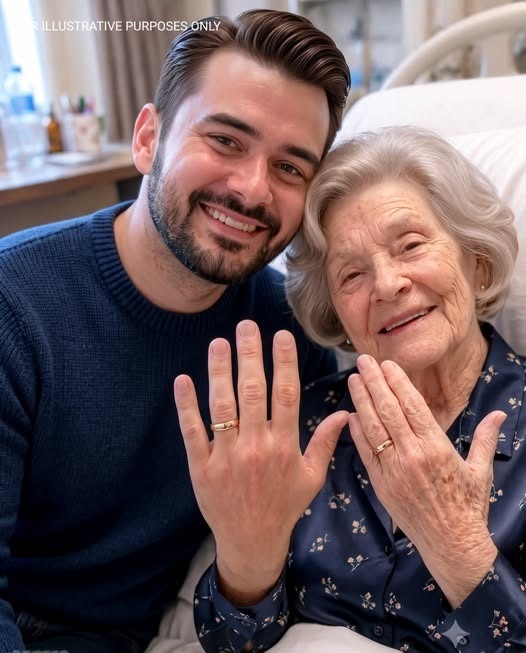
One week later, we were married.
There were no flowers.
No expensive decorations.
No reception.
Just a quiet hospital room filled with sunlight pouring through the window.
A hospital chaplain performed the ceremony.
Sarah stood beside us as our witness.
She hadn’t argued anymore.
She still worried.
I could see it in her eyes.
But she also understood.
Gloria wore a soft pink cardigan instead of a wedding dress.
She insisted on brushing her silver hair herself.
“You only get married twice,” she joked.
“I should at least look respectable.”
I laughed.
“You look beautiful.”
She rolled her eyes.
“You’re a terrible liar.”
The ceremony lasted less than fifteen minutes.
The chaplain spoke gently about companionship, loyalty, and kindness.
When he pronounced us husband and wife, Gloria smiled with a peace I had never seen before.
It wasn’t excitement.
It was relief.
Like someone who had finally finished carrying a burden that had lasted an entire lifetime.
Three days later, she slipped away in her sleep.
I was sitting beside her bed.
My hand rested beneath hers.
Sometime before dawn, her breathing slowed.
Then quietly stopped.
There was no struggle.
No fear.
Just silence.
I sat there for a long time after the nurses covered her with the white sheet.
I wasn’t crying.
Not because I wasn’t grieving.
Because I couldn’t quite understand how someone who had entered my life only two years earlier could leave behind such an enormous emptiness.
Her funeral took place beneath a gray sky with steady rain.
Only a handful of people attended.
Several nurses.
Sarah.
The hospital chaplain.
A few residents who had been healthy enough to travel.
That was all.
After the service ended, I remained standing beside her grave while everyone else slowly drifted away.
That’s when a distinguished man carrying a leather briefcase approached me.
“Daniel?”
“Yes.”
“I’m Theodore Charleston.”
He extended his hand.
“I was Gloria’s attorney.”
I shook it.
Without another word, he lifted something from beneath his arm.
The old canvas hospital bag.
Seeing it outside the hospital made my chest tighten.
He carefully placed it into my hands.
It felt much heavier than I expected.
“There is something inside for you.”
I looked at him.
“A letter.”
Before I could ask another question, Mr. Charleston lowered his voice.
“Gloria wanted you to read it before anything else happens.”
“What do you mean?”
“She anticipated—”
“Daniel.”
A sharp voice interrupted him.
A man in an expensive gray suit walked directly toward us.
Around fifty years old.
Thinning hair.
Hard eyes.
Tight jaw.
I recognized him instantly without ever having seen him.
Marcus.
Gloria’s nephew.
“You must be Daniel.”
“I am.”
“I’m Marcus.”
“I know.”
“I’m sure my aunt mentioned me.”
“She did.”
His smile contained no warmth.
He looked me up and down as though examining a criminal.
“A young orderly marries my eighty-two-year-old aunt three days before she dies.”
His voice dripped with sarcasm.
“Quite a touching love story.”
“It wasn’t like that.”
“They always say that.”
“You don’t know anything about us.”
“I know enough.”
He stepped closer.
“I’ll be contesting everything.”
I frowned.
“The marriage.”
“The will.”
“Every document she signed.”
“My attorney is already preparing the paperwork.”
“I didn’t marry Gloria for money.”
Marcus laughed.
“Of course not.”
“I didn’t.”
“Then you won’t mind giving me that bag.”
My fingers tightened around the worn handles.
“I think Gloria wanted me to have it.”
“I think she was manipulated.”
Mr. Charleston finally spoke.
“Mr. Marcus, this isn’t the time.”
“Oh, I think it’s exactly the time.”
He looked directly at me.
“You exploited a vulnerable old woman.”
“I did no such thing.”
“You’ll have plenty of opportunities to explain that in court.”
My stomach twisted.
Everything Sarah had warned me about was happening.
Already.
I turned toward Mr. Charleston.
He gave the slightest shake of his head.
Almost invisible.
Don’t hand over the bag.
“I need time.”
Without waiting for another response, I walked away.
Behind me I heard Mr. Charleston calling.
“Daniel! Please wait! There’s something you need to know.”
But my thoughts were too loud to hear anything else.
By Monday morning the rumors had spread throughout the nursing home.
Nobody accused me directly.
They didn’t have to.
The conversations stopped whenever I entered a room.
Two nurses whispered near the medication cart before suddenly becoming silent.
Several employees avoided eye contact.
Even a few residents looked confused.
Sarah eventually found me folding towels in the supply room.
She quietly closed the door.
“Management scheduled a formal inquiry.”
“When?”
“Wednesday.”
“I figured.”
She hesitated.
“What are you going to do?”
I looked at the floor.
“I’m giving everything back.”
“What?”
“Whatever Gloria left me.”
“The house.”
“The money.”
“The bag.”
“Everything.”
Sarah stared in disbelief.
“Daniel, that’s exactly what Marcus wants.”
“I don’t care.”
“You should.”
“I don’t.”
“I can’t spend the rest of my life wondering if people think I married her for money.”
She stepped closer.
“You were her family.”
“I was her orderly.”
“You were much more than that.”
I couldn’t answer.
That evening the old canvas bag sat unopened on my apartment floor.
Somehow opening it felt wrong.
Almost like invading the last private part of Gloria’s life.
My phone rang.
Mr. Charleston.
“You haven’t opened it yet.”
“No.”
“Please do.”
“I don’t think I should.”
“You must.”
His voice became firmer.
“Gloria prepared for exactly what’s happening.”
“What do you mean?”
“She knew Marcus would appear.”
“She knew he’d accuse you.”
“She knew you’d want to give everything away.”
Silence.
“Daniel.”
“Please.”
“Read her letter.”
After hanging up, I stared at the faded zipper for nearly ten minutes.
Finally, I took a deep breath.
And opened the bag.
There was no jewelry.
No stacks of cash.
No property deeds.
No hidden fortune.
Instead, there were hundreds of letters.
Carefully tied together with faded blue ribbons.
Some were dated 1972.
Others had been written only months earlier.
There was a cracked photograph of a teenage girl holding a newborn baby.
And resting on top of everything…
A sealed envelope.
My name appeared across the front in Gloria’s unmistakable handwriting.
I opened it with trembling hands.
Every word blurred as tears filled my eyes.

The following morning, Mr. Charleston invited both Marcus and me to his office.
Marcus sat across the conference table with folded arms, looking confident.
Almost smug.
Mr. Charleston nodded toward me.
“When you’re ready.”
I unfolded Gloria’s letter.
Then began reading aloud.
“My dearest Daniel,
If you are reading this, then I am finally at peace.
There is something I have waited my entire life to tell you.
When I was seventeen years old, I gave birth to a baby boy.”
My voice faltered.
I swallowed hard and continued.
“I loved him more than life itself.
But I was young, frightened, and alone.
I believed giving him away would give him a better future than I could ever provide.”
Marcus shifted uneasily.
“I spent the next fifty years writing letters to my son.
Hundreds of them.
I never mailed a single one because I didn’t know where he was.”
I looked at the bundles inside the bag.
Every letter.
Every year.
Every birthday.
Every Christmas.
She had never stopped writing.
“I finally found the adoption records.
Too late.
My son had already passed away.”
The room became perfectly still.
“But he had a son of his own.”
I could barely breathe.
“A little boy who grew up moving through foster homes.”
My hands shook violently.
“That little boy grew into a kind young orderly named Daniel.”
Marcus’s face drained of color.
“I recognized you the moment you entered my room.
I already had your photograph.”
Tears rolled down my cheeks.
“I could have told you immediately who you were.
Instead, I chose to know the man you had become.
Not because fate said I should.
But because my heart already loved you.”
I stopped reading.
I couldn’t continue.
Mr. Charleston quietly finished the final paragraph.
“The marriage was never about inheritance.
It was about protecting my final wish.
Daniel is my grandson.
Everything I leave belongs to my family.”
The room remained silent.
Finally I whispered,
“I’m… her grandson?”
Mr. Charleston nodded.
“Yes.”
He opened a thick file and slid it toward Marcus.
“Inside you’ll find the original adoption records, your aunt’s documentation, and a DNA comparison Gloria commissioned last spring.”
Marcus stared.
“Ninety-nine point nine percent certainty.”
The attorney folded his hands.
“You are welcome to challenge it.”
Marcus opened the folder.
Closed it again.
Looked at me.
Then stood without saying a single word.
He walked out of the office.
The door clicked shut behind him.
I reached into the canvas bag and picked up the old photograph.
A seventeen-year-old Gloria held a baby in her arms.
My father.
All these years…
She had never stopped searching.
“She found you,” Mr. Charleston said quietly.
“No.”
I smiled through tears.
“We found each other.”
A month later I stood inside the modest house Gloria had left me.
The first thing I hung above the fireplace wasn’t an expensive painting.
It was that photograph.
The young mother.
The baby.
The beginning of a family that had been separated for decades.
Using part of the inheritance, I created a permanent visitor program at the nursing home.
Volunteers came every week to spend time with residents whose rooms had become painfully quiet.
No birthdays would pass without company.
No holidays would be spent alone.
No one would leave this world believing they had been forgotten.
Sarah helped organize the very first afternoon.
Watching volunteers laugh with the residents, she smiled at me.
“I always knew Gloria saw something special in you.”
I looked around the room filled with conversation, laughter, and people holding hands.
Then I smiled.
“She didn’t choose me because I was special.”
Sarah raised an eyebrow.
“Then why?”
I glanced at Gloria’s photograph hanging in my office.
“Because she recognized family… even before I knew I had one.”
Source: amomama.com