A Homeless Man Took Shelter on My Porch for One Night, but What He Left Behind Brought Me to Tears
What He Left Behind
My name is Martha, and I have spent most of the past two years learning to want less.
Not in the philosophical sense, not as a practice of intentional minimalism or conscious simplicity, but in the practical immediate sense of a woman who has discovered, later than she would have liked, that the life she thought she was building was being built on a foundation she had never been allowed to inspect. When the divorce was finalized and the numbers were laid out with the calm professional detachment of a family law attorney who had seen this particular configuration before, I understood two things simultaneously: that I had been trusting when I should have been paying attention, and that the mistake, while not my fault in any moral sense, was mine to live with in every practical one.
I do not say this to assign blame, or not only to assign it. Blame has its place in a reckoning like the one I went through, the process of understanding what happened and why and what the shape of the loss actually was. But blame does not pay rent. Blame does not stock a refrigerator or explain to an eight-year-old why the house she grew up in belongs to someone else now and the new home is smaller and the neighborhood is different and everything is different and it is all okay, it is all going to be okay, we are still us.
I had signed things for twenty one years without reading them carefully enough. Not because I was stupid, which is what some part of me kept insisting in the first months after, but because I trusted, which is a different thing, a thing that is not a flaw but a resource that can be exploited. I trusted Daniel with the money and the house and the financial decisions the way you trust someone when you have built a life with them and the building of it has consumed most of your attention and there has always been too much to manage and he was the one who was good with numbers and I was the one who was good with Lily and the house and the daily orchestration of a family’s existence, and the division had seemed, while it was happening, like a reasonable one.
It was not, as it turned out, a reasonable one.
When everything was settled, Lily and I had approximately eight hundred dollars, no house, and a car that had two years left on the loan. Daniel had a lawyer who was better than mine, which was partly a function of money and partly a function of him having started the process earlier, quietly, while I was still inside the marriage believing in it. His preparation and my absence of it had produced an outcome that the legal system was capable of producing and that was, from its own internal perspective, not unjust, and that left me unable to afford to fight it further when my own attorney told me that the cost of continuing would exceed what I stood to gain.
I found the duplex in late October. The landlord was a practical woman named Grace who had owned it for twenty years and who had seen enough difficult situations to have developed a policy of judging tenants on the specificity of their circumstances rather than on the surface presentation. I told her the truth, which was that I was recently divorced, that my credit history was technically my ex-husband’s credit history because most of our financial life had been in his name, and that I had a job at the school district’s administrative office that paid enough to cover rent if nothing went wrong for a while.
She rented to me.
I have spent two years being grateful for that.
The duplex was on a street with old elm trees that produced good shade in summer and a quantity of leaves in fall that Lily found delightful and that I found manageable if I kept up with it, which I did, because keeping up with things is something you learn when the consequences of not keeping up are immediate. We had a small living room and a kitchen and two bedrooms and a bathroom and a covered porch that ran across the front of the unit. The porch was the part that made the duplex feel like something more than a survival arrangement. In good weather I put two chairs out there and Lily and I ate dinner outside on Fridays, the two of us with our food and the street in front of us, and it had a quality that I had not expected, a lightness, the feeling of a life that was small but entirely ours, uncomplicated by the particular kind of dishonesty that had made the larger life so costly.
Lily was ten now, two years from when the divorce had finalized, and she had, with the adaptability of children who are given enough love and enough consistency to feel safe inside the change, become herself in the new environment without particular drama. She had friends at the new school and a teacher she liked and a bedroom she had decorated with the specific aesthetic of a ten year old girl who has opinions about exactly which shades of purple are acceptable and which are not. She did not ask about Daniel often, and when she did I told her the truth in the version appropriate for ten: that her father loved her, that adults sometimes made decisions that hurt people they loved, that the new life was going to be good.
I believed the last part when I said it.
I am still working on making it fully true.
The storm came on Thursday evening, the kind of summer storm that arrives in the afternoon as heat and humidity and builds through dinner into something serious, the sky going the particular yellow-green that means business, the elm trees showing their undersides in the rising wind. Lily was at her father’s for the weekend, one of the structured visitations that the divorce agreement had established, and I was alone, which was its own strange weather, the house quiet in the way that houses are quiet when the child who fills them is somewhere else.
I was closing the windows when I saw him.
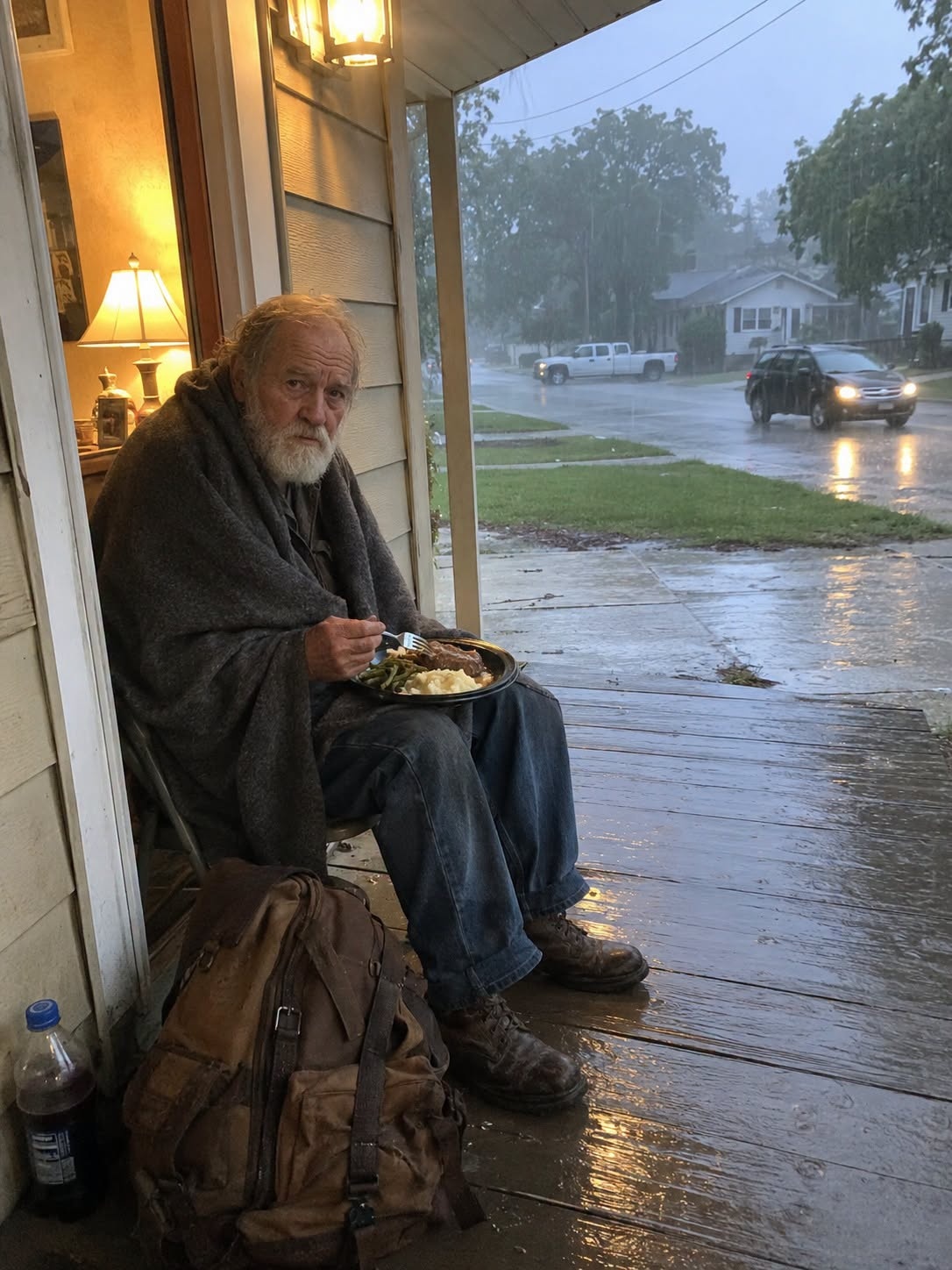
He was across the street, under the elm that stood at the edge of the Calloway property, a man who was clearly old from where I stood, seventy at least from the stoop of his shoulders and the way he moved, or tried not to move, with the stillness of someone who is trying to take up as little space as possible in a situation that has already taken everything else. He was soaked. The rain had been falling for twenty minutes and he was in the full force of it, and he was holding an old backpack against his chest in the way people hold things when the thing is all they have and the having of it is the remaining structure of their life.
I opened the door.
I called to him.
He looked up and across at me with the expression of a person who has heard something that does not immediately register as being addressed to him, as if the possibility of being invited in from the rain was not a category he had available.
I told him I had a couch.
He refused. He refused again when I offered more directly. He was polite in the specific way of people who have been trained by a long time of difficulty not to be a burden, who have internalized the message that their presence imposes, and who refuse not out of pride exactly but out of a form of consideration that has become structural. He looked toward the porch.
The porch was covered. The porch was dry.
He asked if he could wait there until the rain stopped.
I brought cushions and a towel and the warmest blanket I owned, which was the quilted one my mother had made for me years ago, the one that had come with me through the divorce as one of the few things that was unambiguously mine. I brought him dinner, which was chicken soup I had made that afternoon, the kind I made on days when the loneliness was present and cooking felt like something I could do in response to it.
When I handed him the plate, he looked at me for a long moment with an expression I could not fully read, the complex look of someone who is receiving something they need and who has complex feelings about needing it.
He said: you’ve got enough to worry about without taking care of an old man.
I thought about the rent that was ten days away and the car payment that was coming up and the school clothes Lily would need in September and the question of whether the administrative job was secure enough to count on through the budget discussions that were happening at the district.
I smiled.
“Tonight I have enough for both of us,” I said.
And in the way that this was true, it was completely true.
I went inside and I read for a while and then I went to sleep, listening to the rain on the porch roof, thinking about the man on the other side of the door with the soup and the quilt and the old backpack, thinking about the fact that I had done a small thing, a porch and a blanket and a bowl of soup, which had not cost me more than I had and which had been the only response available to me when a person who needed it was standing in the rain.
I slept better than I had in weeks.
In the morning I made breakfast and started coffee and poured an extra cup and carried it to the front door with the particular feeling of a morning that has something good in it, the possibility of a conversation, the simple pleasure of feeding someone.
I opened the door.
The porch was empty.
The blanket, my mother’s quilt, was folded on the doormat. Not left carelessly, not abandoned, but folded with the precision of someone who understood what they had borrowed and who wanted to leave it in better condition than it had been handed to them. The folds were exact and deliberate and the quilt was smooth across the top in a way that took effort, the effort of someone who has been trained somewhere in their life to leave things properly.
When I bent to pick it up, the mat shifted.
Underneath it was an envelope.
My name was written on the front. Not my full name, just Martha, the name I had given him the night before when he asked. The handwriting was firm and clear, the handwriting of someone who had learned to write at a time when penmanship was taught as a skill and who had maintained the skill through decades of whatever had followed.
I sat down on the porch step.
Inside the envelope was a single folded piece of paper. It appeared to have been torn from a small notebook, the kind with the wire spiral at the top, and it had been folded twice into a neat rectangle. Wrapped inside the paper was a key.
An old key, brass, the kind cut for a lock rather than a modern security system, worn smooth on the grip from years of handling. Attached to the key with a piece of twine was a small cardboard tag, and on the tag was an address in a town I did not immediately recognize, a town about forty minutes from where I lived, and below the address the words: the small box, bottom shelf.
The letter was one page. I am going to try to reproduce it as accurately as I can, because the words matter and because I want to be honest about what happened and what it meant.
Martha, it began.
My name is Albert. I have been sleeping on porches and in shelters and under trees for eight months, since my daughter-in-law changed the locks and my son didn’t stop her. I am telling you this not to ask for your sympathy but so that you understand I have not always been a man who sleeps under trees.
I had a business for forty years. Not a large one. A hardware store in a small town, the kind that knows its customers and fixes what it can and orders what it can’t. I built it from nothing and I ran it until my wife, Estelle, became sick, and then I sold it to pay for what the insurance wouldn’t cover, and I would do it again without hesitation because she was worth every dollar of it and then more. We had forty three years.
She died two years ago. My son is a grown man with his own family and his own troubles and his wife has never liked me, which I understand more than I resent because I was not always an easy man to like. I did not fight the locked door because I did not want to make my son choose, and I think he was grateful for this though he has not said so.
I have been moving since then. Eight months is not so long in the scheme of things. I am seventy four years old and my health is good enough for what I need it for, and there are worse things than sleeping under a tree on a summer night except when there is also a summer storm, which is when your porch became the best thing that had happened to me in quite a while.
I watched you from across the street before you saw me. I watched you through your kitchen window, moving around. You looked like someone who was tired but who was not giving in to it. I have known some people like that. Estelle was like that. It is a quality I respect.
I cannot repay you for the soup and the blanket and the porch. Those things cannot be repaid in kind. But I can tell you what the key is for.
Before Estelle died, we had a storage unit. I kept paying for it after she passed because I was not ready to go through what was in it. In eight months of moving I have kept paying for it, which has cost me more than it should, but I was not ready. Last night, sitting on your porch listening to the rain, I became ready.
I am not going to the unit. There is nothing in there I need. But there is something in there that might be useful to someone, and you are the kind of person I want to give it to, because you were kind without knowing anything about me, which is the only kind of kindness that is entirely real.
In the small box on the bottom shelf, there is a leather notebook. Estelle kept it for forty years. She called it the recipe book but it was not only recipes. It was everything she knew about making something from nothing, because she had done it her whole life and she wanted to write it down. Recipes are in there, yes. But also: how she saved, how she stretched, what she did when things were hard, what she told herself when she didn’t know how to keep going. I always meant to do something with it. I never did.
If you have a daughter, she might want it someday.
The unit is paid through the end of the year. You can let it lapse after that if you don’t want to keep it. Everything else in there you can do with as you like. None of it is worth very much except to someone who might need it.
You were kind to me. The soup was the best thing I had eaten in months, and I have eaten some soup. But the kindness was more than the soup.
I hope your worries get smaller.
Albert
I sat on the porch step for a long time.
The elm trees on the street were still wet from the night before, the leaves catching the morning light and holding it. A car went by. A neighbor I did not know well walked her small dog and raised a hand in the wave that meant good morning without requiring conversation. The street was doing its ordinary morning business in the way that streets do when extraordinary things have just happened at the edges of them.
I held the key in one hand and the letter in the other and I thought about Albert. About forty years of a hardware store and forty three years with Estelle and eight months under trees and on porches and in shelters, moving with his old backpack. About a son who had not stopped his wife from changing the locks. About a storage unit he had kept paying for because he was not ready to go through it, and a summer storm that had given him a porch and soup and my mother’s quilt, and a morning in which he had apparently become ready.
I thought about what it meant to become ready. To arrive at the point where the thing you have been holding becomes something you can let go of, or in this case something you can give.
I called Grace, my landlord, and told her I needed to take the morning and asked if it would affect anything, which it would not because my job was hourly and the hours were mine to manage within reason and I had not taken a personal morning in the two years I had been working there. She said of course and I said thank you and I got in the car.
The town was forty minutes north, the kind of small town that highway development had bypassed in the nineties and that had consequently preserved a certain architectural integrity, old storefronts and wide sidewalks and the particular quality of a place that has learned to live with its own smallness. The storage facility was on the edge of town, a row of orange doors behind a chain link fence, the kind of place that exists in every small American town and that holds the overflow of lives being lived in various stages of continuity.
The unit number was on the tag.
I found it on the second row.
The key turned in the lock with the smooth authority of a lock that had been maintained, and the door rolled up on a space that was not large, perhaps eight by ten, lit by the morning light coming in from the open door. It smelled of cardboard and the particular closed smell of contained time.
It was, as Albert had written, not full of things worth very much. A set of wooden chairs that matched a table that was presumably somewhere else. Boxes of books and kitchen items and the accumulated miscellany of a household that had been sorted once, into a storage unit, and not sorted again. An old sewing machine in a wooden case. Several boxes labeled in a handwriting I did not recognize, smaller and more compressed than Albert’s, the handwriting of a woman who wrote quickly and with purpose.
Estelle’s handwriting.
I found the small box on the bottom shelf.
It was a simple wooden box, the kind that might once have held a bottle of something, about the size of a shoebox, with a small brass clasp. Inside it was the notebook Albert had described. It was leather covered, burgundy, soft from years of handling, the leather worn smooth in the places that hands most often go. It was not large, about the size of a paperback novel, but it was thick, the pages dense with the compressed handwriting I had seen on the boxes, entries that ran close to the margins as if she had not wanted to waste space.
I opened it standing in the storage unit in the morning light.
The first page said, in the same handwriting:
If you are reading this, I hope you needed it. I have found that the things I write down are more useful to other people than to myself, because I have already learned them. You may be in the middle of learning them. If so, write in the margins. The book improves with more voices in it.
Estelle.
I sat down on one of the wooden chairs.
I read for a long time.
Estelle had written recipes, as Albert had said. Good ones, the kind that are written by someone who learned to cook by cooking rather than by following instructions, the kind that say a handful of this and until it smells right and you will know when it is done because your grandmother knew and she taught you. Chicken soup, of course, several variations. Bread. Soup in at least a dozen forms, because, she had written in the margin of one, soup is what you make when you need to make something out of almost nothing and soup never lies about being what it is.
But there was more than recipes.
There were pages about money, the specific practical knowledge of a woman who had grown up with very little and who had spent a lifetime converting very little into enough. Not inspirational pages, not the language of abundance mindset or financial wellness, but specific and unsentimental: this is how you make rent when the money is short. This is how you tell your children the truth about difficulty without transferring the anxiety of it. This is the calculation you make when you are deciding between two things and can only afford one. This is how you hold yourself when you are at the end of what you know.
There was a page that said: When you do not know how to keep going, you keep going anyway, and the going is what teaches you.
There was a page that said: The things that are yours are yours because of the work you have put into them, not because someone permitted you to have them. This is true even when someone tries to take them. What they take is the object. What is yours is the work, and the work is still yours, and from the work you make the next thing.
I read this twice.
I read it a third time.
I sat in the orange light of the storage unit with the wooden chair under me and the sewing machine behind me and the boxes of Estelle’s life around me and I thought about Daniel and the house and the eight hundred dollars and the two suitcases and the drive to the duplex with Lily asleep in the backseat, and about the two years since, and about the rent that was due in ten days and the school clothes in September and the question of whether the job was secure.
I thought about the soup I had made the night before, the one I made when the loneliness was present because cooking was something I could do in response to it.
I thought about what it meant to make something from almost nothing.
I drove home.
On the way, I stopped at a coffee shop in the small town and sat for an hour with the notebook and a cup of coffee. I had brought the notebook with me. I had locked the storage unit and kept the key and I had not yet decided what to do with everything else in there, but the notebook had come with me because I understood, sitting in the storage unit with it in my hands, that it was what Albert had meant to give me and that the rest could wait.
I read more of it over the coffee. I made a note in my phone of the things I wanted to come back to. The bread recipe. The page about telling children the truth about difficulty. A section near the middle of the notebook that Estelle had titled simply: What Works, which was a list of practical strategies, specific and grounded, the kind of list made by someone who has tested everything on it.
I called Grace on the drive home and thanked her again.
Then I thought about whether to try to find Albert.
This question stayed with me for several days. I had no information about him beyond what the letter contained and what I had seen on the porch in the storm. I did not know his last name. I knew the town where the storage unit was, which presumably meant some connection to that area, but a man who had been moving for eight months might be anywhere.
I asked at the shelter in town. I described him. The woman at the desk was kind and said she could not share information about residents or former residents, which I understood, but that if someone matching the description came in she could pass along a message.
I left a message.
It said: the soup was the best thing I had made in a long time too. Thank you for Estelle’s book.
I did not know if he would receive it.
Lily came home on Sunday.
She came through the door with the specific energy of a child who has been somewhere else for the weekend and is readjusting to the different register of this home, the home where things are smaller and simpler and where the rules are different and where the person who is there is me rather than her father. She dropped her bag in the hallway and told me about the weekend in the compressed summary of a ten year old for whom the significant events were not necessarily the ones the adults would have selected.
I had soup on the stove.
She came and stood next to me and looked in the pot and said it smelled like the good kind.
“The good kind,” I confirmed.
We ate at the table, the two of us, and I told her I wanted to show her something after dinner. She was curious in the specific performing-not-caring way of ten year olds, which meant she was very curious.
I showed her the notebook after the dishes were done, sitting at the kitchen table with the notebook between us. I told her about the storm and Albert and the porch and the soup and the morning with the folded blanket on the doormat. She listened with the completeness she brought to things she was actually interested in, which was a quality I had been watching develop in her since she was very small, the ability to be fully present inside a story.
I told her about the storage unit and about Estelle and about what the notebook contained.
“She wrote all of it down,” Lily said.
“Everything she knew,” I said.
“So it wouldn’t be lost,” she said.
“Yes.”
She looked at the notebook with the expression she had when she was thinking about something from more than one angle at once.
“Can I read it?”
“Some of it is for later,” I said. “Some of it you’ll understand now.”
She read the first page, the one with Estelle’s introduction. She read it slowly, in the way she read things she was taking seriously, and when she was done she looked up at me.
“Write in the margins,” she said.
“Yes,” I said.
“Are we going to?”
I thought about Estelle’s handwriting in the compressed margins of a lifetime’s worth of knowing. I thought about what I would write if I wrote in those margins, what I had learned in the past two years that was worth adding to a book about making something from almost nothing.
“Yes,” I said. “But not yet. Let’s read it first.”
She nodded. Then she said, “Do you think he’s okay? Albert?”
“I hope so,” I said.
“He kept paying for the storage unit,” she said. “Even when he didn’t have anywhere to live.”
“Yes.”
“Because he wasn’t ready to let it go.”
“That’s what he said.”
She was quiet for a moment.
“But then he was ready,” she said.
“Then he was ready,” I agreed.
She looked at the notebook.
“She must have been really good,” Lily said.
“She wrote it down so that someone else could use it,” I said. “That’s a good kind of person.”
Lily considered this.
“We should do something good,” she said. “Because of the thing Albert did. Like a chain.”
I looked at my daughter.
“What would you want to do?”
She thought about it. “The shelter. The one in town. You said there are people who don’t have somewhere to sleep.”
“Yes.”
“We could make soup,” she said. “We’re good at soup.”
We called the shelter Monday morning. They said yes, they accepted food donations, that soups and stews were particularly useful. They said a woman named Ruth managed the kitchen donations and gave us her number.
We called Ruth.
Ruth was practical and specific, the way shelter coordinators are when they have been doing it long enough, and she told us what they needed and in what quantities and how to deliver it. She said donations from individuals were sometimes more useful than organized drives because individual donors tended to show up consistently, and consistency was what the shelter needed more than anything.
We made soup that Thursday, Lily and I, in the largest pot I owned, the one that technically was too large for the two of us but that I had kept because you never know. We made the chicken soup from Estelle’s notebook, following the handwritten instructions that said a handful of this and until it smells right, and Lily was the one who decided when it smelled right because her nose was better than mine and she had read the recipe herself and had decided she knew what Estelle meant.
We delivered it on Friday morning before school.
Ruth met us at the back door of the shelter with the efficient warmth of a person who loves what she does and has no patience for anything that wastes time in the doing of it. She looked at the pot and said it was a good amount. She looked at Lily and said she was welcome to come back.
Lily said she would.
In the car on the way to school, she was quiet for a few minutes in the way that means she is finishing a thought.
“Mom,” she said.
“Yes.”
“Albert didn’t have to leave us anything. He could have just gone.”
“Yes,” I said. “He could have.”
“Why do you think he didn’t?”
I had been thinking about this since Friday morning on the porch step with the letter and the key. About why a man who had been moving for eight months and who had been given a porch and soup and a blanket would choose to give something back, when the easier choice and perhaps the more understandable one was to simply go, to take the warmth and the soup and the night out of the rain and to move on, as he had been moving for months.
“I think,” I said, “that he had been carrying something he was ready to put down. And that the right person to give it to appeared.”
Lily thought about this.
“Like how the storm brought him to our porch,” she said.
“Maybe,” I said.
“And you made soup,” she said. “Which was the thing you make when you don’t know what else to do.”
I looked at her.
“Yes,” I said.
“That’s a lot of things that had to happen,” she said.
“It is,” I said.
She was quiet for a moment more.
“I think Estelle would be glad,” she said.
She got out of the car at school and pulled her backpack on and walked through the front door without looking back, which was something she had started doing recently that I was still adjusting to, the child who no longer needed to confirm I was watching when she walked away.
I drove home.
The notebook was on the kitchen table where we had left it the night before, open to the bread recipe that Lily had decided she wanted to try next weekend. Estelle’s handwriting running close to the margins, the ink faded slightly in some places from the years.
I picked up a pen.
At the bottom of the bread recipe page, below Estelle’s last instruction, I wrote in the margin: this is good bread. a ten year old made it and was right about how it should smell. E. was right. you know when it is done.
I looked at what I had written.
Then I added: a man named Albert left us this book. we are trying to be worthy of it.
I put down the pen.
I went to make coffee.
The rent was due in nine days and the school clothes were still a question for September and the job was still the question it had always been. None of these things had changed. The practical landscape of my life was the same landscape it had been before the storm, before the porch, before the morning with the folded blanket and the envelope and the key.
But I had the notebook.
I had Estelle’s voice in the margins saying: the things that are yours are yours because of the work you have put into them. What they take is the object. What is yours is the work, and from the work you make the next thing.
I had Lily deciding when the soup smelled right.
I had Ruth at the back door of the shelter with her efficient warmth.
I had a storage unit forty minutes north, paid through the end of the year, with four wooden chairs and a table they presumably matched and a sewing machine in a wooden case, and I had not yet decided what to do with any of it, but I had time, and the having of time was itself a form of wealth I had not always recognized.
I had Albert, wherever he was. I hoped he was on a porch somewhere with soup.
I had, I realized, standing in my kitchen with the coffee maker beginning its work, considerably more than nothing. Which was different from what I had thought when I woke up on the morning the storm ended and went to pour an extra cup of coffee for the man on my porch.
I had thought then that I was barely holding on.
I was still barely holding on, in the practical sense of the rent and the school clothes and the questions about the job. But barely holding on is not nothing. Barely holding on is holding on. Estelle had written about this, in the middle section of the notebook, in a passage that I had read three times over the coffee in the small town: the days when you are barely holding on are also the days when you are entirely capable, because the barely is doing the work and the work is what you have.
I had the work.
I was making the next thing from it.
Outside the kitchen window, the elm trees on the street were doing what they did at the end of summer, beginning the first imperceptible shift toward fall, the green still holding but something in it loosening, the leaves ready to do what leaves do when the time comes.
The time comes.
You are ready or you are not, and either way the time comes.
Albert had been ready on a storm-wet porch with soup and a quilt, and he had given what he had to give, which was a key and a letter and a dead woman’s notebook full of everything she had learned about making something from almost nothing.
I was going to try to be worthy of it.
Lily was already ahead of me.
That, too, seemed right.
That seemed, in fact, like the whole of it.
We heard from Albert six weeks later.
Not directly. The shelter called, Ruth herself, on a Tuesday morning when I was at my desk at the administrative office and my phone vibrated in my pocket and I saw the shelter’s number and stepped into the hallway to answer.
She said: a man came in last week. He said his name was Albert and he asked if anyone had left a message for him. She had given him the message I had left, the one about the soup. He had asked for a pen and written a note in reply and asked if she could pass it along to me when she had a chance. She had been meaning to call for several days and this was the first morning she had found the time.
She read it to me over the phone.
The note said: I am glad the soup was good. I hope the book is useful. My Estelle always said a recipe is just the beginning of a conversation.
Then: I am staying for a while. They have beds and the work is honest. I am helping in the kitchen. Ruth says I make a decent stock.
Then: I hope your worries have gotten smaller.
Albert.
I stood in the hallway of the school district administrative office with the phone to my ear and the note just read to me by the shelter coordinator who made a decent stock herself and who had given me this job of delivering it with the matter-of-fact competence she brought to everything, and I did not cry, which surprised me, because I had cried at the letter under the doormat and I had cried reading Estelle’s notebook in the storage unit chair, but standing in the hallway with this news I did not cry.
I felt, instead, something simpler than crying. Something that was not relief exactly and not joy exactly but was in the same general landscape as both. The feeling of a thing having landed correctly. Of a sequence completing.
He was making stock.
He was in a kitchen.
He was somewhere.
I went back to my desk and worked through the morning and at lunch I texted Lily at school, which I did not usually do during the school day but which this seemed to warrant: Albert is at the shelter. He is helping with the cooking.
She texted back immediately, which meant she had her phone out during lunch, which was technically not allowed: I TOLD YOU he would be okay.
I smiled at my phone.
I texted back: you did.
She sent three soup emojis.
I put my phone in my drawer and went back to work.
The bread took three tries before we got it right. The first attempt was dense in a way that Estelle had warned about in a marginal note that said: if it doesn’t rise it’s either the yeast or the patience. We had used new yeast and determined it was the patience. The second attempt was better but the crust did not have the color Lily felt it should have based on her reading of the instruction until it is done. The third attempt she pulled from the oven and looked at it for a long moment and said: that is the color.
We ate it with butter and it was the kind of bread that is not complicated but is exactly right, the kind that makes you understand why Estelle had written it down.
I put a note in the margin: third try. Lily was right about the color. this is the bread.
The storage unit I returned to in September, on a Saturday, with a rented truck and the help of my friend Diane who had been helping me with things since the divorce with the patient persistent generosity of someone who understands that what a person in difficulty needs most is not advice but company. We loaded the chairs and the table into the truck and drove them to a family Diane knew through her church who had just moved into their first apartment and who had nothing in it yet. The chairs and table fit their kitchen exactly.
The sewing machine I kept.
I do not sew. But I have been thinking about learning, because Estelle’s notebook has a section in the back about mending, about the things you mend because replacing them would cost more than the mending, about the things you mend because they are worth mending, about the difference between the two categories and how to tell which is which. I have read this section more than once. I think there is something in it that goes beyond fabric.
The boxes of books I sorted on my porch over two October weekends, Lily helping, the two of us making piles: keep, donate, shelter. The shelter pile was the largest. Ruth said they always needed books.
Estelle’s boxes I went through alone.
She had saved things with the specificity of someone who understood that objects carry meaning and that meaning should not be lost carelessly. A small collection of recipes cut from newspapers and magazines and folded into a particular square, the same way you could tell they had all been folded by the same hands. Photographs of people I did not know and would never know. A set of letters bound with twine that I did not read because letters bound with twine are private things and I had not been given permission.
I packed the photographs and letters carefully and addressed them to Albert at the shelter and left them at the post office on a Monday morning with the hope that they would reach him and that receiving them would be, for him, the right kind of arriving.
A week later, a postcard came.
The front of the postcard was a photograph of a winter landscape, mountains and snow, the kind of postcard that is sold in tourist shops in small towns with views worth selling. On the back, in Albert’s firm handwriting:
The photographs arrived. Thank you. I had forgotten I still had my wife’s face. I have put the best one on the windowsill.
I put the postcard on the board in my kitchen, next to the photograph of Daniel that I still keep because Lily is in it and she was four in it and she has her father’s eyes in a way that I want her to know about even if everything else about it is complicated. Next to the postcard I put a small note I had written from Estelle’s notebook, the line about the things that are yours being yours because of the work, and the work still being yours.
The board is getting full.
I am not sure that is a problem.
The school clothes worked out. There was a sale in late August that I had been watching for and the timing was good and Lily came out of it with the three specific items she had indicated were necessary, the green jacket and the particular kind of jeans and the boots she had researched with the rigor of a professional consumer. She wore the green jacket on the first day of school and came home still wearing it, which I took as a good sign.
The job, as of October, appears to be secure. The budget discussions concluded and my position was not among those eliminated, which I learned in the specific way you learn these things in administrative offices, not through any formal announcement but through the gradual resumption of normalcy in the conversations around you, the absence of the particular quality of collective anxiety that had been present for several weeks. I have not stopped attending to the signals, because I have learned not to stop attending to signals, but the signals are currently quiet.
The rent is due in three days.
I have it.
I have it with enough left over that I was able to put a small amount into a savings account that I opened in September in my own name, a thing I had not had for twenty one years. It is not a large amount. But it is an account and my name is the only name on it and the number in it is the result of my own work and no one else’s decisions.
I found this unreasonably moving when the bank representative handed me the paperwork and I signed it and she asked if I had any questions and I said no and she said have a great day and I went out to my car and sat for a few minutes thinking about what it meant to have a thing that was mine in that unambiguous way.
I thought about Estelle: the things that are yours are yours because of the work.
Yes, I thought.
Yes.
Lily wants to go to the shelter on Fridays now, not every Friday but most of them, to help Ruth in the kitchen. Ruth said yes. I said yes. Lily said she wanted to learn to make the stock the way Albert made it, which Ruth described to us as unhurried and very particular about the temperature, a description that I found I could have predicted from the letter.
He is still there, as far as I know. Still in the kitchen. Ruth mentions him occasionally, not with great detail, with the specificity of someone who respects the privacy of the people in her care. She says he is doing well. She says he has taught two other residents to make a proper stock, which she considers an accomplishment.
She says he seems less tired than when he arrived.
I think about the porch and the storm and the folded quilt and the envelope under the doormat, and I think about what Albert said at the end of the letter: I hope your worries get smaller.
They have not gotten smaller in any absolute sense. They have become more manageable, which is a different thing, the difference between a weight that is unchanged and a person who has gotten stronger. I am getting stronger, slowly and in the way that only happens when you are doing the work and the work is what you have.
The notebook is on my nightstand now. I read a page or two most evenings before sleep, the way some people read scripture, looking for the part that applies to today. Some evenings I write in the margins. Some evenings Lily has already been there before me, a small notation in the handwriting of a ten year old who is learning to make stock, to let bread rise, to know when things are done.
Estelle said: if you are reading this, I hope you needed it.
I needed it.
I am still reading it.
I think I will be reading it for a long time.
Which seems, given everything, like exactly the right thing.
The elm trees outside are bare now.
In spring they will be green again, which is not a promise anyone made but which is, nonetheless, something I am counting on.
That is where I am.
Counting on the green.
That is not nothing. For where I started, that is quite a lot.
Estelle would understand that. Albert too.
I think they would both be pleased.
And so, in a quieter way than I once would have needed, am I.