The Crowd Reaction That Was Never Part of the Script
The lights dimmed across the stadium as anticipation rolled through the crowd like a living current. Thousands of spectators leaned forward, phones raised, flags waving gently in the evening air. The Opening Ceremony had followed its script perfectly so far — precise timing, synchronized motion, controlled spectacle.
Events of this scale are designed that way. Every step, every entrance, every symbol is planned to reflect unity, diplomacy, and coordination. Behind the scenes, officials rely on structure and protocol to guide what millions of viewers will see worldwide.
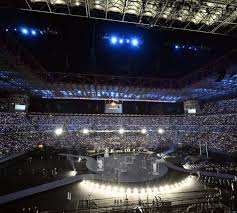
But global gatherings are never purely mechanical. They are emotional ecosystems — filled with identity, pride, memory, and spontaneous reaction.
As Team USA approached the arena floor, a shift moved through sections of the audience. It began subtly — a murmur, scattered applause, isolated reactions that didn’t align with the ceremony’s carefully balanced tone.
Moments later, the sound grew. Not chaotic, not hostile — just undeniably organic.
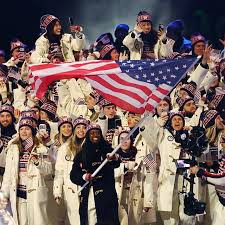
Spectators responded in their own way, independent of the anticipated rhythm. It wasn’t disruption in the traditional sense. It was simply humanity asserting itself inside a highly orchestrated environment.
Large-scale events often reveal this tension between institutional choreography and individual expression. Event planners attempt to design neutral stages, yet audiences arrive carrying national loyalties, cultural perspectives, and emotional investments.
Sports psychologists and crowd-behavior researchers have long observed that shared identity amplifies reaction. A symbol — a flag, a uniform, a delegation — can trigger enthusiasm that spreads faster than regulation can anticipate.
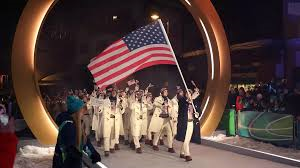
In this imagined moment, the stadium became a demonstration of that principle.
Officials continued their duties. The ceremony flowed forward. Cameras captured angles both polished and unscripted. And for viewers, it served as a reminder that international events are not just performances — they are intersections of structure and sentiment.
The power of global sport lies precisely there.
Not in perfect predictability, but in the coexistence of protocol and spontaneity — governance and emotion — spectacle and authenticity.
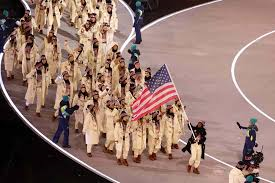
Whether real or imagined, scenes like this resonate because they reflect a universal truth:
When thousands gather under shared symbols, outcomes are never entirely scripted.
And sometimes the most memorable moments are those shaped by collective feeling rather than formal design.