The Garden
The third ready-mix truck was coming out of my lane when I turned in.
I had to pull my Buick half into the ditch grass to let him by. The driver lifted two fingers off the wheel, and I lifted two back, because that is manners. Only after he had gone did I wonder what a concrete truck was doing on my farm.
I had been in Bedford all morning having my eyes checked.
Brian’s truck was parked behind the barn. So were two others I did not know.
I walked back in my good shoes. It is a fair way, past the barn lot and the old loading chute and through the gate Carl hung in 1989, and the ground was cut up the whole length of it. Three loaded trucks will do that to April ground.
Then I came around the corn crib and saw it.
A slab. Gray and wet and flat as a church floor, sitting in the middle of my back lot, where there had been nothing that morning but orchard grass and a killdeer.
My son was on his knees at the far edge of it with a steel trowel. Two men I did not know were running a float over the middle on a long handle. Nobody looked up.
“Brian.”
He looked up then. He had concrete to the elbows and a streak of it in his hair, and he smiled at me like a boy who has finally got the mower running.
“Hey, Mom. You’re back early.”
“What is this?”
“It’s a pad.” He stood, and his knees cracked, because he is forty-one now and has spent twenty years under other people’s machinery. “Thirty by forty. Six inches thick, on account of the lift. For the shop.”
“What shop?”
“My shop.” He said it gently, as if I had forgotten something he’d told me. “I’ve got a steel building coming in June. Bolts right down to this.”
I looked at the pad. Along the edges there were bolts standing up out of the wet concrete, set in a row, neat as teeth.
“You poured this on my back lot,” I said.
“It’s the only flat piece on the place that isn’t good for anything.”
“You didn’t ask me.”
He wiped his hands down his jeans, which did nothing for either.
“Mom.” Brian lowered his voice, the way you do with somebody in a waiting room. “Come on. It’ll all be mine soon enough anyway.”
I want to tell you what that sentence did, because he did not say it mean. That was the worst of it. He said it the way you would mention rain was coming. Kindly. As a fact we both knew.
I was sixty-seven years old. I had a pot roast thawing in the icebox.
And my son had looked across forty feet of wet concrete and seen a woman who was mostly a matter of time.
“I see,” I said.
“I’d have asked, but you’d have fretted over it, and the trucks were scheduled, and…” He lifted a hand and let it drop. “It’s done now. It’s a good pad, Mom. Dad would’ve liked it.”
“Would he.”
“He’s the one who…” He stopped. One of the men called something about the north corner going off, and Brian looked over his shoulder. “I’ve got to work this while it’s wet. I’ll come up to the house after.”
He got back down on his knees.
I stood there a minute longer. The concrete had a smell, wet and chalky, like a creek bed turned over. The killdeer was running along the far fence, crying about her nest.
Then I walked back up to the house, and I took the pot roast out of the sink and put it back in the freezer, because I was not going to be cooking for anybody.
He did not come up to the house after. I watched his truck go down the lane a little past six, with the two others behind it.
Stacy called at eight.
I will say this for my daughter-in-law: she does not hide behind a man. She has worked the pharmacy counter in Paoli for eleven years.
“Evelyn,” she said. “He told me tonight you didn’t know.”
“I did not.”
“He told me in February you’d said it was fine.”
In February Brian had sat at my kitchen table and said he was thinking about putting something up out back someday, and I had said, “We’ll see,” which in this family has always meant no.
“I said we’d see.”
Stacy let out her breath.
“I’m not calling to make excuses for him,” she said. “I’m calling so you know what’s in that ground before you decide anything.”
“Go ahead.”
She had the receipts in front of her. I could hear the paper. Twenty-three yards of concrete at a hundred and sixty dollars a yard: three thousand six hundred and eighty. Gravel for the base, nine hundred. Rebar and form lumber, six hundred twenty. And eight hundred to the two men with the power trowel, who were brothers from over by French Lick and did flatwork on the side.
“Six thousand dollars,” Stacy said. “Even. That was the tax refund and every bit of what was left of his severance.”
I had done the adding along with her on the back of the electric bill. It came out even.
“And the building?”
“He put a thousand down. The rest is on payments.” She was quiet a second. “Evelyn, he’s been fixing hay balers in our driveway since January. The landlord’s given us a letter. He’s got a man’s combine head sitting in pieces in Dale’s machine shed because he’s got nowhere with a roof. He’s not sleeping.”
I knew some of that. I knew the implement dealer in Orleans had sold to a bigger outfit after Christmas, and the bigger outfit had let four mechanics go and kept the two youngest. I knew Brian was the best one they’d had.
“He should have asked me,” I said.
“He should have. I told him so tonight, and I wasn’t nice.” She stopped. “What he said to you. About it being his. Did he say that?”
“He did.”
“Oh, Evelyn.”
“Good night, Stacy. Kiss Josie.”
I hung up and sat down in Carl’s chair, which I do not often do.
A neighbor of mine heard this story and said, “Well, it was your ground. Why didn’t you just make him tear it out?”
I thought about it for a good hour.
But concrete doesn’t un-pour. You break it up with a hammer on a skid loader and haul it off in chunks, and you pay a man to do that, and when he’s done you have a hole, and six thousand dollars of a young family’s money is in a pile behind somebody’s barn. And my granddaughter’s father still has nowhere to work.
And none of it would touch the sentence.
The pad was not the injury. I could walk around a pad. What I could not walk around was “soon enough.”
Because here is the part I had to sit in that chair and admit. He had not gotten the notion out of thin air.
Carl died six years ago in October. His heart, in the barn lot, with the gate open and a feed bucket in his hand. I sold the cows that winter. I rented the tillable ground to Dale, sixty-one acres at a fair cash rent, and I let the back lot go to grass, and I told anybody who asked that I was too old to fool with it.
For six years my son had watched his mother keep one kitchen light on in the middle of eighty acres and do nothing. Is it any wonder he thought I was through?
He was wrong to say it. But I had been saying a version of it myself.
There is a drawer in Carl’s desk that I don’t go in. That night I went in it.
Under the tractor manuals and a rubber-banded stack of Farm Bureau calendars was a nursery catalog from the spring of 1987. I knew it would be there. I had put it there myself.
The corner of page fourteen was turned down. Apple trees. I had circled six of them in blue ballpoint, thirty-nine years ago, when I was a girl of twenty-eight with a three-year-old hanging on my leg and a head full of plans.
In the margin, in Carl’s square carpenter’s hand, it said: Back lot. When we get to it.
We never got to it. There was always a reason, and they were good reasons. The back lot was the only close hay. The year we had money we needed a baler, and the year we had time we had no money. “We’ll get to it, Evie,” he’d say, and he meant it every time.
Forty-one years I was married to that man, and I do not hold one day of it against him.
But I sat there with that catalog in my lap and understood that I had been told to wait by two men now. One of them said, “We’ll get to it.” The other said, “Soon enough.”
And both of them had been talking about the same two acres.
I slept fine. I had made up my mind, and I have always slept well once that’s done.
The extension office opens at eight. I called at one minute after.
Mr. Pruitt has been the county extension man in Orange County for nineteen years. Purdue calls him an educator now, but nobody around here does. He stood in our hay field with Carl the summer the armyworms came through and did not once say, “You should have called sooner.”
“Mrs. Baker,” he said. “What can I do for you?”
“I want to put in a garden. A big one. Sweet corn, a cutting garden and an orchard. On about two acres.”
“When are you thinking?”
“This year.”
“It’s the fourteenth of April.”
“I know what day it is, Mr. Pruitt.”
He laughed. He said he could come Thursday.
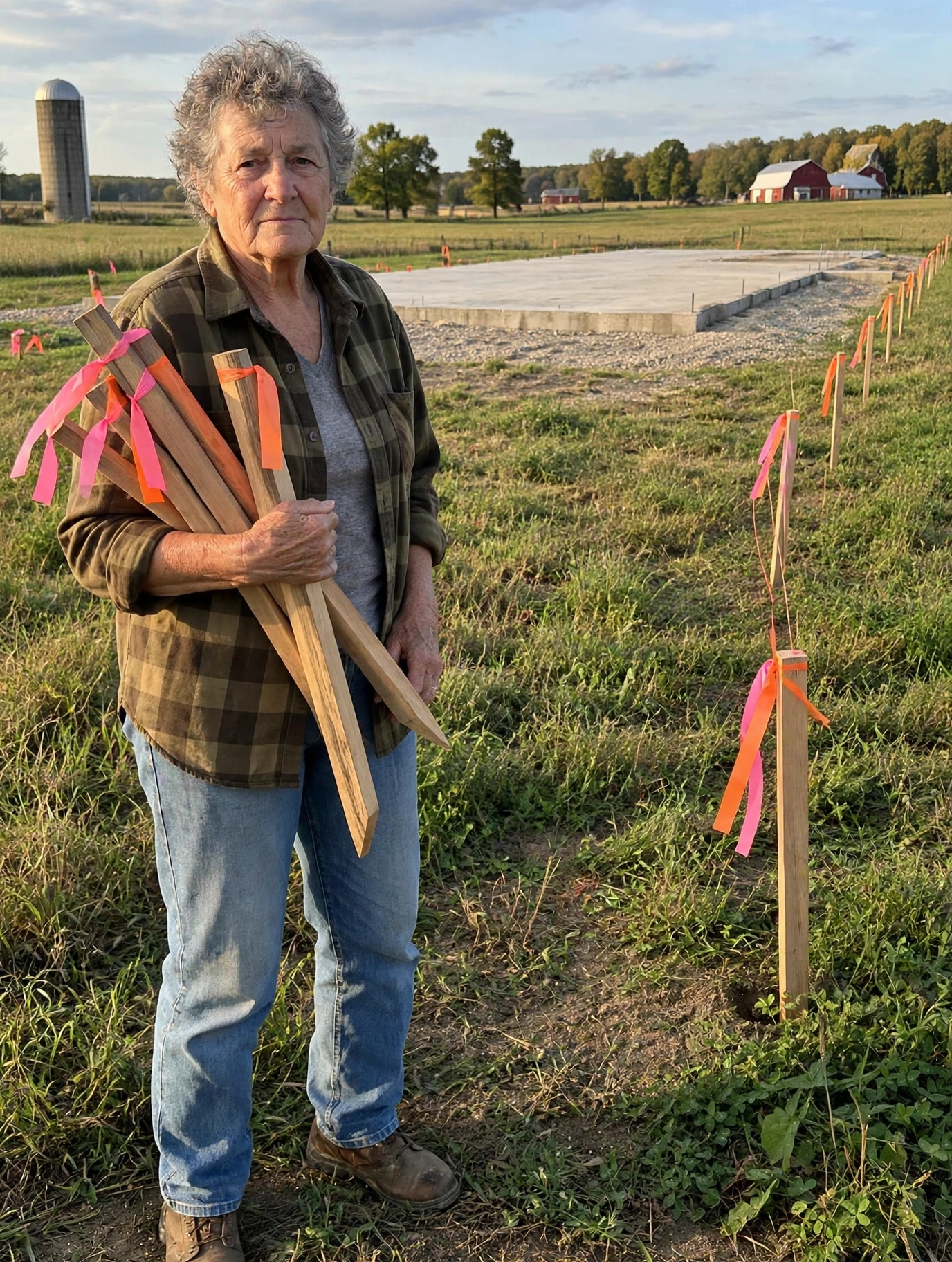
He came Thursday at nine in a county pickup with a soil probe, a white plastic bucket, a three-hundred-foot tape on a reel, and a bundle of wooden stakes in the bed.
We walked back together. He is a tall, slow-talking man who does not fill a silence just because one is available. He looked at the ruts. He looked at the slab, which had gone from wet gray to a pale dry gray and had a sheet of plastic over it weighted down with boards.