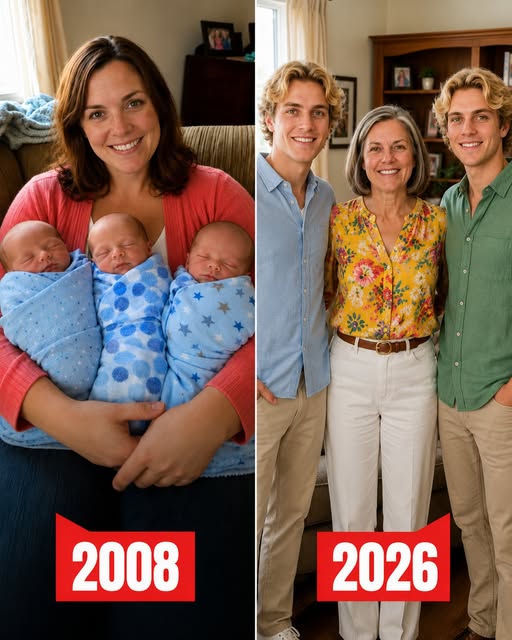
One of My Triplets Died Six Months After Birth But on Their 18th Birthday, a Box Appeared on My Doorstep Marked, “Happy Birthday, Brothers!”
For eighteen years, I believed I had lost one of my triplets. Then, on my sons’ eighteenth birthday, a box arrived with the words “Happy Birthday, Brothers,” and the note inside sent me back to the hospital, my mother, and a devastating truth that had been hidden from me all along.
I had just stepped inside to finish frosting the cake. Through the open kitchen window came the sounds of the backyard music, shouting, and the unmistakable laughter of eighteen-year-old boys.
My husband, Watson, leaned over and kissed the side of my head.
“You okay?”
“I’m fine.”
His eyes settled on the cake.
Two large candles rested beside it. One and eight.
“You okay?”
Hidden behind the flour container, where only I could see it, was the tiny white candle I lit every year for Rowan.
Watson noticed where I was looking.
“I’ll light it with you later,” he said.
“After everyone leaves.”
He gave a quiet nod.
We had never allowed Riley and Rex to forget their brother. Rowan wasn’t a secret in our family. He was one of my sons.
We came home with only two babies because Doctor Jefferson told us Rowan had died before he became strong enough to leave the hospital.
That was how I’d counted my children from the day they were born.
Watson’s gaze followed mine.
Then the doorbell rang.
“I’ll get it, hon,” I said, brushing frosting off my thumb.
Watson glanced toward the backyard.
“Probably another kid who forgot which gate to use.”
I opened the front door, expecting to see a teenager holding a gift bag with grass stains on his shoes.
There was no one there.
Only a small brown box rested on the welcome mat. It had no mailing label or postage—just a sentence written across the lid in black marker.
“I’ll get it, hon.”
“Happy Birthday, Brothers.”
A chill ran through my body.
“Who is it?” Watson called from the kitchen.
“No one.”
I lifted the box. It felt light, but something shifted inside.
Watson walked into the hallway and read the writing.
“Happy Birthday, Brothers.”
“Maybe one of the boys ordered something.”
“No,” I replied. “I’m taking it to our room. I don’t want them opening some cruel joke in front of everyone.”
His expression changed. He understood.
I shut our bedroom door and sat on the edge of the bed. For a long moment, I simply stared at the box.
Then I opened it.
A folded letter rested on top.
His expression changed.
“Dawn,
Please don’t show this to anyone until you finish reading.
Don’t trust Grandma.”

My breath caught.
Beneath the letter lay a tiny hospital bracelet.
It was faded yellow with age.
“Don’t trust Grandma.”
Printed on it was one name:
Rowan.
Underneath was a photograph of a young man standing beside a lake.
He had Riley’s smile, Rex’s height, Watson’s jawline, and my eyes.
A sound escaped me that I’d never heard before.
Watson knocked softly.
“Dawn?”
I couldn’t answer.
The same broken sound escaped my throat again.
“Dawn, open the door.”
With trembling hands, I unlocked it.
He stepped inside and saw the box lying on the bed.
I held up the bracelet.
“It says Rowan.”
The color drained from Watson’s face.
“It says Rowan.”
His gaze shifted to the photograph, and he collapsed onto the bed beside me.
“No.”
I handed him the letter.
“Read it.”
He shook his head.
“Watson. Read it.”
His voice cracked on the very first sentence.
He shook his head.
“My name is Rowan. I was told you loved my brothers but couldn’t love all three of us.”
Watson covered his mouth.
I took the letter back and forced myself to continue.
“I didn’t believe that at first.
Then I found papers with your signatures. I don’t know if you gave me away or if someone made that choice for you. But I need the truth before I spend the rest of my life hating the wrong person.
I found your address in a locked folder my adoptive parents kept with my bracelet, placement papers, and your signed forms.”
“I didn’t believe that at first.”
I turned toward Watson.
“I didn’t give him away.”
“I know.”
“I would’ve crawled through fire for him.”
“I know, Dawn.”
“Then why does he have our signatures?”
“I know, Dawn.”
Watson stared into the box.
“What else is in there?”
I pulled out a photocopied document.
At first the words blurred together.
Medical release. Placement. Best interest. Extended care.
At the bottom was my signature.
It looked thin, crooked, and barely recognizable.
Next to it was Watson’s.
“I don’t remember signing this,” I whispered.
“What else is in there?”
Watson took the page, and his hands began shaking.
“I remember a clipboard.”
I looked at him.
“What?”
“At the hospital, sweetheart. Your mother handed it to me. She said you had already signed. She said they needed mine so Rowan wouldn’t suffer.”
My stomach twisted.
“What?”
“Peggy said that?”
He nodded.
“She said you couldn’t face it. She said I had to be strong enough for both of us.”
I shot to my feet so quickly the box nearly hit the floor.
For eighteen years, fragments of that night in the hospital had stayed with me.
Doctor Jefferson walking toward us.
My mother wrapping me in her arms.
“She said you couldn’t face it.”
Someone saying,
“He’s gone, Dawn.”
I had been sedated, shattered, and far too weak to hold a pen without help.
Everything after that dissolved into a blur.
Now I looked at Watson.
“I need the old folder.”
“Now?”
“Right now.”
He followed me to the hallway closet while music pounded outside.
“I need the old folder.”
I dragged down the plastic storage bin and emptied every hospital paper across the bedroom floor.
Watson knelt beside me.
“What are we looking for?”
“Proof that Rowan died.”
His hands froze.
I found Riley’s discharge paperwork, Rex’s feeding records, sympathy cards, and the funeral receipt my mother had handled because I could barely stand.
“What are we looking for?”
But there was no death certificate.
My mother had always insisted the official documents were locked safely inside her fireproof box.
“Watson.”
He looked at the empty gap in the file.
“There’s nothing,” I said.
“Maybe Peggy kept it.”
“Of course she did.”
But there was no death certificate.
Then I found Doctor Jefferson’s old business card.
On the back, he had written:
“I hope one day you find peace with the decision made for Rowan.”
Watson read it twice.
“Decision?”
“That’s what I thought.”
He glanced at the copied paperwork on the bed.
I grabbed my keys.
“We’re going to Doctor Jefferson.”
Watson stood.
“Now?”
“Right now.”
“We’re going to Doctor Jefferson.”

Doctor Jefferson looked much older than I remembered.
His receptionist tried to stop us, but I held up Rowan’s bracelet.
“Tell him it’s about the baby he told me was dead.”
A minute later, after she showed him the bracelet, he opened his office door.
I laid the bracelet on his desk.
“Where did this come from?”
His expression shifted.
“Where did this come from?”
“Where did you get that?”
“From my son.”
His eyes dropped to the copied document in my hand.
“I want Rowan’s records,” I said.
“There are procedures, Dawn.”
“Then get me the form.”
“Dawn, I can’t discuss this without proper paperwork.”
“I want Rowan’s records.”
“Fine. Answer one question.” I leaned closer. “Did Rowan die?”
Doctor Jefferson slowly lowered himself into his chair.
“Rowan was critically ill.”
“That wasn’t the question.”
He folded his hands.
“He stabilized after the transfer.”
I gripped the edge of his desk.
“You told me he died.”
“I was told you understood the placement option. Your mother said the private placement had already been discussed with the social worker.”
“Rowan was critically ill.”
“By me?”
He looked away.
That answer was enough.
“By my mom,” I said. “Right?”
Watson’s voice cracked.
“We buried him.”
Doctor Jefferson swallowed.
“Your mother arranged the memorial. I was told you and Watson understood there would be no viewing.”
“We buried him.”
“The family?” I asked. “Or her?”
Silence.
“Did you ever ask me, without my mom in the room, if I wanted my son placed with another family?”
Doctor Jefferson lowered his eyes.
“No.”
“Did you ask Watson?”
“No.”
“Then you never confirmed consent,” I said. “You had a grieving woman’s signature and my mother’s version of grief.”
Doctor Jefferson kept looking down.
“I told myself Rowan needed a stable home.”
“He had one,” Watson said. “It was ours.”
I picked up the bracelet.
“I’m filing for every record. Every page. Every note. And then I’m filing complaints wherever I need to.”
Doctor Jefferson nodded.
“No,” I said. “You don’t understand. But you will.”
“It was ours.”
Watson’s voice cracked again.
“Where is he?”
“I don’t know now,” the doctor admitted. “The couple moved years ago.”
I raised the photograph.
“He found us first.”
When we drove back into the driveway, the party was still in full swing.
Riley and Rex were laughing in the backyard, and my mother’s car was parked by the curb.
Watson reached for my hand.
“Let me go in first.”
“He found us first.”
“No,” I said. “You’re coming with me.”
Together we walked up the porch steps.
A tall young man stood beside the railing, looking as though he couldn’t decide whether to knock or leave.
“I’m sorry,” he said. “I left the box and walked away. But I heard them laughing out back, and I couldn’t leave.”
I recognized him before he spoke again.
“You’re coming with me.”
“Rowan.”
His eyes filled with tears.
“I don’t know what I’m supposed to call you.”
“You don’t have to call me anything yet.”
He turned toward Watson.
“Are you angry?”
Watson let out a broken sound.
“At you? Never.”
Rowan looked back at me.
“I just needed to know if I was unwanted.”
“No.” I stepped closer, then paused. “Can I?”
He nodded.
I touched his cheek with two fingertips.
He was warm, real, and breathing.
“You were wanted every second, my boy.”
The patio door slid open behind us.
Mom stepped outside carrying a bright gift bag.
“Dawn? Why are you standing out front? I brought the boys their presents.”
He was warm, real, and breathing.
My mother froze when she saw Rowan.
“Dawn,” she whispered.
I stepped between her and my son.
“Which boys, Mom?”
Her mouth opened, but no words came.
“You brought gifts for Riley and Rex,” I said. “But you knew there were three.”
Watson stood beside me.
“You told us Rowan died.”
My mother stared at Rowan.
Her grip tightened around the gift bag.
“Not now. Let’s do this later, when the backyard isn’t crawling with teenagers.”
“No,” I said. “Let’s do it now.”
The backyard fell silent.
Riley reached the patio door first, with Rex close behind him.
“Mom?” Riley asked. “What’s going on?”
Watson’s voice broke.
“Boys, this is Rowan.”
“What’s going on?”
Rex stared at him.
“Our brother?”
For several long seconds, no one moved.
Rowan lowered his eyes.
“I didn’t come here to take anything from you.”
Riley stepped closer, fighting the urge to hug him.
“You’re not taking anything.”
Rowan’s jaw trembled.
“I spent my whole life thinking I was the one nobody could keep.”
“No,” I said. “That was never true.”
“You’re not taking anything.”
Mom began crying.
“You were falling apart, Dawn. Two babies at home, bills, machines, no sleep. I arranged the funeral because you couldn’t look at the tiny coffin.”
My stomach turned.
“You told me not to,” I said.
“I wanted you to remember him happy. Not like that.”
“You put his framed baby picture on a sealed coffin and said Rowan was too fragile to view. But it was empty.”
“I was protecting you.”
“You were falling apart, Dawn.”
“No. You were hiding what you’d done.”
Watson wiped tears from his face.
“We buried an empty box because you decided grief was easier to manage than truth.”
Mom looked at Rowan.
“I found you a good home. Parents who loved you before they met you. They had money. They could focus just on you.”
Rowan flinched.
“You told them I wasn’t wanted. You told them that my parents had given me up because they didn’t want another mouth to feed.”
“You were hiding what you’d done.”
“I said your mother couldn’t raise you.”
“I could have,” I said. “Tired mothers are still mothers.”
Riley looked at Mom. “Grandma, did you know he was alive this whole time?”
She didn’t answer.
Rex stepped back when she reached for him. “Don’t.”“Rex, honey.”
“No. You don’t get to touch us right now.”
I pointed toward the side gate. “Leave.”“Tired mothers are still mothers.”
“Dawn, please.”
“All contact goes through a lawyer.”
“You’re cutting me off from my family?”
“No,” I said. “You did that eighteen years ago.”
***
After she left, Rowan stayed near the porch steps.
Riley glanced at him. “Do you like chocolate cake?”“Dawn, please.”
Rowan gave a broken little laugh. “I don’t know. I usually had vanilla.”
Rex wiped his eyes. “That’s tragic. We’ll fix that first.”
I brought out the cake and lit three small candles.
One for each of my sons.
Watson whispered, “Make a wish.”
I looked at my sons. We weren’t fixed, and we weren’t whole yet, but we were finally standing in the same light.
“I already got mine back,” I said. “Now we learn how to keep it.”We’ll fix that first.”
***
Later, Rowan and I sat on the porch steps while the party settled into a softer kind of noise behind us.
“I’m not asking you to pretend I raised you,” I said. “And I’m not asking you to call me Mom before you’re ready.”
“I don’t know what I’m ready for.”
“That’s okay,” I said. “You get to choose the pace. But I need you to know one thing. There has always been a place for you in this family. Even when I thought you were gone.”
His mouth trembled.“I don’t know what I’m ready for.”
“I spent so long thinking I was the baby nobody could keep.”
I shook my head. “No. You were the baby someone took choices away from.”
Then he reached over and placed his hand on my arm.
“Thank you for fighting for me, Dawn.”
My chest tightened at the sound of my name. It hurt, but it was honest. And honest was more than I’d had for eighteen years.
Thank you for fighting for me.”
“I’m requesting every record,” I said. “Then I’m speaking to a lawyer. Doctor Jefferson and my mother don’t get to hide behind eighteen years of silence.”
Behind us, Riley shouted, “Rowan! Rex says vanilla cake counts as a personality flaw!”
Rowan laughed under his breath.
I watched him stand and walk toward his brothers.
Peggy had stolen eighteen years from us. No lawyer could hand those years back.
But that night, my son was no longer a secret, a lie, or an empty place at the table.
He was home.