I Raised My Fiancé’s 10 Children After He Left Us – 30 Years Later, His Attorney Appeared at My Door and Said, ‘He Asked Me to Deliver This Envelope Today’
He was raising ten children on his own after losing his wife two years earlier.
I met him inside a grocery store.
His cart overflowed with cereal boxes, bread, milk enough food to feed an army. A tiny toddler reached toward me with both arms while he tried to keep everything balanced.
That little girl was Sophie.
Michael quickly scooped her up and smiled apologetically.
“I’m sorry,” he said. “She does that with anyone who smiles at her.”
“Then I guess I’ll keep smiling,” I replied.
He laughed — a tired laugh, but full of warmth.
And somehow, that small moment changed my entire life.
I didn’t just fall in love with Michael. I fell in love with all of them.
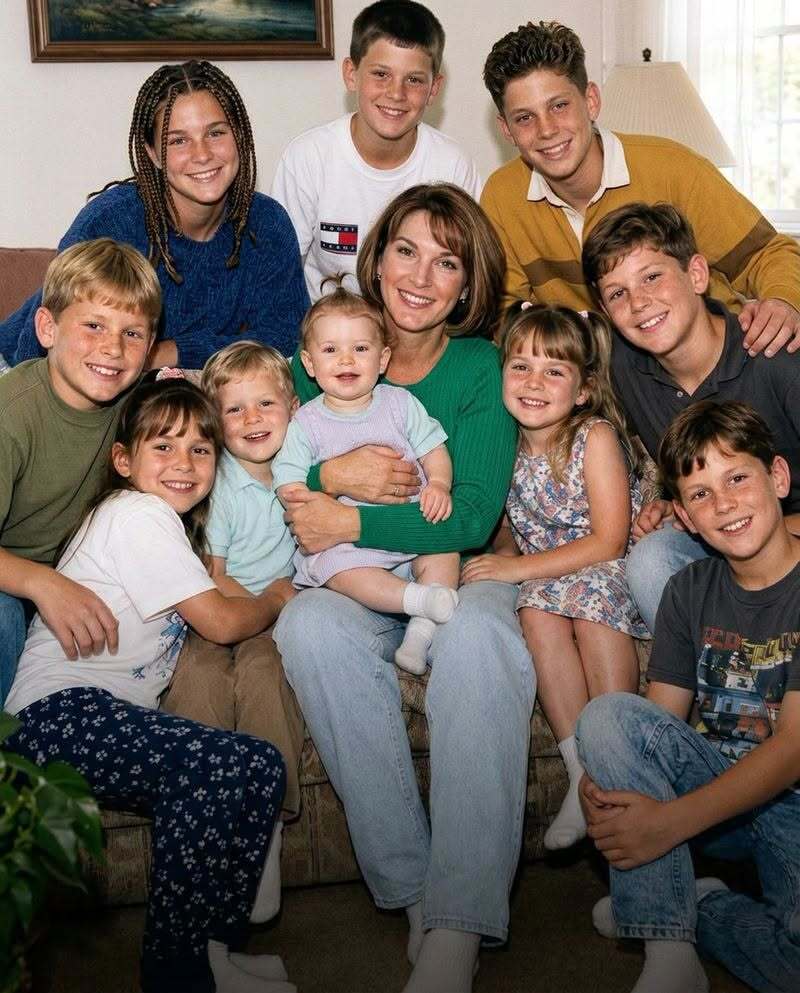
Amanda, already too mature for her age. Quiet Derrick, who could fix anything that broke. Sue, who talked with her hands whenever she got excited. Jacob and David, the twins who turned every chore into a competition. The four energetic quadruplets who never stopped moving. And little Sophie, who began calling me Mama without anyone telling her to.
Before long, I was spending more evenings at their house than my own. I helped with homework, cooked dinner, found missing socks, bandaged scraped knees, and learned which child needed gentle encouragement and which needed honest truth.
It all felt strangely natural.
Six months later, Michael proposed over meatloaf and mashed potatoes while ten children pretended not to listen from the hallway.
He smiled. “Will you marry us?”
I cried before I could answer. “Yes.”
My mother thought I’d lost my mind. “Ten children, Margaret,” she said. “You haven’t even lived your own life yet.”
“They are my life, Mama.”
“You’re making a terrible mistake.”
But I never listened. Because by then, they already felt like mine.
Two weeks before the wedding, I stood in front of a mirror wearing my dress while Amanda zipped the back. Sophie clapped her hands excitedly. The boys pretended to gag dramatically from the doorway.
Then I saw Michael standing behind me.
He looked at me in a way I didn’t understand at the time. “You look beautiful,” he said softly.
“You’re not supposed to see the dress.”
“I know.” He smiled. “I just wanted to remember.”
At the time, I thought he was being sentimental. Years later, I realized something else entirely. Part of him already knew he was about to leave.
The morning Michael disappeared, the house felt wrong. Too quiet. His truck was gone. His side of the bed was cold. His phone was turned off.
Then I found the note beneath the sugar bowl. Three devastating sentences.
I’m sorry. I can’t do this anymore.
No explanation. No goodbye. No mention of the children.
My world collapsed.
Then Sophie walked into the kitchen wearing her pajamas and wrapped herself around my leg. “Mama, juice?”
That was the moment my life split in two.
My mother called almost immediately. “This is a sign,” she said. “Let the system take the children. You’re still young.”
“They’re upstairs, Mama.”
“They aren’t your responsibility.”
“I can’t leave them.”
“You’re throwing your life away.”
But when I looked around that kitchen table and saw ten frightened faces staring back at me, I knew there was no decision to make.
I loved them. They were mine.
At the county office, a social worker looked at me carefully. “Ten children is an enormous responsibility.”
“I know.”
“There’s no shame in stepping back.”
I shook my head. “They already call me Mama.”
I signed the papers. The guardianship became adoption. But in my heart, they became my children that very day.
The years that followed were the hardest of my life. I worked at a fabric warehouse during the day. At night, I sewed school uniforms to earn extra money.
Amanda learned to cook. Derrick handled repairs. Sue took charge of laundry. The twins argued over every chore imaginable.
Life was exhausting. Messy. Beautiful.
Several men entered my life briefly over the years. Every conversation ended the same way. “Ten children?” Then they disappeared.
Eventually, I stopped trying. My life belonged to homework assignments, fevers, birthday parties, bills, and bedtime prayers. And somehow, that was enough.
Years passed. Then decades.
Amanda became a nurse. Derrick opened an auto shop. Sue became a teacher. Jacob and David became engineers. The younger children built wonderful lives of their own.
Then grandchildren arrived. Every Saturday, my home filled with laughter again.
Thirty years passed faster than I could have imagined.
Then one ordinary Saturday, someone knocked on my front door.
A man in a gray suit stood there holding a leather folder. “My name is Mr. Johnson,” he said. “I’m Michael’s attorney.”
My breath caught immediately.
He handed me an envelope. My name was written across the front in familiar handwriting — Michael’s handwriting.
“I was instructed to deliver this exactly thirty years after his departure.”
The entire room behind me fell silent. My ten grown children watched as I opened it.
Then I began reading.
Michael had been dying.
Months before our wedding, doctors discovered a serious illness and told him he might only have months to live. There was an experimental treatment, but no guarantees.
He wrote: “I couldn’t bear to marry you, then make you a widow, leave you with ten grieving children, and bury all of you beneath medical debt. I thought leaving would hurt less than staying.”
Then came another revelation. The treatment had worked. Against every expectation.
Two years later, he returned. He drove past the house. He saw Amanda carrying groceries. He saw Derrick teaching the twins how to fix a bicycle. He saw Sophie running toward me screaming, ‘Mama!’
Then he drove away. He believed coming back would destroy the stability we had built. He wrote that he didn’t know whether he was right or wrong. So he chose distance.
For thirty years.
He never remarried. Never had more children. Instead, he quietly watched over us through an investigator. He knew everything — graduations, jobs, milestones, achievements.
He created a trust for all of us.
And then he wrote one final sentence: “You gave them the life I couldn’t. I’m not asking you to excuse me. I only ask that someday, if your heart allows it, you forgive me.”
For thirty years, I had believed I wasn’t enough reason for him to stay. Now I finally understood.
It had never been about not loving us. It had been about fear — fear disguised as sacrifice.
Whether he had been right or wrong no longer mattered.
I looked around my table. Ten children. Grandchildren everywhere. A life built from heartbreak.
I lifted my teacup. “To Michael,” I said quietly.
Amanda smiled through tears. “And to Mama.”
Everyone repeated it together. “To Mama.”
And for the first time in three decades, the empty chair Michael left behind no longer felt painful. It simply felt like part of the family we had survived long enough to become.