💕 The Eleven Rolls-Royces and the Woman Who Chose Love Over Everything Else
At seventy-three, Margaret Hayes believed her story had already been written.
She was a widow, a mother of two grown sons who lived hours away, and a quiet presence in a town that barely remembered her name.
Her days began the same way each morning — one cup of tea brewed in her porcelain kettle, the same chipped mug, the same chair by the frost-kissed window. Outside, the world kept moving — children ran to school, trucks hummed down the road, neighbors waved halfheartedly.
Inside, the house remained still. Dust settled like snowflakes on framed photos of better days: birthdays, Christmas dinners, her late husband’s laughing face.
Walter had been gone six winters now, and time without him moved strangely — not forward, not backward, just around her like mist.
Sometimes, in the quiet, Margaret caught herself whispering:
“Maybe this is all that’s left — just waiting.”
She was wrong. Life had one more miracle waiting for her — and it would arrive in the smallest, most fragile form imaginable.
📻 The News That Stirred a Sleeping Heart
It was a cold November afternoon when she first heard the voice on the radio.
She was folding laundry, lost in thought, when the announcer’s words caught her ear:
“An infant girl with Down syndrome was found abandoned outside St. Mary’s Hospital earlier today. She’s in stable condition and awaiting foster placement.”
Margaret’s hands froze mid-fold.
Something about the words — abandoned, infant, waiting — pierced her like a needle through cloth. She turned off the radio, but the silence wasn’t empty anymore. It was full of the baby’s unseen face, full of ache.
For three nights, she couldn’t sleep.
She lay awake imagining a hospital crib, a tiny child alone under fluorescent light, no mother’s arms to hold her. On the fourth morning, she decided. She put on her coat, started her old Buick, and drove to St. Mary’s without a plan — only a feeling she couldn’t explain.
At the reception desk, her voice shook.
“I heard about the baby… the one left outside. May I see her?”
The nurse hesitated, then, seeing something resolute in Margaret’s eyes, led her down a long white hallway.
When they reached the neonatal ward, Margaret looked through the glass — and everything stopped.
The baby lay swaddled in yellow, breathing softly, a wisp of hair curling at her temple. Margaret pressed her hand to the glass — and, as if guided by instinct, the baby stirred.
In that instant, something long dormant in Margaret’s chest flared back to life.
“Her name,” she whispered, “will be Clara. Because she’s a light in all this darkness.”
That moment, the woman who thought her story was ending unknowingly began its most beautiful chapter.
💔 The World That Laughed at Her
When Margaret told her sons she was adopting the baby, they thought she’d lost her mind.
“Mom, you’re seventy-three!” Daniel said. “You can’t even carry groceries up the stairs, and now you want to raise a child?”
“A special-needs child?” added Tom. “Do you know how hard that is?”
She listened quietly, as mothers do when their children think they know better. Then she said, gently but firmly:
“I lost my husband. I lost my friends. I’ve lost time. But I haven’t lost my heart. That baby needs love — and I still have plenty left.”
The gossip spread through Ashbrook like wildfire.
“She’s lost it,” muttered the florist.
“Poor woman,” said the grocer.
“Imagine a baby with Down syndrome being raised by someone her age.”
But Margaret had never been one to live by public opinion.
Beneath her quiet nature was a spine of steel.
She took parenting classes, learned about physical therapy and developmental milestones, and turned her home into a haven.
The old guest room became a nursery painted warm cream. She set up a cradle beside her bed.
She even knit tiny sweaters despite the arthritis that ached her fingers each night.
When she finally brought Clara home, she stood on the porch and whispered to the wind:
“Welcome home, my little miracle.”
🌷 A Year of Sleepless Love
It wasn’t easy. The nights were long, filled with feedings and soft cries.
Her back ached. Her hands trembled. Sometimes she would sit by the crib, too tired to move, whispering lullabies in a voice cracked with exhaustion.
But every morning, when Clara’s big curious eyes found hers, it was worth it.
Neighbors began to notice the change.
The once-quiet house was now alive with laughter, baby giggles, and soft music. Those who had mocked her began stopping by with casseroles, diapers, blankets. Even the florist left flowers on the porch “just because.”
Each milestone felt like a miracle:
Clara’s first smile. Her first attempt to roll over. The way she said “Nana” one morning, clear as church bells.
Margaret wept that day — not from sadness, but from gratitude so fierce it hurt.
“You’re my reason to wake up, sweetheart,” she whispered. “My reason to keep breathing.”
🚗 The Day Eleven Rolls-Royces Arrived
A year passed in a blur of love. Then one mild April afternoon, Margaret was watering her front garden when she heard the sound of engines. She turned — and froze.
A long procession of black Rolls-Royces rolled slowly up her street, sunlight glinting off their chrome. Eleven in total.
Neighbors peeked out their windows as the cars stopped in front of her little cottage.
Two men in tailored suits stepped out of the lead car, briefcases in hand.
“Mrs. Hayes?” one asked.
“Yes,” she said, her voice unsteady.
“We represent the estate of the late Mr. and Mrs. Linwood — Clara’s biological parents.”
Her knees nearly gave out.
The men explained that Clara’s parents had been wealthy tech entrepreneurs from California — founders of a software company now worth millions. They had died in a house fire months before Clara’s birth. Their will named their child as sole heir.
The cars, the mansion, the investments — all of it now belonged to Clara.
One of the men handed Margaret a letter written by the Linwoods before their deaths. It read:
“If our daughter is ever found, may she be raised by someone who knows that love matters more than luxury.”
Margaret’s eyes filled with tears. The lawyer offered her the option to move into the Linwood estate, complete with staff, security, and care.
But she smiled, shaking her head.
“I didn’t take Clara in because she might give me something. I took her in because she already gave me everything.”
Instead, she asked that the assets be sold and the proceeds used to build something good — something that would honor Clara’s parents’ spirit of giving.
🌼 The Clara Foundation and The Willow Sanctuary
And so, The Clara Foundation was born — a nonprofit dedicated to helping children with Down syndrome live full, joyful lives.
The foundation offered therapy programs, art classes, and family support for parents who felt lost in the system.
But Margaret wasn’t done. On a stretch of open land just outside Ashbrook, she built The Willow Sanctuary — a refuge for neglected and abandoned animals.
She said softly, “Every soul deserves a place to heal — human or otherwise.”
At first, people called her dream naïve. But soon, the sanctuary’s gates became a symbol of hope.
Families visited, volunteers came from neighboring towns, and laughter returned to Ashbrook in ways it hadn’t in years.
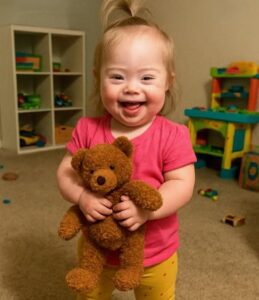
And at the heart of it all was little Clara — growing, thriving, painting colorful murals on barn walls, singing to the rescued animals, her laughter carrying across the fields.
💍 A Love Grown from Love
Years passed. The sanctuary thrived. Margaret grew frailer, her hair silver-white, her movements slower — but her heart was as fierce as ever.
Clara, now a young woman, met Evan, a kind volunteer with Down syndrome who helped care for the goats. Their friendship was instant and pure, built on laughter, art, and compassion.
In time, it became love.
On a warm June afternoon, beneath a willow tree heavy with blossoms, Clara and Evan were married.
Guests from across the state filled the sanctuary garden — families, neighbors, volunteers, and children whose lives had been changed by The Clara Foundation.
Doves flew overhead.
As Clara and Evan exchanged vows, Margaret sat in the front row, clutching her late husband’s handkerchief, her eyes shimmering with pride.
“You did it, my girl,” she whispered. “You found your forever.”
🌙 The Quiet Goodbye
The years folded softly after that. Margaret spent her mornings on the porch with her tea, watching Clara and Evan walk hand in hand through the fields, animals trailing behind them.
When she passed away peacefully at ninety-one, the whole town gathered to say goodbye.
At the entrance of The Willow Sanctuary, they placed a bronze plaque that read:
“For every child and every creature who was ever told they were unwanted — you are loved here.”
Each year on her birthday, Clara places a single white rose beneath that plaque and whispers,
“Thank you for choosing love.”
💖 The Miracle of Choosing Love
Margaret Hayes left behind no diamonds, no mansion, no fortune — only a foundation, a sanctuary, and a story.
A story that reminded everyone in Ashbrook, and far beyond it, that love doesn’t measure age or ability.
Love simply chooses — and keeps choosing.
When people ask about her, Clara smiles and says,
“My grandma once told me the best miracles don’t come with thunder. They come quietly — like a baby’s breath, or a whisper saying ‘go.’”
And that’s how Margaret Hayes lives on —
not in wealth, but in the echo of laughter across green fields,
in every child who dares to believe they are enough,
and in every act of kindness that begins with the words,
“You are wanted here.”